
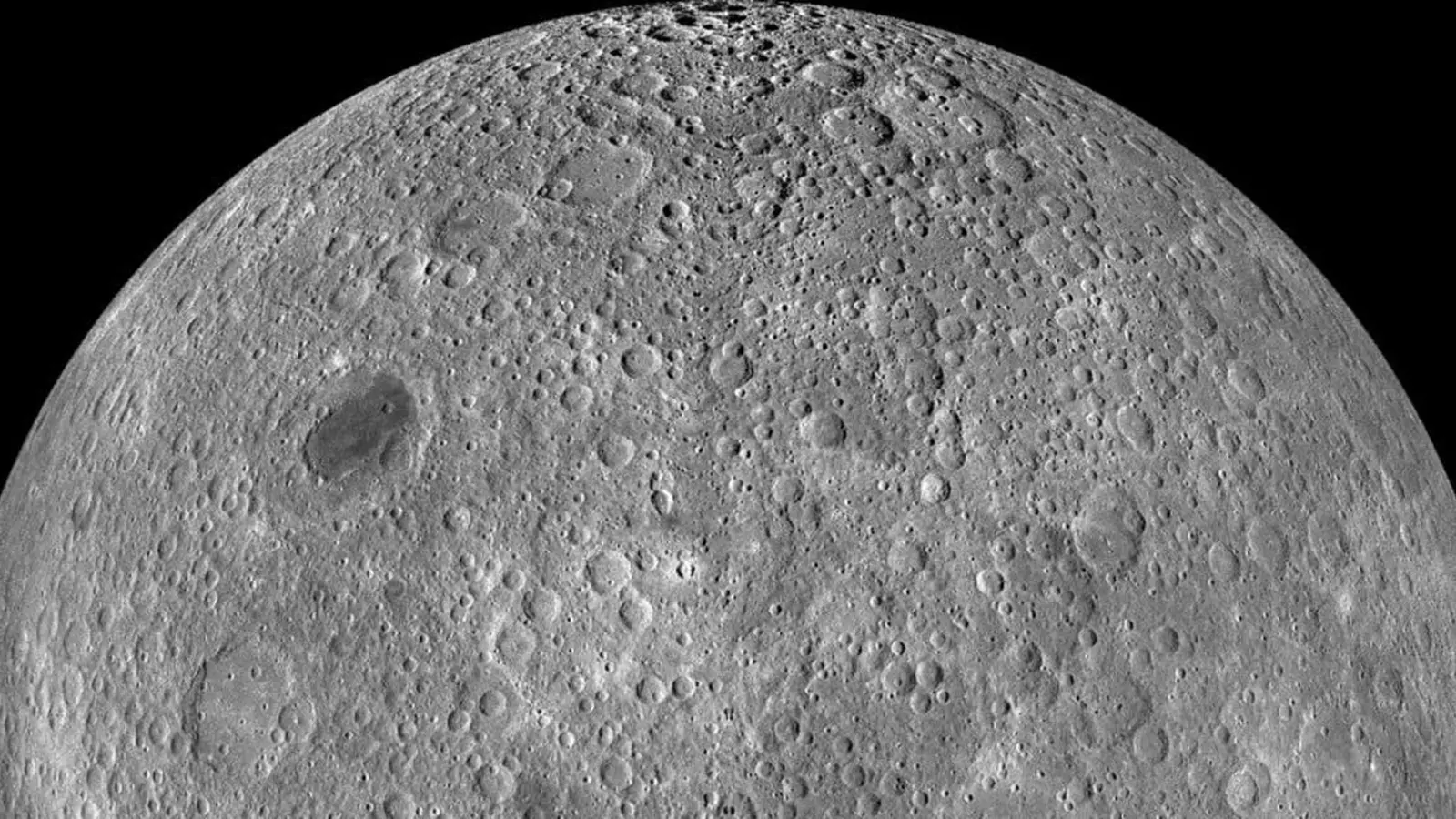
Imagine a world with two moods: one smooth and dark, the other ancient and jagged. That is the Moon — but why did it wake up that way? Recent analyses of samples returned by China’s Chang’e-6 mission are pulling back the curtain on a drama that unfolded billions of years ago inside a global ocean of melt.
In 2024, Chang’e-6 delivered the first rocks ever collected from the lunar farside, and a team led by Professor Hejiu Hui at Nanjing University has since put those fragments under the microscope. They examined anorthosites, Mg‑suite rocks and mare basalts and then compared them with nearside samples brought back by Apollo and Chang’e‑5. What emerged is not a tale of two completely different interiors but rather a story of similar mantles and very different crustal fates.
At depth, the Moon seems surprisingly uniform. The Chang’e‑6 basalts show signs of a depleted mantle source much like the Apollo low‑Ti basalts, suggesting the cumulates that sank and crystallized as the lunar magma ocean (LMO) cooled were compositionally alike beneath both hemispheres. Mg# values in Mg‑suite rocks from the farside match those from the nearside, reinforcing the idea that mantle cumulates do not record a major nearside–farside compositional split.
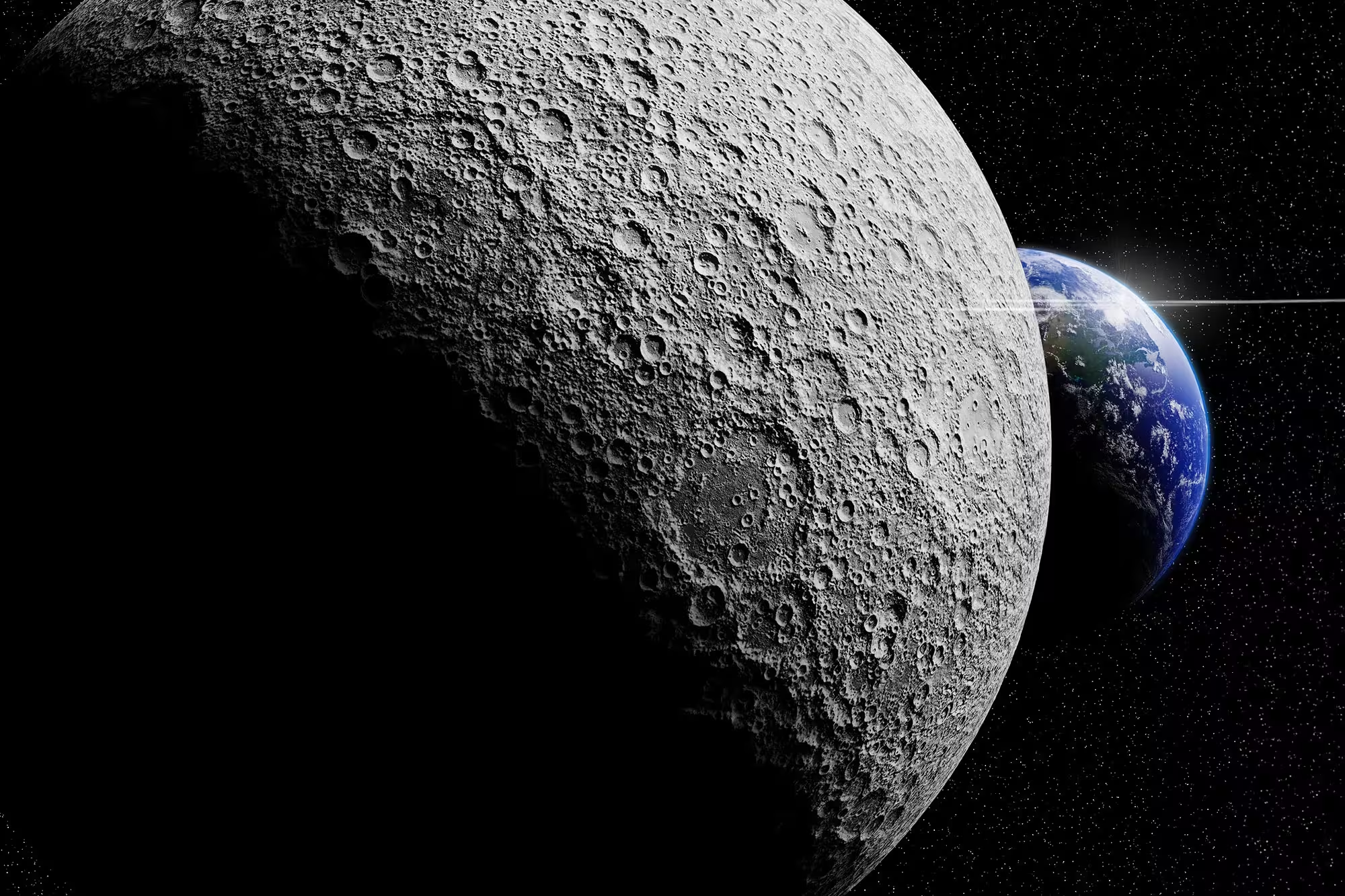
The Moon’s farside is a rugged, heavily cratered landscape that looks strikingly different from the hemisphere we see from Earth. It has a thicker crust, far fewer dark volcanic plains, and preserves some of the Moon’s oldest terrain, making it a valuable window into the satellite’s early history.
The twist appears in the crust: Chang’e‑6 anorthosites carry higher peak magnesium, pointing to a farside crust that is richer in Mg and thicker than the crust we see from Earth. Those same Mg‑suite samples from the farside are unusually poor in rare earth elements and show lower Th/Sm ratios than comparable Apollo specimens. Either farside magmatism brewed up without much KREEP influence, or the KREEP layer itself — that cocktail of potassium, rare earths and phosphorus tied to late LMO melts — was handed out unevenly across the lunar surface.
So how do you get a similar mantle but a lopsided crust? The new interpretation pivots on timing: what happened after the Moon became tidally locked to Earth. Before locking, the LMO cooled and formed the early mantle cumulates and floating plagioclase crust in a roughly symmetric way. But once the Moon kept one face toward Earth and the two bodies orbited close together, heating from tidal forces favored the nearside. That created a sustained temperature contrast between hemispheres.
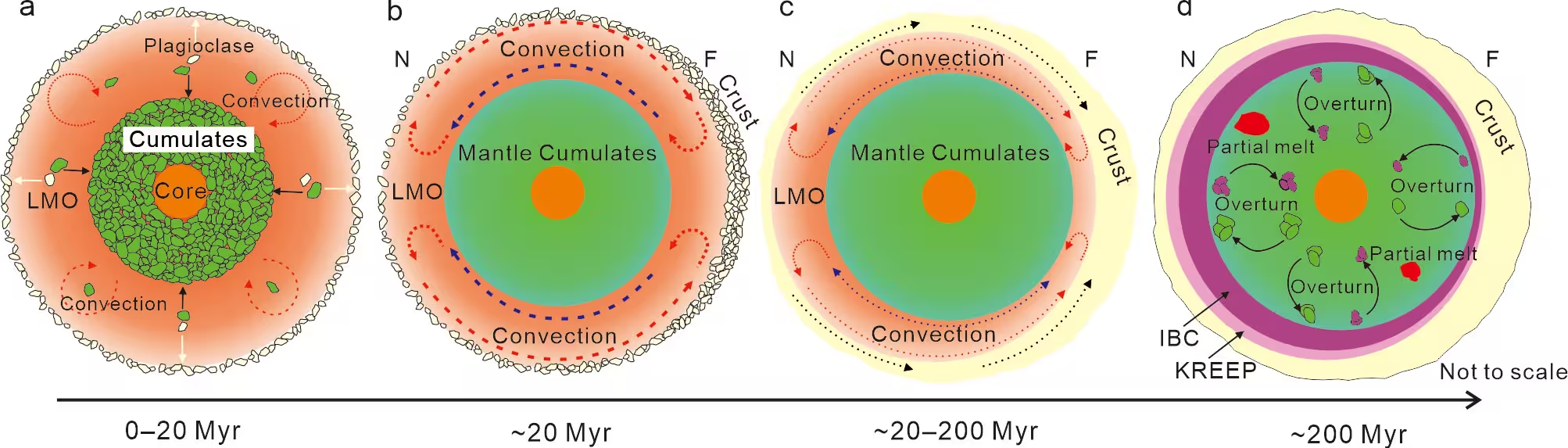
The lunar magma ocean (LMO) cooled rapidly to form early mantle cumulates before tidal locking, and floating plagioclase formed the anorthositic crust. After tidal locking was established, the nearside-farside thermal contrast triggered lateral convection within the LMO, which moved anorthositic crust toward the farside and residual melts to the nearside. Continuous cooling of residual melts ultimately produced thinner late-stage LMO cumulate layers on the farside. N, nearside; F, farside.
Temperature differences drive motion. In this case, lateral thermal convection — think of vast, slow currents within the residual melt of the magma ocean — would have ferried hot material and late-stage melts toward the sunlit, tidally warmed nearside, while sweeping earlier-formed, magnesium‑rich anorthositic fragments toward the farside. Over time, the farside accumulated thicker, more Mg‑rich crust while the nearside became the repository for KREEP and ilmenite‑bearing cumulates.
It’s a tidy mechanism because it links two observations that previously felt hard to reconcile: a largely homogeneous mantle and a strongly asymmetric crust. Other hypotheses have been on the table — giant impacts, asymmetric crustal growth, tidal dissipation in different forms — but few models explain how crustal composition and thickness could diverge so markedly without leaving a corresponding signal deep below.
The implications ripple beyond lunar geology. If tidal locking and lateral convection can rework a global magma ocean this dramatically, similar processes might operate on other rocky bodies early in their histories, especially satellites or planets that form hot and orbited closely by a large companion. Does that mean ancient magma oceans on exoplanets could produce hemisphere-scale difference in crustal makeup? Possibly. It’s a question worth asking as we start to interpret remote signatures from distant worlds.

Chang’e‑6 didn’t just bring rocks home; it handed scientists a new way to read the Moon’s early thermal choreography. And while debates about impacts and chemical heterogeneity will continue, the idea that uneven heating set up planetary-scale currents inside the LMO offers a clear, testable framework—and a reminder that even the quietest bodies hide turbulent childhoods.

Leave a Comment
Comments (2)
wait, are we sure the nearside got all the KREEP? sounds plausible but where's the evidence for such strong lateral currents, any models lol
wow, lunar crust got dragged like clothes in a washer? kinda poetic, but if tidal currents did that... mind blown, curious about the timing and scale this is wild