
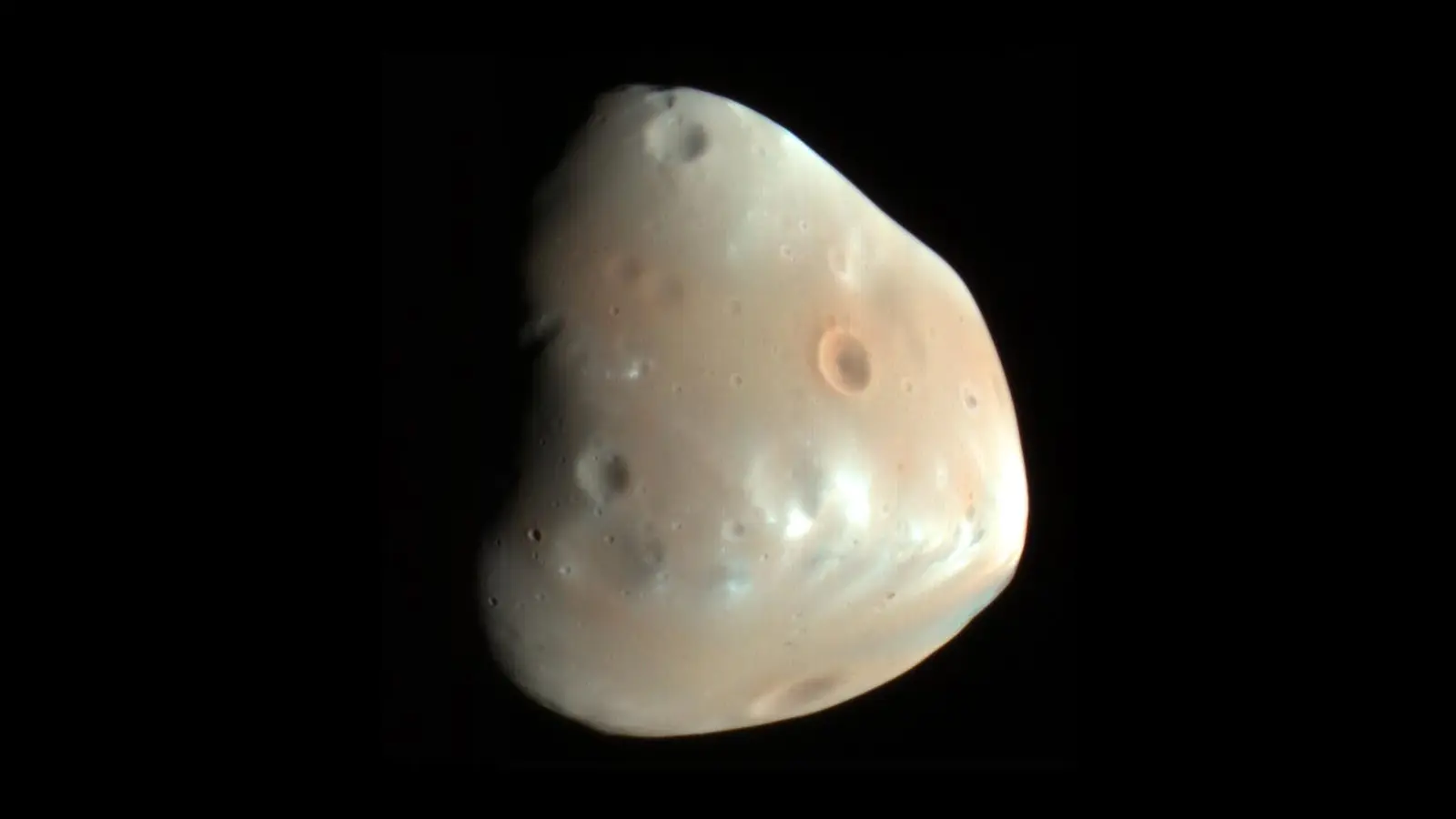
Picture a cosmic billiard ball striking a tiny moon and leaving it smoothed, scarred, and wrapped in dust. That’s the image scientists are now entertaining for Deimos, Mars’ understated, oval satellite, after a fresh blend of spacecraft observations and high-resolution simulations.
Researchers led by the University of Bern fed new data from ESA’s Hera flyby into the Bern Smoothed Particle Hydrodynamics (SPH) code — a sophisticated impact simulator honed over two decades — and ran roughly a hundred different collision scenarios. The result? One plausible, surprisingly elegant explanation: a single, oblique asteroid blow could have excavated the broad depression near Deimos’ south pole and flung enough material to carpet the entire moon in a deep, dusty blanket.
How violent was that event? The simulations point to an impactor roughly 320 meters across hitting at about a 45-degree angle. Violent enough to redistribute material globally, the models show, but not so catastrophic as to tear Deimos apart. In some regions the newly deposited debris — the regolith that gives Deimos its unusually smooth look — may sit more than two hundred meters thick. Short sentence. Big consequence.
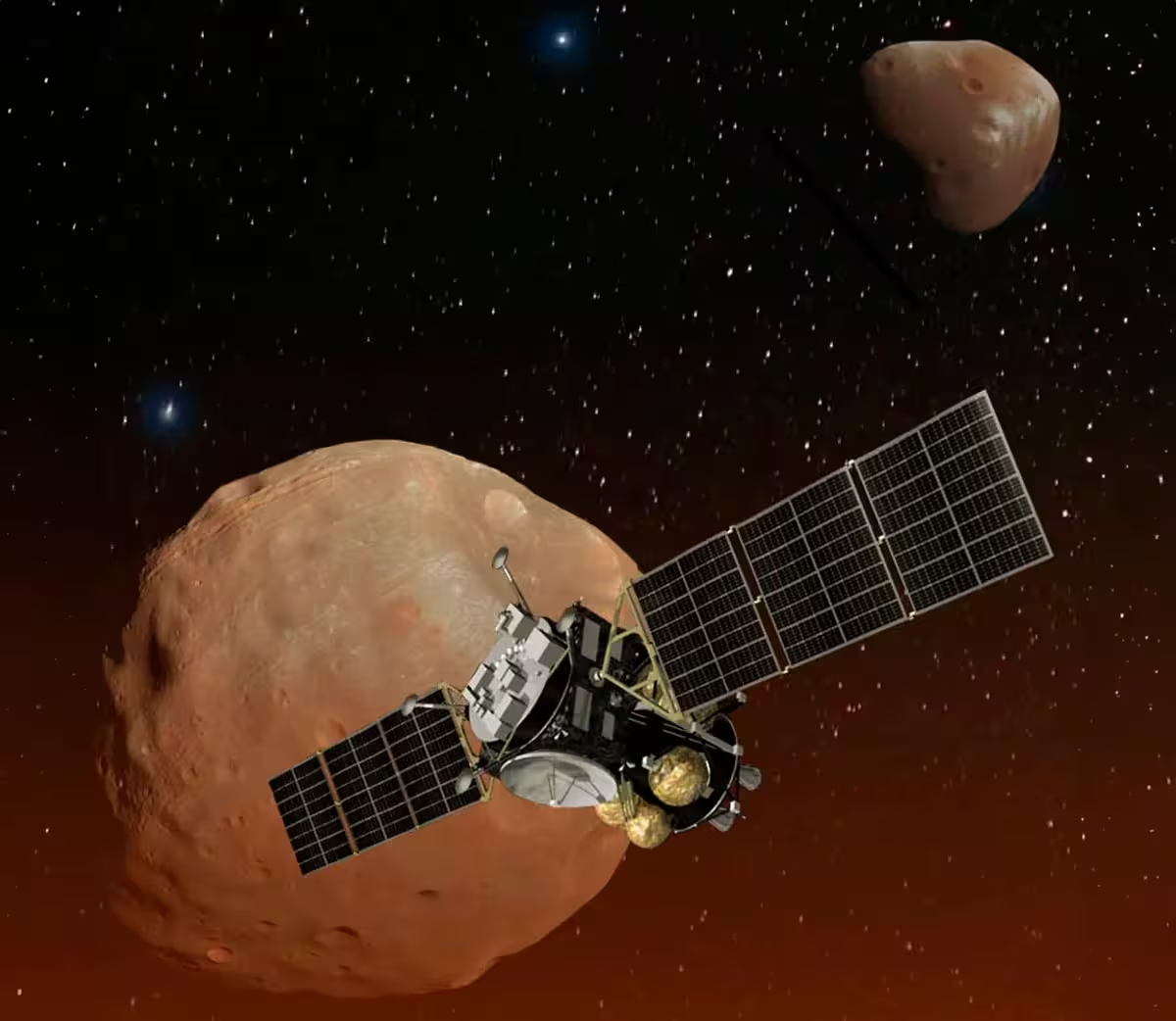
Artist’s concept of Japan’s Mars Moons eXploration (MMX) spacecraft, carrying a NASA instrument to study the Martian moons Phobos and Deimos.
Why would Deimos survive what otherwise seems like a devastating strike? The models and Hera’s measurements converge on an answer: Deimos behaves like a rubble pile. Its outer layer appears weak, and the interior is highly porous. Those internal gaps act like nature’s shock absorbers, dissipating energy and preventing wholesale fragmentation. In essence, the moon’s fragility saved it.

That characterization matters. Rubble-pile bodies are loosely bound aggregates rather than monolithic rock. They respond to impacts very differently from a solid satellite — they slough and settle, they bury older scars under new blankets of debris, and they can reconfigure their surface on a planetary timescale. Deimos’ current visage — smooth, dusty, and punctuated by a prominent southern basin — fits that behavior.
Hera’s March 2025 Mars flyby provided a rare, close-in snapshot of Deimos, and the Bern team used those observations to test which simulated collisions best matched reality. The study, published in Nature Astronomy, is the first to incorporate Hera’s Deimos imaging into detailed impact models. It’s also a reminder that flybys can deliver science even while a spacecraft is en route to another target.
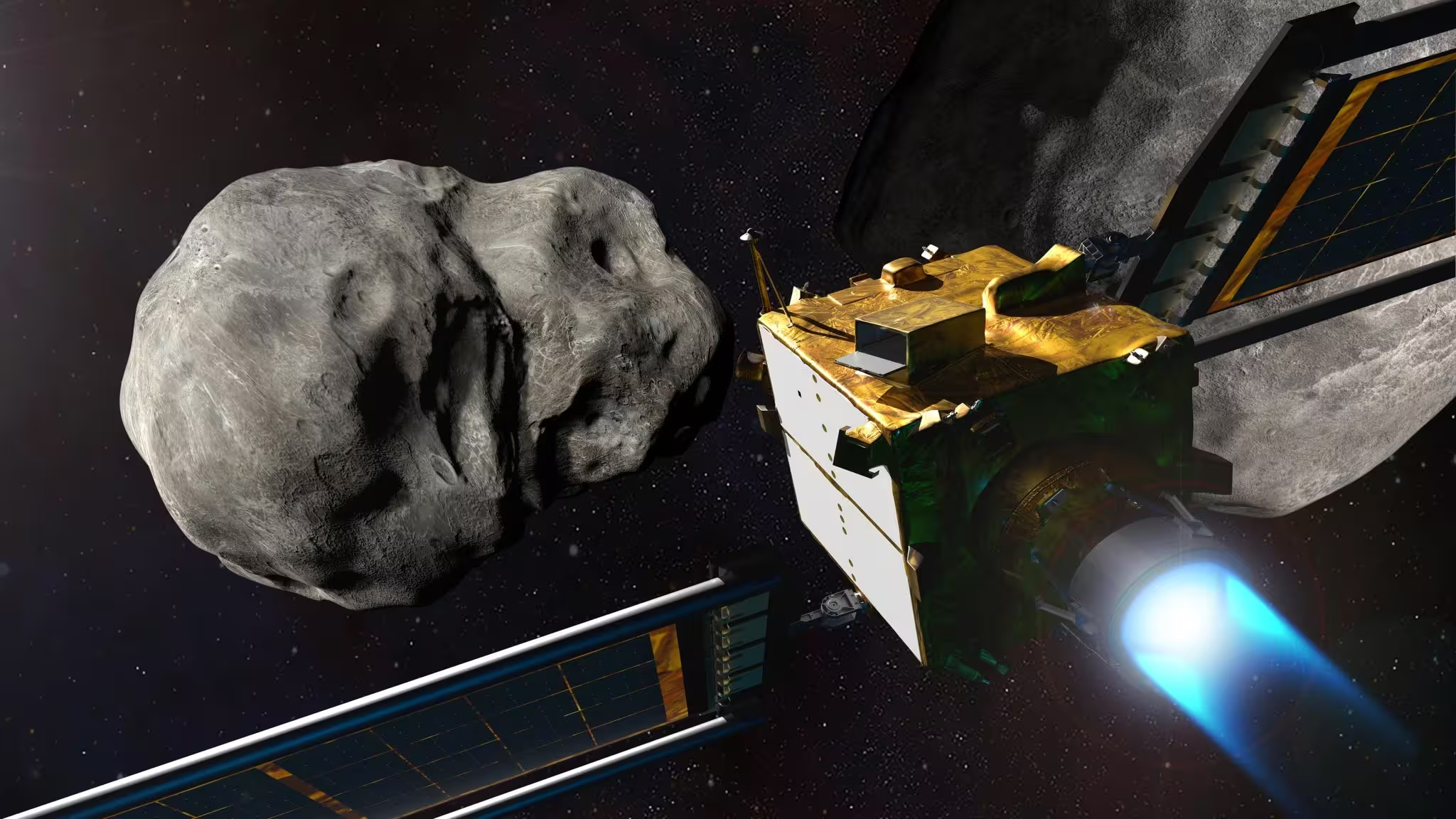
This illustration depicts NASA’s Double Asteroid Redirection Test (DART) spacecraft prior to impact at the Didymos binary asteroid system.
There’s an extra layer to this story: planetary defense and mission planning. The same Bern SPH code has been used to model spacecraft strikes such as NASA’s DART experiment on Dimorphos, and the Deimos results feed directly into predictions for future exploration. Japan’s MMX mission, set to visit both Martian moons and return Phobos samples, will be able to test specific forecasts from these simulations — the thickness and distribution of regolith, the mechanical properties of near-surface material, and where buried terrain might preserve older geology.
Of course, a single-impact origin is not the only hypothesis on the table. Alternative scenarios remain plausible, and nature rarely hands over simple stories without caveats. But the beauty of this work lies in its specificity: it links a realistic impactor size and angle to observable surface features, and it produces testable predictions for the next generation of missions.
In the end, Deimos looks less like a frozen relic and more like a moon with a dramatic past, one shaped by a single, decisive event that both scarred and smoothed it. The next spacecraft to arrive will tell us whether this cosmic bruise really explains the moon we see, or whether the truth is even stranger.

Leave a Comment
Comments (2)
Is this even true? Single impact explains the smoothness… maybe, but feels a bit tailored to the data. Where's the alt scenarios, or samples? curious but skeptical
wow, Deimos survived a 320m hit? mind blown. Rubble pile idea actually fits, poetic, messy and kinda cruel. if MMX finds thick dust layers i'll freak