
Picture this: an Earth twin hiding a hair's breadth away from a star so blinding it outshines the planet by ten billion times. Tiny speck. Immense glare. How do you even begin to see the world in that light?
That is the puzzle British astronomers are gearing up to solve. The UK Space Agency has awarded about £3 million to extend development of a proposed core instrument for NASA's next flagship, the Habitable Worlds Observatory (HWO). The money won’t buy a telescope overnight. It will, however, fund the meticulous engineering and lab work needed to turn designs into hardware capable of separating a faint planetary whisper from a star's roar.
HWO is being framed as the next step after Roman and Webb: an observatory with an 8-metre segmented mirror and the extreme stability required to image Earth-like planets directly. Think atomic-scale steadiness. Think blocking a flamethrower to spot a moth. That recital of metaphors sounds dramatic because the task is dramatic. To see an Earth analogue around a nearby star, the telescope must suppress starlight with precision approaching the width of an atom.

How the HWO might see the Solar System if it were at a distance of 30 light-years.
UK teams are not merely onlookers. Scientists and engineers from Durham, The Open University, Leicester, RAL Space, Portsmouth, Oxford, the UK Astronomy Technology Centre and UCL's Mullard Space Science Laboratory have led instrument studies shared with NASA. Their proposed High Resolution Imager (HRI) and Multi-Object Spectrograph (MOS) could form the observatory’s eyes and ears: cameras and spectrographs that will both pinpoint faint planets and read the chemistry in their atmospheres.
Why does that chemistry matter? Because the real prize is not a picture but a spectrum. Absorption lines carved into starlight filtered through an atmosphere can reveal oxygen, methane, water vapor, and other molecules that — in the right combinations — point to processes we associate with life. HWO will concentrate on our cosmic backyard, targeting stars within roughly 30 light-years where reflected light from rocky, temperate planets might be strong enough to study.


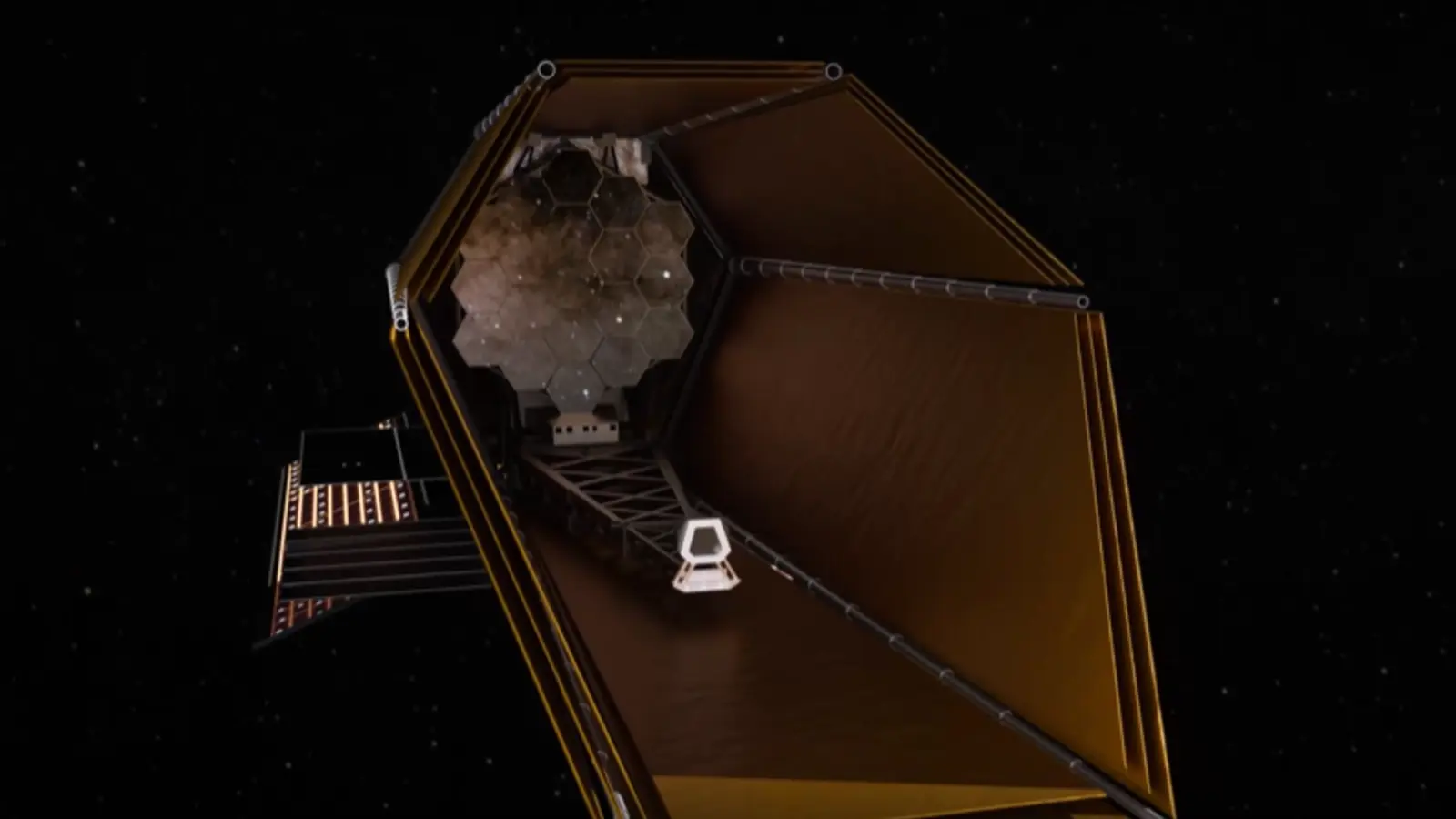
A conceptual design of the Habitable Worlds Observatory, showing an 8m segmented primary mirror and off-centre secondary.
There’s a long horizon. HWO is planned for the 2040s, which means today’s graduate students could be the mission scientists tomorrow. That reality underpins why this £3 million matters beyond testbeds and optics: it sustains a pipeline of expertise. Building cutting-edge detectors, wavefront control systems and coronagraphs is one thing. Cultivating an active UK community ready to analyze data and lead discoveries is another. Both are needed if Britain is to claim a substantive scientific role when the observatory finally flies.
Still, the path is not free of hurdles. Research groups across the country face funding pressures and institutional cuts that risk eroding the very capabilities this effort aims to grow. If the technical work advances but the science community withers, the UK could hand leadership opportunities to partners overseas. That’s the blunt calculus behind appeals for continued investment: hardware without a user base yields inert achievement.
Historically, Britain has left an imprint on flagship missions. UK teams contributed to Hubble and took a leading role in MIRI for Webb. The current programme builds on that legacy but pushes into new territory: instruments designed from the ground up for the explicit hunt for biosignatures, coupled with coronagraphic systems to starve the glare.
What would success look like? First, crisp images of small, rocky worlds close to their host stars. Then, spectra revealing atmospheric gases that merit further study. And, possibly, a puzzle piece in the greatest question we can ask: are we alone? Even non-detections will refine models, constrain habitability, and inform future missions.

The new UK funding broadens the instrument development programme, scaling laboratory demonstrations and risk-reduction activities so the HRI and MOS concepts can mature into flight-ready hardware. Teams will test detectors, develop precise wavefront sensing and control, and prototype multi-object spectrograph designs that can handle both point-like planets and the complex backgrounds of nearby stellar systems.
International collaboration remains central. NASA leads HWO, but major components are expected from partners around the world. The UK’s aim is clear: deliver a camera at the telescope’s focal plane and contribute systems that make direct imaging feasible. If the funding landscape stabilises, those contributions could secure a long-term scientific stake in HWO discoveries.
.webp "NASA Confirms 6,000 Exoplanets: Mapping New Alien Worlds")
Two decades from now, when HWO begins to survey the local stars, the project will test methods and instruments honed today. Young scientists training now will be the ones to interpret spectra, run follow-up observations, and lead teams that turn faint photons into profound insight. It’s a marathon of expertise, equipment and patience. The £3 million is a mile marker. The race is still on.

Leave a Comment
Comments
No comments yet. Be the first.