
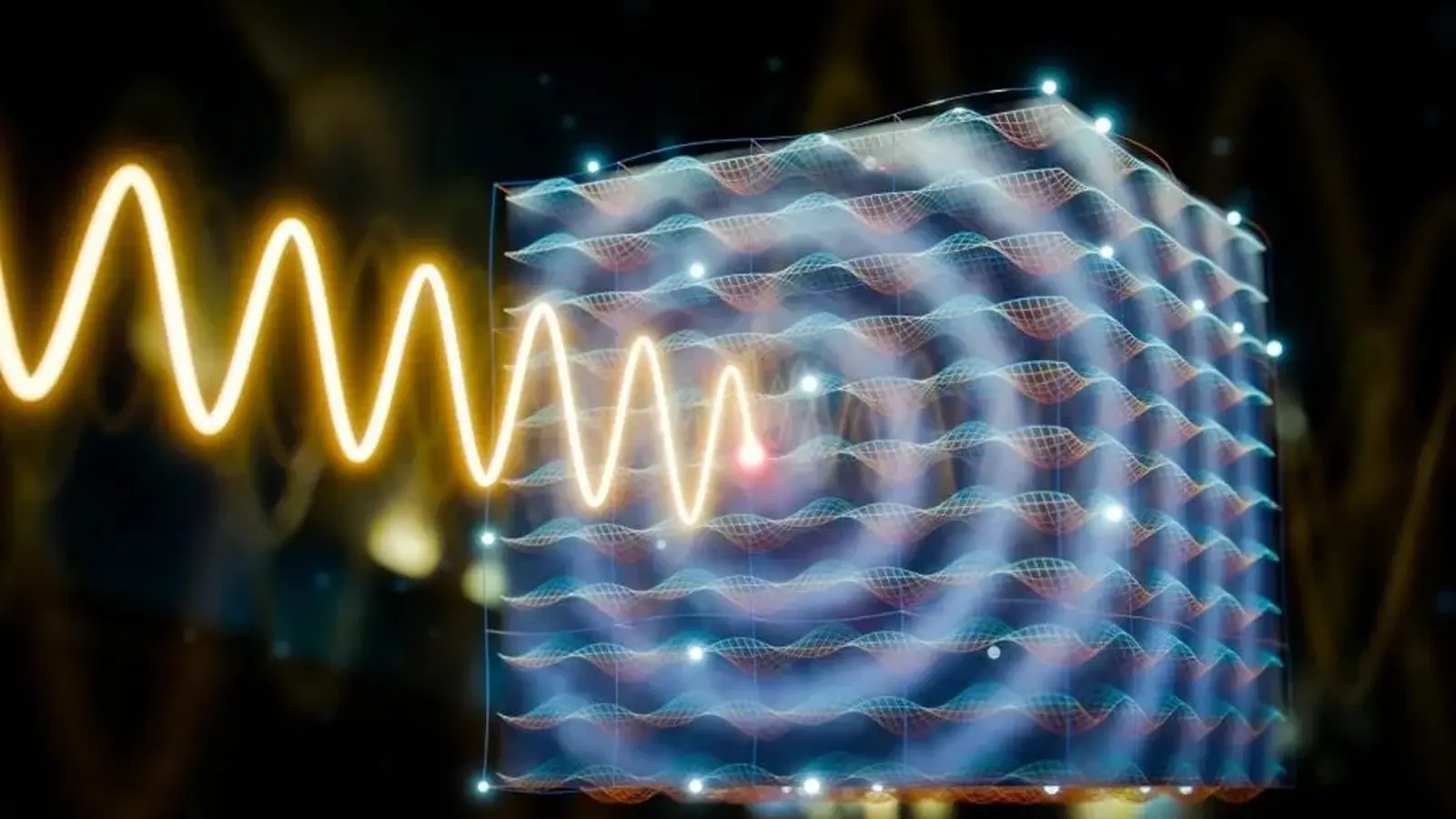
Imagine flicking a switch not in space, but in time — at the same pace that light itself vibrates. That is the provocative idea behind the newest breakthrough from a team of French and German researchers: the first photonic time crystal capable of shaping light at terahertz frequencies.
Traditional photonic crystals work like microscopic traffic engineers for photons. Tiny patterns in materials steer, trap, or reject specific wavelengths, much as the lattice of a semiconductor controls electrons. Until now, researchers changed a crystal's behavior by altering conditions — temperature, magnetic fields — and then watched the material settle into a new, static optical response.
This new device breaks that mold. Instead of a repeating pattern carved into space, the team built a pattern that repeats in time. Its optical properties swing on picosecond scales — a heartbeat so fast it rivals the oscillations of the light it manipulates. The result: dynamic control of light in the THz band, with changes happening fast enough to interact with light's own rhythm.
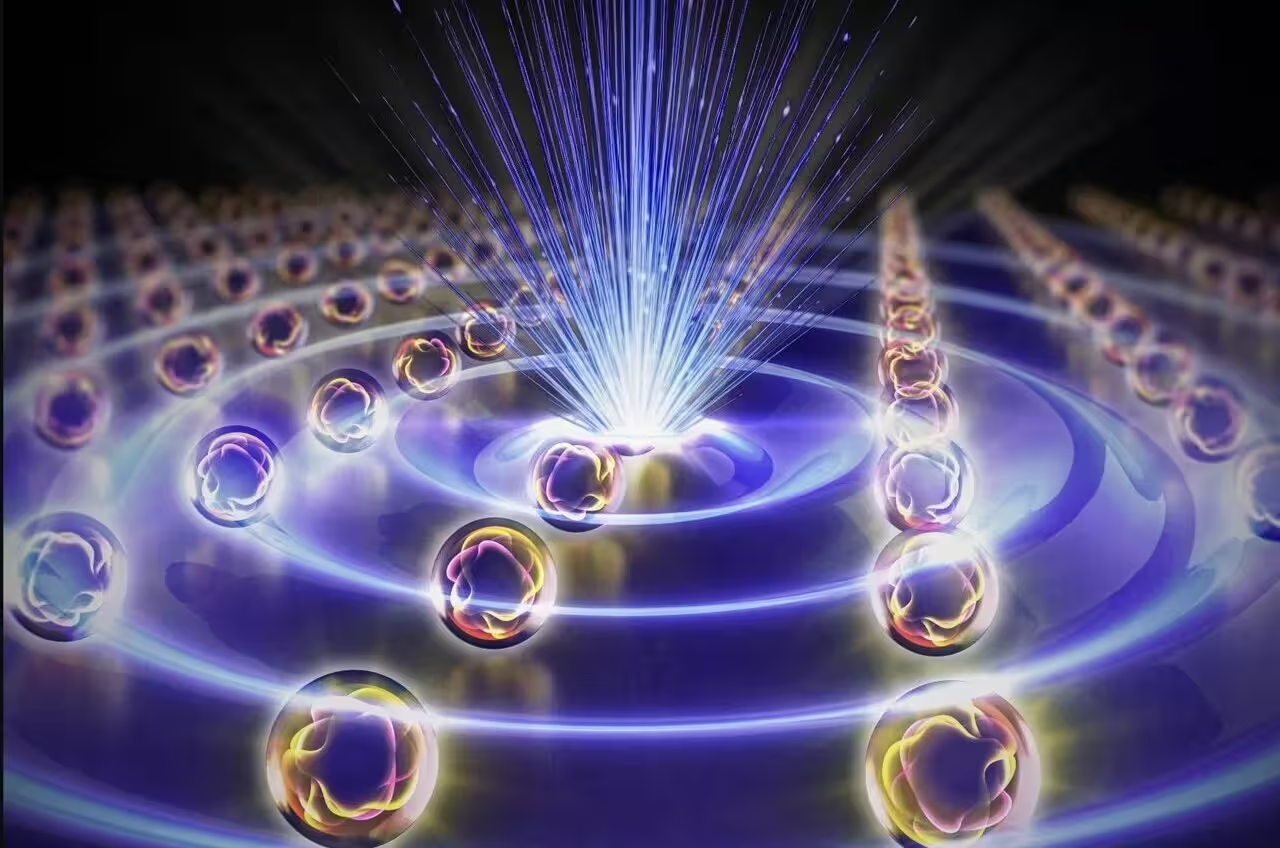
Getting there required an intricate design. The researchers engineered a plasmonic metamaterial: arrays of micron-scale gold structures patterned on a thin insulating layer above an indium antimonide semiconductor. Those gold elements form tiny cavities that trap electromagnetic energy in the gap between metal and semiconductor. Excite the semiconductor surface, and surface plasmons — collective ripples of electrons — spring to life, capturing and sustaining optical oscillations.
Short pulses of excitation tune those plasmonic resonances on ultrafast timescales. The trapped photons then experience an environment that is changing as they circulate. Think of it as a hall of mirrors where the mirrors shift position while the light bounces. That level of temporal sculpting opens possibilities that steady-state photonic crystals simply cannot reach.
Why does this matter? Because controlling light in time, at THz speeds, rewrites the rulebook for several technologies. Ultrafast optical computing becomes more feasible when optical states can be switched and routed at the cadence of light. Communications systems could gain new channels and smarter modulation schemes. Medical imaging might tap lasers that are tunable on microscopic time windows, improving contrast or speeding up acquisition. And the technique points toward a new generation of adjustable lasers and sensors.
The work is the product of a collaboration involving École Polytechnique, Collège de France and the Helmholtz-Zentrum Dresden-Rossendorf (HZDR). The findings, which push the frontier of temporal control in photonics, were published in Nature.
We tend to measure progress by smaller components and finer patterns. This time, progress comes from rearranging the order of events themselves — and the implications for how we handle light are only beginning to take shape.


Leave a Comment
Comments
No comments yet. Be the first.