
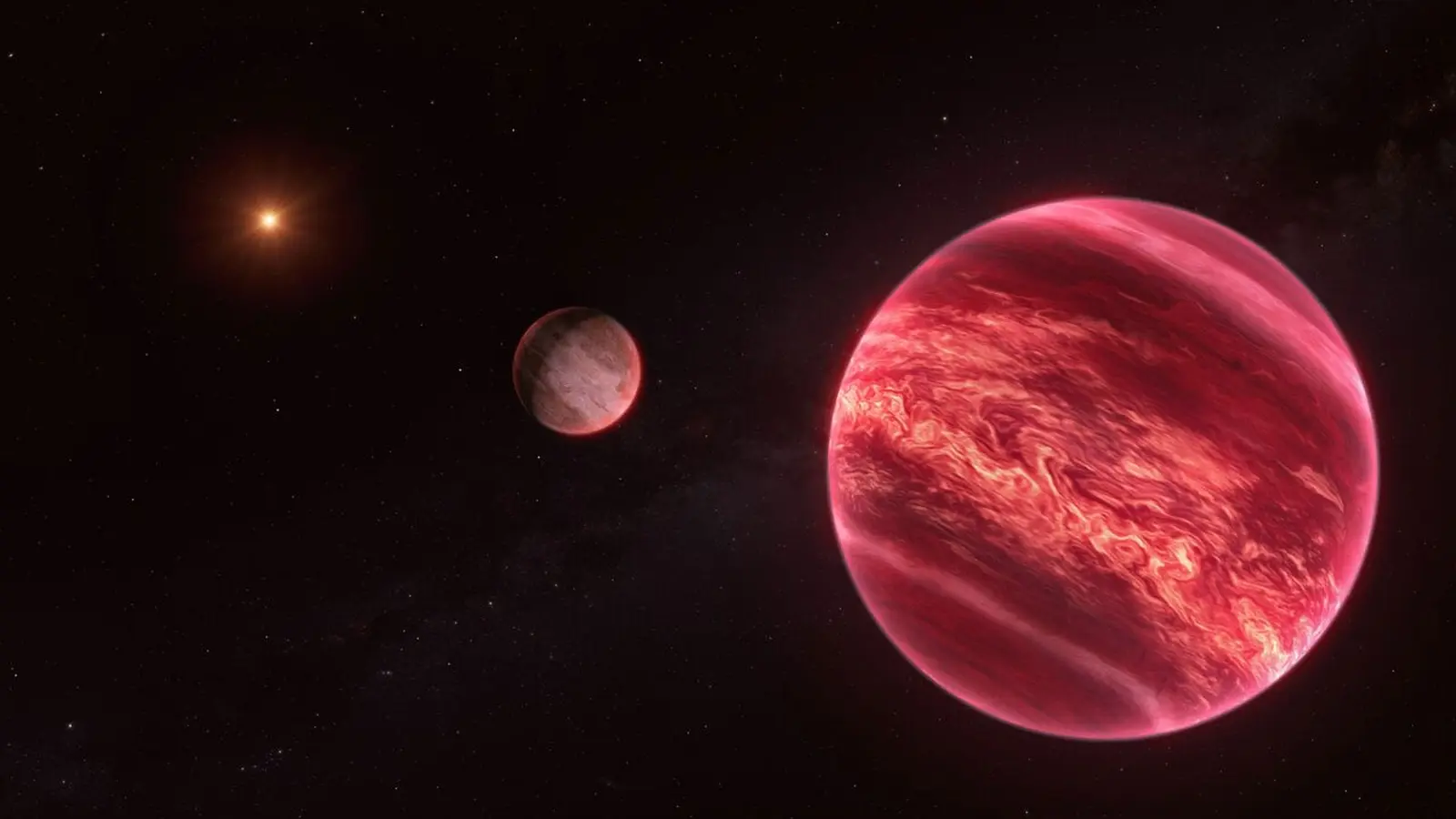
Imagine a moon the size of Jupiter, not orbiting a planet but circling a brown dwarf that itself orbits a star. Strange. Beautiful. Completely unlike anything in our backyard.
A team using the European Southern Observatory's Very Large Telescope has flagged just such an object in the young CD-35 2722 system. At the center sits a star about half the mass of our Sun. Around it orbits a brown dwarf roughly 37 times the mass of Jupiter. And around that brown dwarf, astronomers detected a companion with at least Jupiter's mass, tugging at its host like a heavyweight satellite.
Lead author Kevin Hoy, based in Chile and affiliated with Universidad Diego Portales and the Millennium Nucleus of Young Exoplanets and their Moons, spent months unraveling the system. He describes it as unusually complex compared with Solar System archetypes. The team published their findings in Nature after analyzing precision spectra from CRIRES+, the high-resolution infrared spectrograph on the VLT.

Artist’s impression of the CD-35 2722 system.
The detection hinged on a subtle wobble. Using the radial velocity technique, the researchers measured tiny shifts in the brown dwarf's motion that point to an unseen companion pulling on it. Those wobbles are the same trick used to discover the first exoplanets around Sun-like stars, but here the dynamics are noisier and the players are heavier.
The awkwardness of labels is part of the story. The newfound body is massive enough to qualify as a planet by mass, and yet it does not orbit a star directly. To reflect that blurred identity, the team uses the term exosatellite. Call it a moon, an exomoon candidate, or a subplanetary companion—the system resists tidy categories.
.webp "Could This Be the First Moon Found Beyond Our System")
If confirmed, this would be the first credible detection of an exomoon beyond our Solar System.
Alice Zurlo, director of the YEMS consortium and a collaborator on the paper, emphasizes how this system muddles the lines between star, planet, and satellite. Astronomers have cataloged more than 6,000 exoplanets, but convincing exomoons have remained elusive. There have been tantalizing hints before, such as recent interferometric observations of HD 206893 led by Quentin Kral, but none reached a definitive detection.
What makes CD-35 2722 compelling is both the quality of the radial velocity signal from CRIRES+ and the clean architecture of the system: a clear central star, a directly imaged brown dwarf companion, and a secondary body whose gravitational imprint can be measured. Still, the team is cautious. Independent confirmation and more data are needed to rule out alternative explanations.

This image shows the region in the sky around CD-35 2722, a star orbited by a brown dwarf, which is itself orbited by an object at least as massive as Jupiter. CD-35 2722 is the star right at the center of this image. The brown dwarf is not visible here, as it is embedded in the glare of the star, but it has been directly imaged by other telescopes. The ‘moon’ orbiting the brown dwarf is not visible either, but it has been detected via the gravitational pull it exerts on the brown dwarf.
Beyond the headline is a deeper prize. Finding satellites in other systems opens a new window on how worlds form and evolve. Are moons born in circumplanetary disks like miniature planetary nurseries, or do some form through captures and collisions? The answers could look very different around brown dwarfs than around Sun-like stars.
Looking ahead, ESO's forthcoming Extremely Large Telescope, with its 39-meter mirror and suite of advanced instruments, should make it possible to probe smaller, less massive moons and to study systems currently beyond reach. The discovery in CD-35 2722 is a hint of how messy and marvelous planetary systems can be—and a reminder that our definitions may need an update as telescopes peer deeper and farther.
So what do we call this heavyweight companion: a planet, a moon, or something in between? The next generation of observations will decide, and the answer promises to reshape how we think about satellites across the galaxy.

Leave a Comment
Comments
No comments yet. Be the first.