

Think of a face as a jigsaw puzzle your brain solves in a heartbeat. For many autistic children, that puzzle is assembled on a different timetable.
Researchers using full-scalp electroencephalography have traced how brains parse faces with far greater resolution than before. Instead of sampling activity from a few sensors, the team read signals from 128 electrodes across the skull while children looked at faces and everyday objects. The result was a richer map of the milliseconds-long choreography that turns eyes and mouths into identity and emotion.
What emerged was striking: neural signatures tied to faces were less distinct in autistic participants. In neurotypical children those signals sharpened with age — a kind of neural specialization that makes face recognition more precise. In autistic children that refinement was blunted or absent. The pattern suggests an altered developmental trajectory, not just later life experience.
“We tapped into the full volume of information an EEG can give,” said James McPartland of Yale, the study's senior author. “When we look across the whole scalp rather than a few sites, differences appear earlier and across more of the brain.”
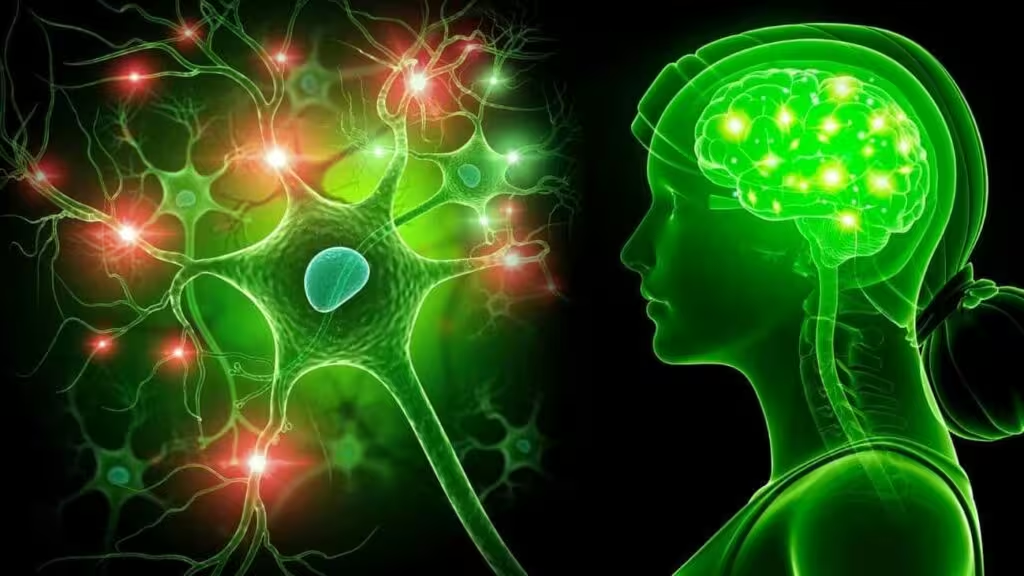
Previous work often focused on the N170, a well-known face-response that shows up about 170 milliseconds after a face is seen and is sometimes delayed in autism. This new analysis reveals that atypical processing can begin even earlier in the temporal cascade of signals. In short: the divergence is not confined to a single marker; it spans the early temporal window of perception.
Jason Griffin, the paper’s first author, framed the method as a satellite view rather than a single-camera snapshot. The machine-learning models could predict when a neurotypical child was viewing a face more reliably than when an autistic child was — a quantitative hint that the scalp-recorded patterns are less face-specific in autism.
This whole-scalp EEG pattern suggests a candidate biomarker for autism and points to a narrower window when interventions might be most helpful.
That doesn’t mean forcing eye contact. Decades of behavioral work show that coercive strategies fail and can harm trust. Instead, the neural timeline supports the idea of earlier, experience-sensitive supports tailored to perception — not mere social polishing.
The study draws on nearly 400 participants from a multi-site consortium, giving the findings statistical weight across ages. That scale helps separate core biological differences from effects accumulated through life — a persistent challenge in autism science.
Practical implications are clear: a biologically grounded signal could refine diagnosis, categorize subgroups, or predict who might benefit from specific therapies. But the authors are careful. Not every neurodivergent person wants or needs intervention. For those who struggle to read faces, however, understanding when and how perception diverges could change daily life — from playgrounds to workplace interviews.
It’s one thing to know faces look different to some brains. It’s another to have a measurable map of how and when that difference unfolds. That map is what this study has begun to draw, and it raises the next question: how do we translate early neural markers into humane, practical support for people who actually live with them?


Leave a Comment
Comments
No comments yet. Be the first.