
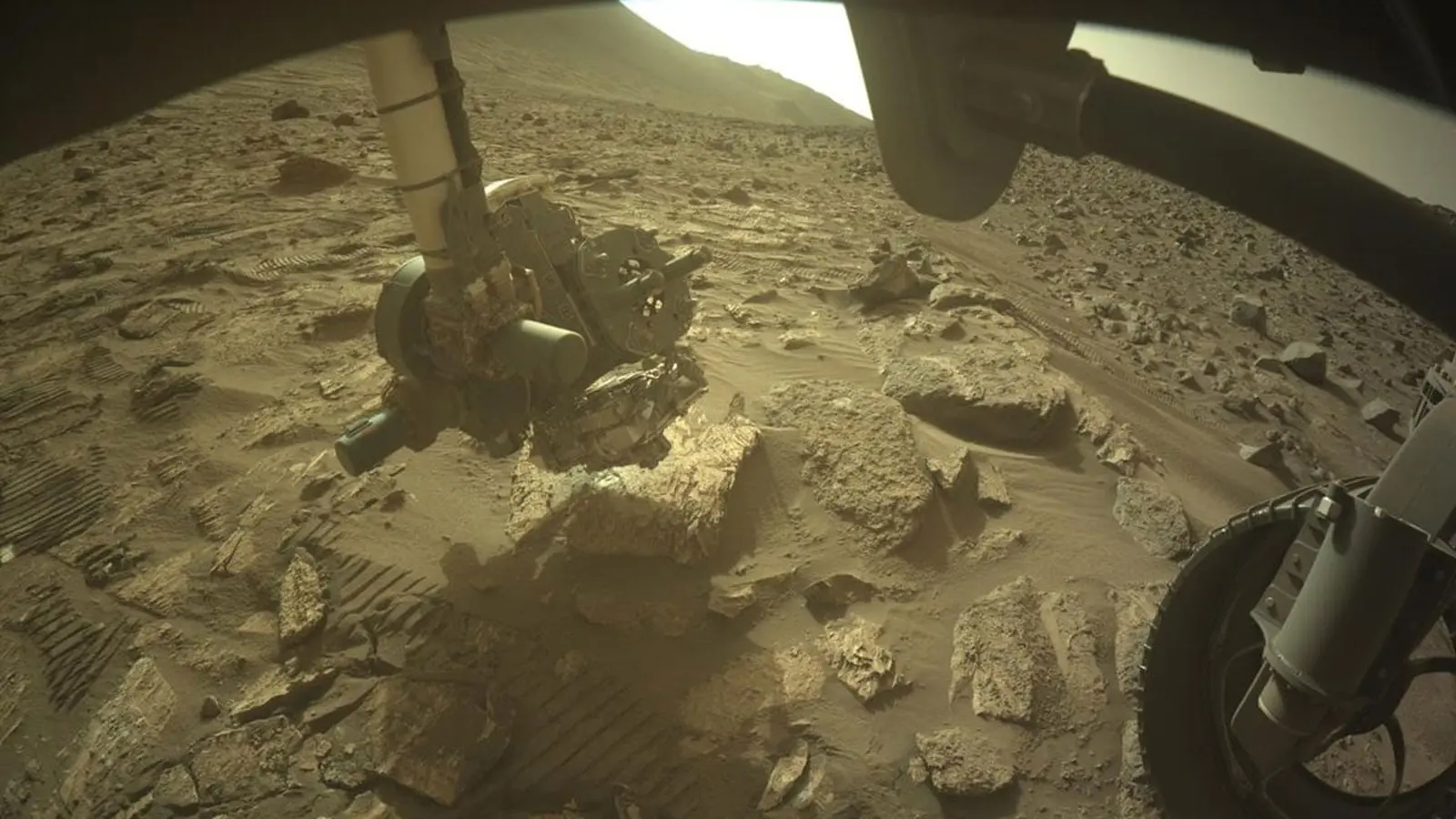
Imagine peeling back a sheet of paper and finding the chemical whispers of ancient organic material clinging to the layer below. That’s essentially what NASA’s Perseverance rover has done on Mars — not with hands, but with lasers and careful sleuthing.
In the mudstones of Jezero Crater’s Bright Angel formation, the rover’s SHERLOC instrument mapped macromolecular carbon, a complex, web-like form of organic carbon that on Earth and in meteorites often turns up in rocks. SHERLOC — short for Scanning Habitable Environments with Raman & Luminescence for Organics & Chemicals — fires laser light at targets and reads the spectral signatures that bounce back. It’s nondestructive, precise, and perfectly suited to tease apart minerals from organics without slicing a rock open.
Perseverance examined several outcrops and sampled a rock nicknamed Cheyava Falls. The team, led by researchers including Ashley Murphy and Kyle Uckert, reported that the organic signal appears interleaved with fine-grained sediments and with carbonate and sulfate minerals that formed later when water interacted with the sediments. In other words, the organics seem tied to multiple episodes in the lake-and-river history that filled Jezero billions of years ago.

There’s a twist. The macromolecular carbon shows up only microns beneath the rock surface — thinner than a sheet of office paper. Find it that close and you’d expect radiation, sunlight-driven chemistry, and reactive minerals to have long since erased it. So why is it still detectable? Two possibilities stand out: either this particular organic material is unusually resistant to breakdown, or it was sheltered by neighboring minerals — clays, carbonates or iron-bearing soils — that acted like a natural sunscreen.
That shallow preservation is important for more than poetic reasons. It expands the map of Martian organics, placing these materials more than 2,000 miles from Curiosity’s earlier detections in Gale Crater. If organics were widespread in ancient lakes and rivers, then raw ingredients for prebiotic chemistry were not a single, isolated supply but perhaps a regional phenomenon.
But let’s be clear: macromolecular carbon is not a smoking gun for past life. It’s one ingredient in a long recipe. MMC can form in abiotic settings as well as in biological ones. The instruments on Perseverance were built to flag promising biosignatures — to point human scientists to the most intriguing samples. They weren’t built to deliver the final verdict.
That final verdict requires Earth-class labs. If samples from Bright Angel are returned, terrestrial instruments could probe isotopic ratios, molecular structures, and microtextures at resolutions impossible on the rover. Those analyses could reveal whether the organic webs were woven by geology, by biology, or by a more convoluted mix of both.
Meanwhile, the discovery refines how scientists think about preservation on Mars. It nudges researchers to ask new, sharper questions: Which minerals provide the best shielding? How long can different organic types survive under Martian surface conditions? Can shallow organics survive long enough to be sampled reliably?
Perseverance’s find is a reminder that Mars keeps yielding fragments of its past — some tantalizing, some maddeningly ambiguous — and that each detection shapes the path toward the one experiment that may finally settle the matter: returning Martian rocks to Earth for close inspection.

Leave a Comment
Comments
No comments yet. Be the first.