
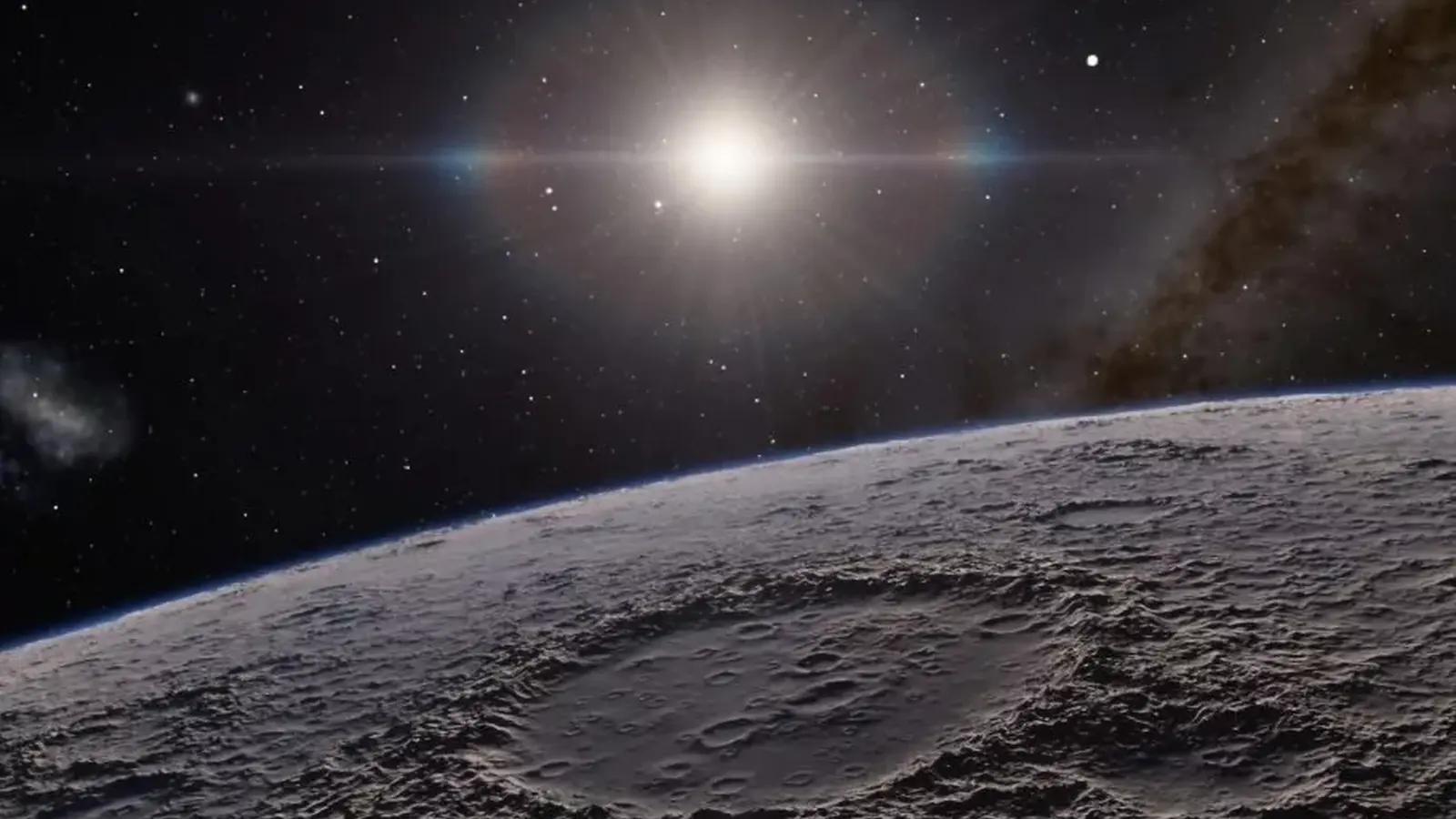
A four-ton relic of a Falcon 9 second stage that launched in January 2025 finally met the Moon after 18 months of aimless orbit — and it hit hard. Traveling at roughly 8,690 km/h, about seven times the speed of sound, the abandoned rocket stage struck the lunar surface near the Einstein crater, punching a fresh scar into the regolith.
Telescopes and amateur skywatchers around the world were on alert for the impact, yet no direct video or photograph of the moment circulated. That doesn’t mean the event left no trace. Minutes after the predicted collision time, the European Southern Observatory’s Very Large Telescope in Chile recorded sudden glows of sodium and lithium in the lunar exosphere. The sodium signature points to excavated lunar rock and dust. The lithium? That almost certainly came from rocket hardware and its residues.
NASA’s preliminary damage estimate reads like a small excavation job: a crater roughly 60 feet (about 18 meters) across and some 12 feet (3.6 meters) deep, with on the order of one million kilograms of dust and rock lofted up to 100 kilometers above the surface. Imagine a plume rising in near-vacuum, particles arcing silently into thin daylight — a rare spectacle for the Moon.

Why did an inert rocket stage wander into the lunar neighborhood in the first place? SpaceX engineers and NASA program leads point to a subtle, cumulative interplay of solar activity and the gravitational tugs of Earth, the Moon, and the Sun. Over the course of a year and a half those tiny forces nudged the stage onto a new path, one that ended with an impact rather than a long-term stable orbit.
Direct imaging of the fresh crater could still be imminent. NASA’s Lunar Reconnaissance Orbiter and South Korea’s lunar probe are expected to pass over the site in the coming days and return high-resolution photos of the newly formed depression and its ejecta blanket. Those images will help researchers compare models of impact physics with a real-world event where both the object and the target are well characterized.
Impacts like this are unusual, even though Earth orbit is cluttered: estimates put more than 130 million pieces of debris around our planet. Moon strikes by human-made objects have happened before — for example, debris tracked to the lunar surface in March 2022 and NASA’s intentional crashes in 2009 to study ejecta — but each collision provides a fresh chance to study how artificial materials interact with lunar soil and how ephemeral exospheres respond to sudden injections of vaporized matter.
So what now? Scientists will parse the spectroscopic fingerprints, map the new crater, and update orbital models. Engineers will re-examine mission disposal plans. And the Moon will keep its new bruise. In the end, the event is a stark reminder that even in the quiet of cislunar space, small forces add up — and trajectories once considered settled can drift toward surprising destinations.

Leave a Comment
Comments
No comments yet. Be the first.