
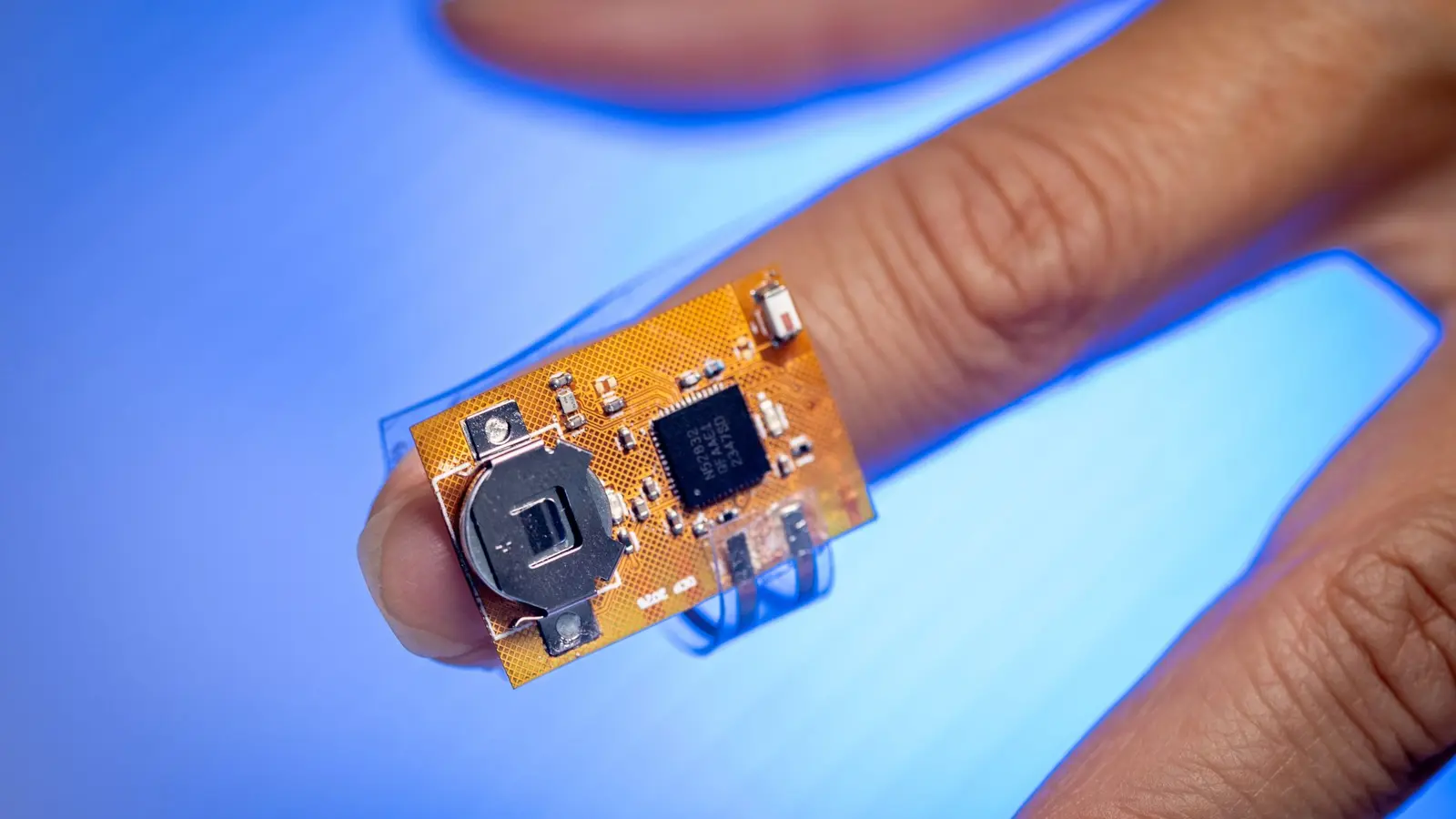
Imagine a tiny sticker on your fingertip that tells a doctor, in real time, when your Parkinson’s medication is running low. It sounds like a gadget from science fiction. Yet researchers at the University of California San Diego have built just that: a soft, battery-free patch that samples fingertip sweat to track levodopa levels continuously.
Why the fingertip? It isn’t fashion. The pad of the finger hosts one of the densest networks of sweat glands on the body, making it an ideal site to harvest the tiny droplets that carry biochemical clues. The patch draws that sweat into an absorbent hydrogel infused with salts and harmless solvents; because water flows toward higher salt concentrations, the gel acts like a gentle sponge, channeling fluid into the sensing zone.
Inside that zone, embedded enzymes meet levodopa and spark a chemical reaction. The result is a small, measurable voltage. That voltage does two jobs at once: it powers the meter and encodes how much drug is present. In short: the body’s own sweat both informs the sensor and keeps it running. It both measures levodopa and harvests the energy it needs from sweat.
Clinical volunteers—healthy people and individuals with Parkinson’s—wore the patch while researchers compared its output to conventional laboratory blood assays. The readings tracked closely with lab measurements, but with one striking difference: participants with Parkinson’s cleared levodopa faster than healthy volunteers. That accelerated drop helps explain the sudden “off” moments patients report when a dose stops working sooner than expected.

The device grew out of a long-running collaboration between Joseph Wang’s engineering lab and Irene Litvan’s neuroscience group, with Tamoghna Saha leading hands-on development and testing. The study, published in Proceedings of the National Academy of Sciences, frames the patch not as a replacement for clinical testing but as a practical bridge: continuous, at-home monitoring that can reveal when dosing schedules need adjustment—without waiting days for lab results.

Think of the implications. Doctors now lean on subjective symptom diaries to tune levodopa timing; those notes miss subtleties and sudden lapses. A fingertip monitor opens the door to truly personalized regimens. And it could slot into a closed-loop system: a patch that senses falling drug levels, a pump that refills them, and an algorithm that times doses to keep movement steady.
There are still hurdles—longer-term wearability, broader trials, and integration with treatment devices—but the work points to a future where a patient’s skin quietly narrates the pharmacology happening inside. Who wouldn’t want their medication to be that well tuned?


Leave a Comment
Comments
No comments yet. Be the first.