
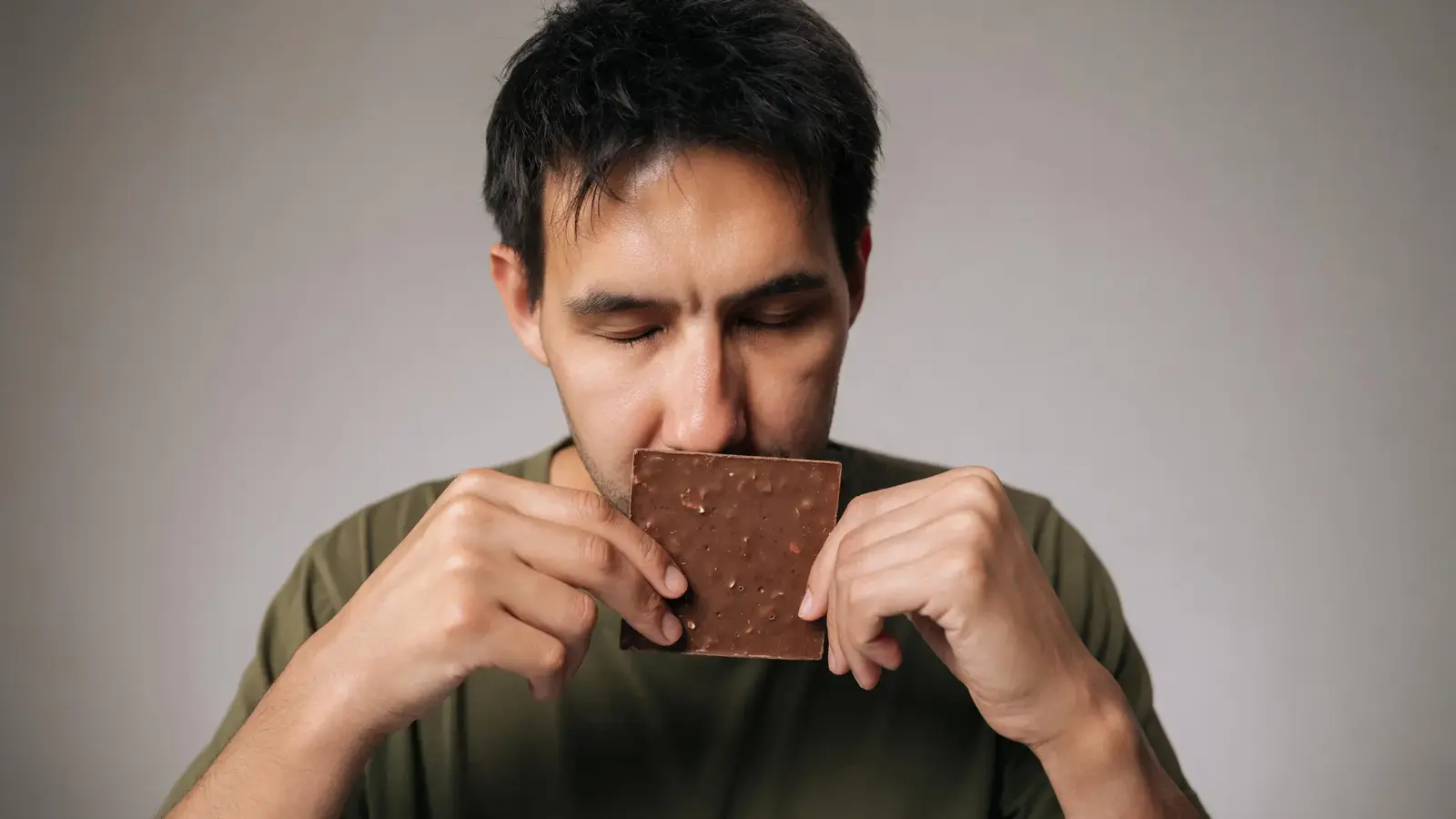
You hit rep ten. Your legs burn. The last five look impossible. Then the air changes—rich, cocoa and familiar. You only breathe it in. No bite. Just the smell. And somehow, you keep going.
Researchers at the University of Malaya tested whether that momentary whiff could actually push people past fatigue. They recruited 23 healthy men who had been lifting weights for at least two years and asked each to take part in three separate morning sessions after fasting overnight. In one session the men smelled a preparation scented with 90 percent dark chocolate. In another they sniffed a milk-chocolate mixture. The third was a water-based control. Each scent was inhaled for 30 seconds before exercise and during the short rests between sets, then participants performed repeated leg extensions on a machine until they could no longer complete the required reps.
Smelling dark chocolate before and during sets increased total leg-extension repetitions by an average of 18 compared with a water control. The milk-chocolate scent also helped, but less: about nine extra repetitions on average. Dark chocolate was linked to roughly one more completed set than either of the other conditions.

The results were not just about numbers. Smelling dark chocolate before exercising tended to suppress appetite: participants reported less hunger and greater fullness. The milk-chocolate scent behaved differently. It was judged slightly more pleasant and, oddly, raised the desire to eat compared with the control without reliably changing fullness or hunger scores.
Could reduced appetite explain the extra reps? The inside-the-study correlations pointed in that direction—lower hunger and higher fullness were associated with better performance within individuals—but the team could not prove a causal chain. 'Appetite is a plausible mechanism, but the present study cannot establish causality,' said Mohamed Nashrudin bin Naharudin, an exercise physiologist and the study's senior author.
Expectations complicate the picture further. An independent staff member prepared and coded the scent mixtures and assessors were not told which one was used. Still, the control carried no chocolate odor, and participants were able to identify it more often than the chocolate conditions. If someone realizes they have the bland condition, motivation and mindset can shift. The researchers did not measure hormones or brain activity that might reveal whether scent triggered biological pathways, and they suggest future experiments could use a scented control to tease apart sensory effects from expectation.
Ratings of perceived exertion climbed steadily as sets accumulated, but they did not differ clearly between the scent conditions. In other words, men pushed out more reps without reporting that the work felt easier. The study has other boundaries: just one exercise was tested, sessions were conducted after fasting, and the sample was small and limited to trained young men. That makes the findings intriguing but preliminary.
Published in Frontiers in Physiology, the experiment is a neat proof of concept. It raises a simple, human question: if odors can nudge appetite and motivation, might a gym that smells like your favorite snack change when you decide you’ve had enough?


Leave a Comment
Comments
No comments yet. Be the first.