
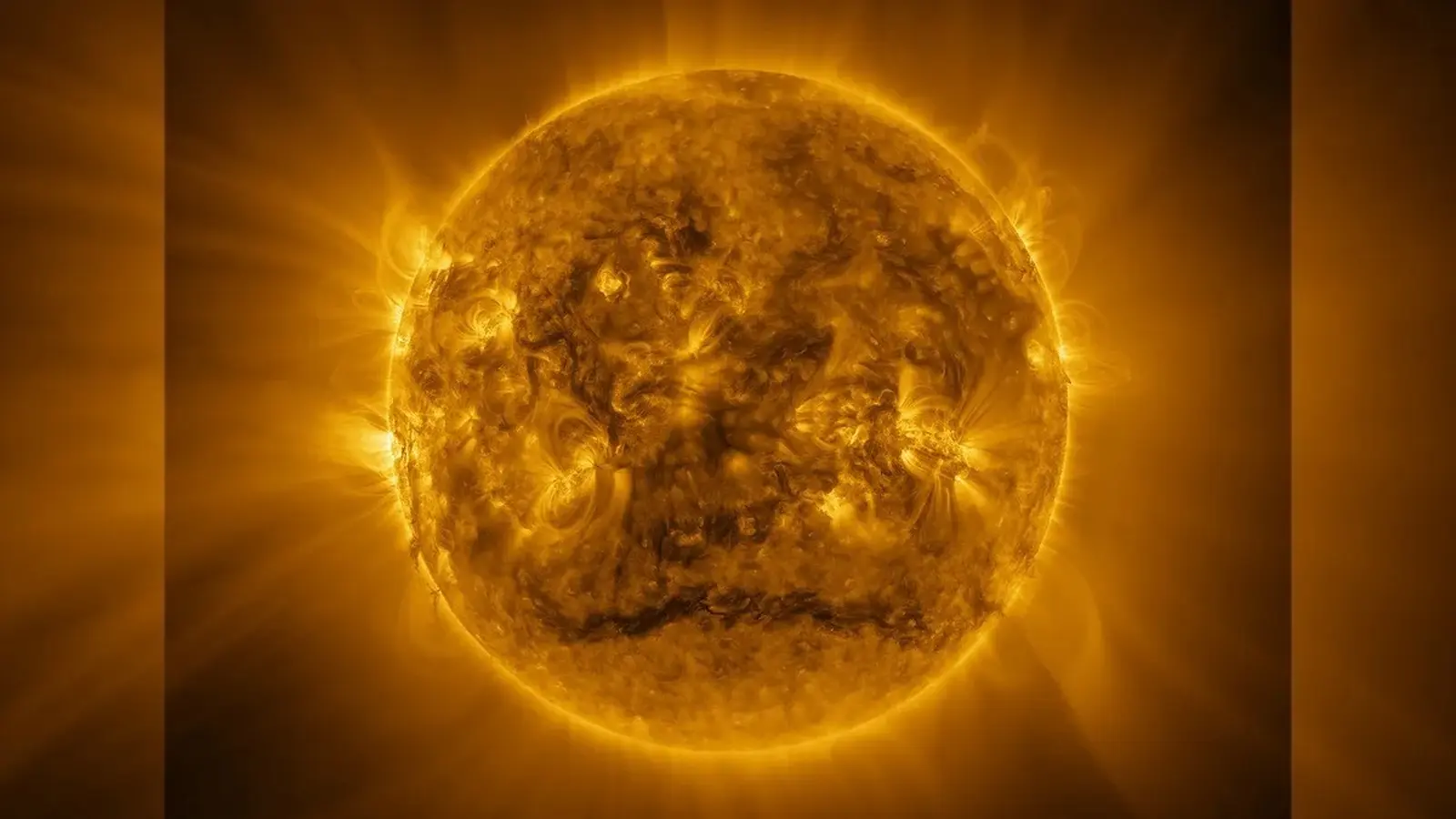
Look: the Sun is not a smooth, glowing ball. It churns with tiny whirlpools—thousands of them—spinning on the visible surface like eddies on a boiling pot.
New high-resolution images from the Daniel K. Inouye Solar Telescope in Hawai‘i have lifted a curtain on a phenomenon that hid from astronomers for 150 years. A time-lapse sequence captures what researchers say is the first direct evidence of the Kelvin–Helmholtz instability playing out on the Sun. Named after 19th-century physicists Lord Kelvin and Hermann von Helmholtz, this effect appears when layers of plasma slide past one another at different speeds and roll up into spiral, wave-like patterns.
The images are the sharpest yet of the photosphere, the Sun’s visible skin. They show dozens of compact vortices collecting along the borders of magnetic regions, often accompanied by thin, dark streaks known as striations. DKIST’s clarity is astonishing: structures only a few dozen miles across become visible, letting scientists see behavior that earlier telescopes blurred into smooth motion.
Researchers didn’t stop at impressive pictures. They ran detailed magneto-hydrodynamic simulations of the photosphere and compared them frame by frame with observations. The match was uncanny—even the spacing between vortices lined up with the models—giving strong confidence that the instability has really been caught in the act on our star.

These tiny whirlpools may be a key engine behind the Sun’s most violent outbursts.
Why does that matter? Because these miniature rotations can twist and braid the Sun’s magnetic field lines, steadily storing and then releasing magnetic energy. That process is a plausible contributor to solar flares and coronal mass ejections—events that can fling charged particles toward Earth and disrupt satellites and power grids.
Thomas Rimmele, DKIST’s senior scientist for technology, says the discovery offers important clues about how energy moves through the Sun and how its outer atmosphere gets heated. Better understanding of these micro-scale dynamics will sharpen our models of solar activity and, ultimately, improve space-weather forecasting.
The Sun is still full of surprises. With telescopes that can see the tiniest swirls, astronomers are finally reading the small-scale handwriting that shapes the star’s temper—one vortex at a time.

Leave a Comment
Comments
No comments yet. Be the first.