
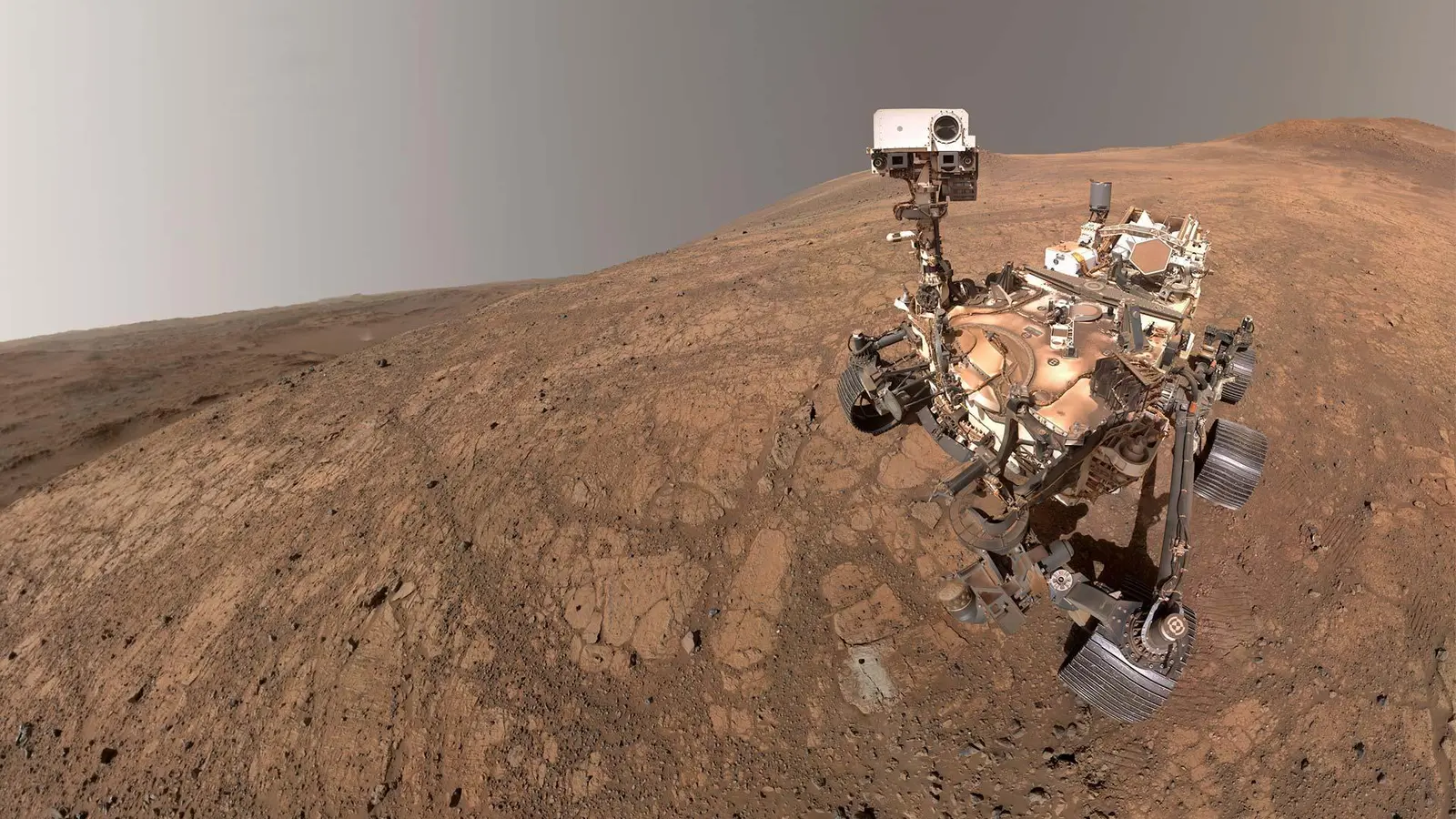
A tiny moon blinked. For a heartbeat, Earth vanished.
On the evening of July 2, NASA's Perseverance rover turned its Mastcam‑Z toward the sky and caught a moment most of us will never see: Phobos, the larger of Mars' two moons, passed directly in front of Earth and briefly hid our planet from view as seen from Jezero Crater.
This is the first time Earth has been observed being occulted from the surface of another planet.
JPL has released a set of images and a processed composite that highlights the event. The raw shot shows the familiar reddish plains of Jezero at dusk, a thin Martian atmosphere scattering light, and then—nearby and small—a dark crescent crossing a brighter disk. In the cleaned version, where scattered sky glow was reduced, the backdrop behind Phobos and the hidden Earth turns nearly black, making the silhouette stark and cinematic.
Why is this so unusual? Part of the answer is geometry. Astronomical terms like eclipse, transit and occultation are bandied about, but they refer to subtle differences in perspective. From Earth we cheer for solar and lunar eclipses. From Mars, seeing a moon cover a distant world is a rarer trick: Phobos and Deimos present tiny apparent disks in the Martian sky, especially when they’re near the horizon at sunrise or sunset. That smallness shrinks the chance they’ll line up with an interesting background object.

Timing and luck both played roles. The sun had already set for Jezero's northern hemisphere, so the illuminated portion of Earth stood out against a darkening sky. And Phobos happened to be in a thin crescent phase. If the moon had been fuller it would have been too bright and would have overwhelmed the planetary disk instead of letting Earth show through at all.
Perseverance wasn't designed to stare at the heavens. Its mission is geology: sample collection, rock coring, and hunting for signs of ancient habitability. Mastcam‑Z is versatile, but even at launch it wasn't the flagship of planetary-sky imaging. More than five years into its mission, the camera is no longer cutting-edge. Be that as it may, its lenses captured something profound: our blue marble briefly slipping behind an alien neighbor.
Scientists involved with the imagery noted that such alignments require precise planning and a measure of serendipity. Phobos sweeps across the Martian sky multiple times each day, and Earth remains visible for months at a time from Mars, but the overlap of the two at just the right apparent separation is uncommon. Add to that the fact that Phobos orbits very close to Mars' surface: only a narrow swath of the planet can witness any given occultation. Jezero simply was in the tiny sweet spot.

There are precedents for watching worlds obscure one another. During the Artemis II mission astronauts filmed Earth slipping behind our Moon—but that view came from space, not from the surface of another world. Later, future explorers on Mars might watch Phobos and Deimos parade across their skies as a daily spectacle. Will anything top the odd beauty of seeing our own planet hide behind a foreign moon? Perhaps the rarest sight would be Earth crossing the face of the Sun as seen from Mars, an event that happens only on long cycles.
Images like these remind us that perspective changes everything. Tonight, when you look up, imagine how tiny and bright we might appear from another world's doorstep.


Leave a Comment
Comments
No comments yet. Be the first.