
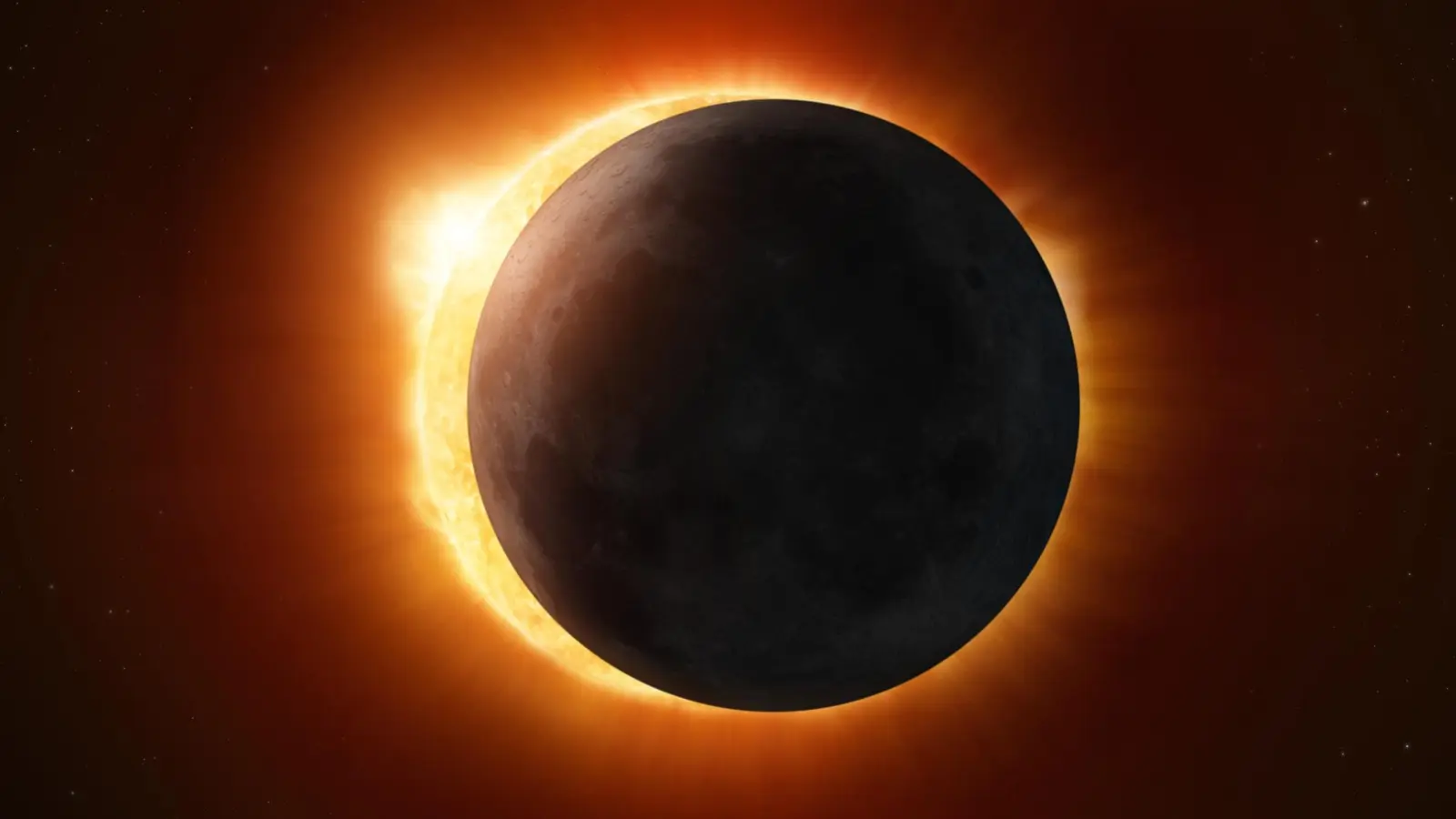
Midday will go quiet. The hustle of a summer day will fall away for a heartbeat, and for those standing beneath the Moon's shadow, the sky will look borrowed from another world.
On August 12, 2026, a total solar eclipse will sweep across a slice of the Northern Hemisphere, tracing a narrow path of totality that touches Greenland, Iceland, a sliver of northeastern Portugal and then cuts across Spain. Far beyond that corridor, most of Europe will witness a partial eclipse, the Sun taking a visible 'bite' as daylight softens and the first stars wink in the daytime sky.
Why should you care? Because totality is not just a pretty trick. When the Moon finally hides the Sun's disk, the solar corona — the Sun's ethereal outer atmosphere, usually drowned out by sunlight — blooms into view. Temperatures can drop, breezes shift, animals falter between day and night, and the entire scene becomes a live experiment in atmospheric and solar physics.

This map shows where a total (red) and the partial (orange) eclipse will be visible across Earth’s northern hemisphere. The eclipse will follow the red band of totality counterclockwise from the top to the bottom. Interestingly, this eclipse starts around midnight in the Arctic, made possible thanks to midnight Sun, and traces out a path that initially moves west-to-east (‘back in time’) before moving in the usual east-to-west direction.
Not everyone needs to travel. The European Space Agency will stream the event live from the Observatorio Astrofísico de Javalambre in Teruel, Spain, beginning on August 12 at 1:30 p.m. EDT, with the program wrapping up around 2:45 p.m. EDT. Expect a mix of telescope views, drone footage, and on-site reactions as presenters and scientists experience totality in real time.
Javalambre is an excellent vantage point. The observatory sits directly inside the path of totality, enjoys dark skies, low cloud frequency and a wide view toward the western horizon — a crucial advantage because the Sun will be sinking toward sunset as totality arrives. For Javalambre the key moment comes at 2:31 p.m. EDT, when the Moon will fully occlude the Sun for roughly 1 minute and 21 seconds.
Television-style production will still be intimate: Dame Dr. Maggie Aderin will host, with guests including ESA's Director of Science Professor Carole Mundell and other ESA researchers. They'll discuss not just the spectacle but the science behind it — from lingering mysteries of the solar corona to how eclipses have historically reshaped our understanding of gravity — and even ESA's experiments to recreate eclipse-like conditions in space.

This infographic shows when, where and for how long totality will be visible across Spain. The percentages outside the band of totality indicate the maximum percentage of darkness visible for those regions during the partial eclipse.
Live streams will not rely on a single camera. Additional feeds will transmit from a public event in León and from Frómista in Palencia, where collaborators will bring smaller telescopes and specialized instruments to follow the Moon's transit across the Sun. That redundancy matters; weather can be fickle, and multiple viewpoints increase the chance of crisp, uninterrupted images.
Curious minds can participate. Questions submitted with #AskESA on Bluesky or X may be selected and answered during the broadcast, making the program conversational rather than a one-way feed of images.
If you plan to watch in person, use certified eclipse eyewear except during the brief interval of totality. If you plan to tune in online, pick a comfortable chair and something warm to sip: even a short eclipse tends to linger in memory far longer than the minutes it lasts.
When the Moon’s shadow passes and daylight tightens into a narrow band of darkness, the moment will feel both ancient and immediate — a reminder that, on occasion, cosmic geometry writes its name across our skies.

Leave a Comment
Comments (2)
Streaming looks cool, but will clouds or tech glitches ruin it? also, 1m21s sounds so short… camera angles matter big time.
wow, that midnight Sun totality bit gave me goosebumps. gotta see it IRL someday, but flights + hotels are gonna be crazy... if only work would let me.