
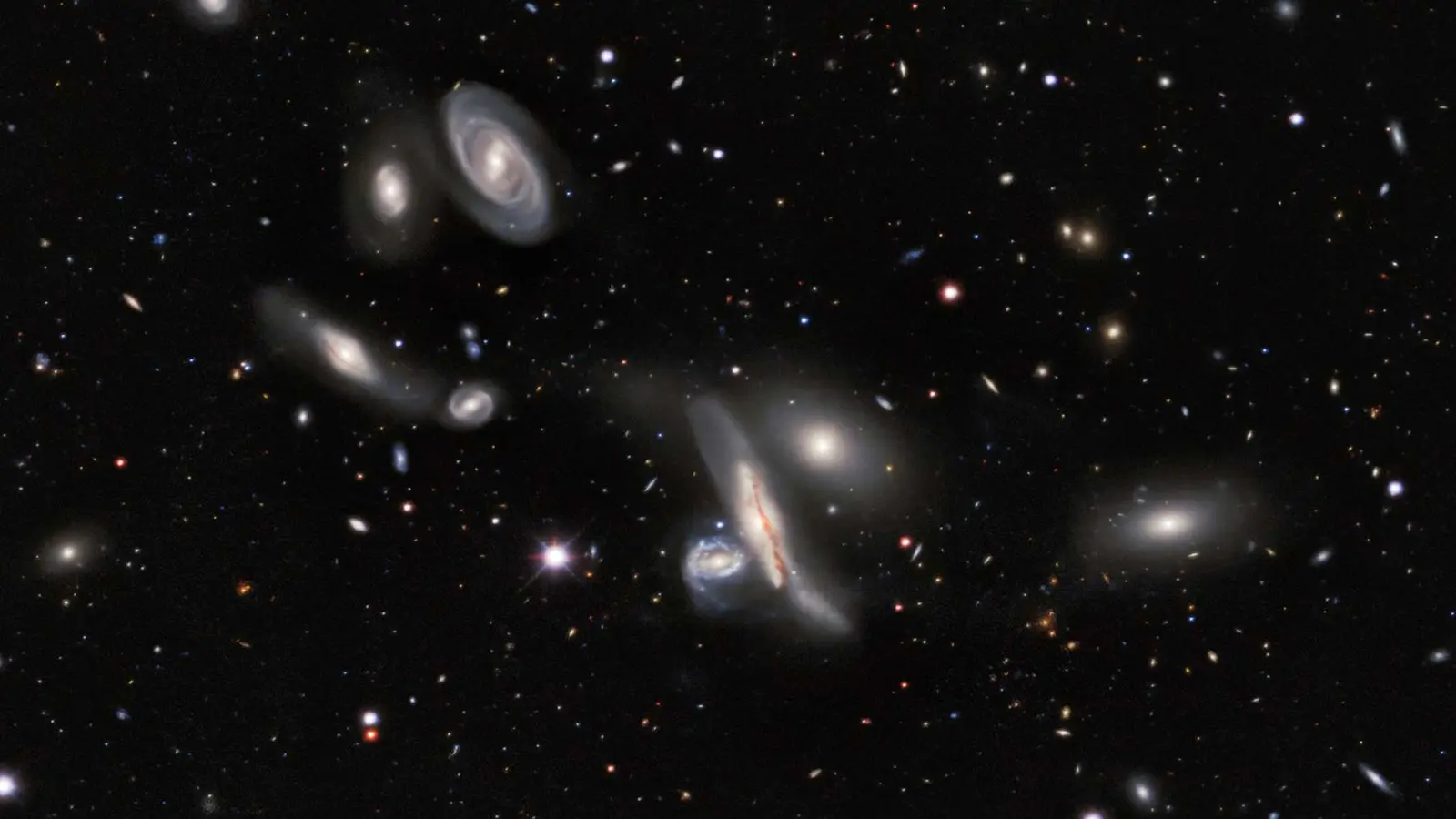
Imagine a photograph so vast that every scroll reveals a new island of stars. That is the simplest way to think about the latest sky mosaic released by the DESI Legacy Imaging Surveys: a stitched-together portrait made from more than 263,000 telescope exposures and totaling some 5.6 trillion pixels.
The image covers roughly three-quarters of the celestial sphere and catalogs nearly four billion distinct objects—stars, galaxies, and other cosmic curiosities—captured across visible and near-infrared wavelengths. The dataset is the product of over a decade of observations and processing, and it now sits as a foundational resource for astronomers worldwide.
Why does a two-dimensional map matter when modern cosmology is obsessed with 3D? Because this enormous 2D atlas was designed to guide the next steps: pointing DESI's thousands of robotic optical fibers and other spectrographs to precisely the regions that will yield redshifts. Redshifts convert the flat sky into depth, turning an image into a three-dimensional map of the universe.
DESI—the Dark Energy Spectroscopic Instrument—mounted on the 4-meter Mayall telescope at Kitt Peak, measures the spectra of galaxies and quasars to gauge their recessional velocities. Those measurements anchor studies of cosmic expansion and the mysterious agent known as dark energy. By April 2026, DESI had already charted more than 47 million galaxies and quasars, producing the largest high-resolution 3D map of the universe to date.

This new imaging release is not just a navigational chart for DESI. Previous versions of the survey data have been cited in more than 1,800 scientific papers. The fresh mosaic will help astronomers hunt for rare or transient objects, study galaxy evolution across cosmic time, and train machine-learning systems to sift through the deluge of data forthcoming from next-generation observatories.
Think of it as a public atlas. As David Schlegel of Lawrence Berkeley National Laboratory put it, researchers often begin a study by opening the imaging atlas to see what the sky actually contains at the locations they care about. NOIRLab emphasizes that these observations span visible to near-infrared light, offering a broad, high-fidelity view of structure in the Milky Way and far beyond.
Other teams are taking complementary approaches. HETDEX, for example, peers at faint Lyman-alpha glow from intergalactic hydrogen to reveal three-dimensional scaffolding from 9 to 11 billion years ago—features that imaging alone can miss. Together, these surveys form a toolkit: wide, deep images to find targets and clever spectroscopic experiments to measure their distances.
Even familiar islands appear in the mosaic. Messier 96, a graceful spiral roughly 35 million light-years away in Leo, shows up among the billions cataloged. But the real marvel is the map’s scale and utility. Five-point-six trillion pixels is more than a number—it’s an invitation to discovery. Who knows which faint object or subtle pattern this atlas will help astronomers find next?


Leave a Comment
Comments
No comments yet. Be the first.