
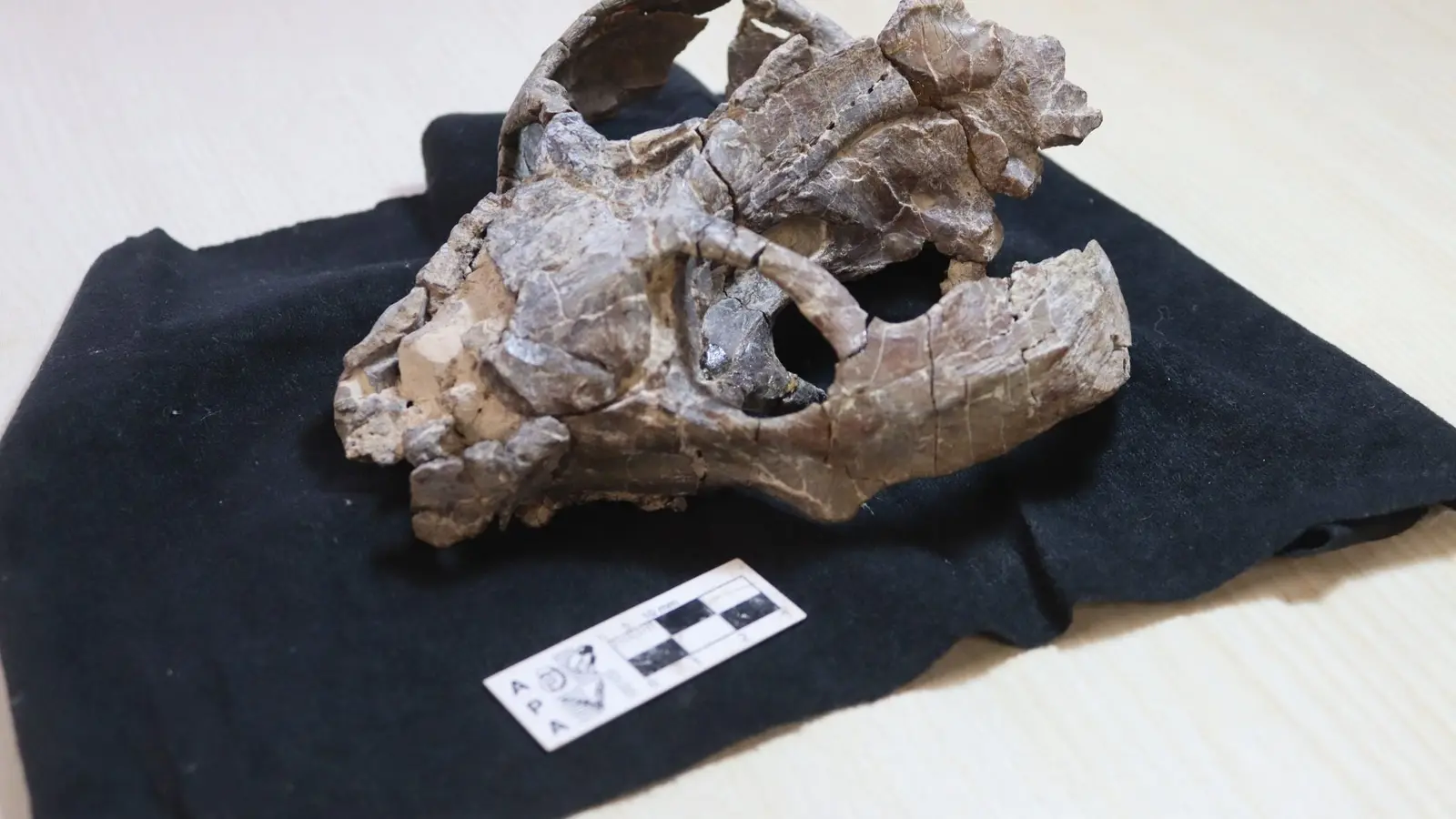
A thin, microscopic ring trapped in fossilized bone has the kind of story that rewrites chapters: it hints that an ancestor of mammals gave live birth 236 million years ago. No guesswork. No wishful thinking. Just a tiny growth mark that behaves like a neonatal fingerprint.
The fossil belongs to Chiniquodon theotonicus, a carnivorous cynodont from Triassic Argentina. While preparing slides during a postgraduate lab, researchers discovered an unusual growth line inside one adult specimen’s bone. That feature matched a neonatal line—a sharp growth change that, in living animals, often appears right after birth when physiology and life regimes shift dramatically.
Eggs or live young? It’s an old question in paleontology. The team, led by Dr. Leandro Gaetano of CONICET, didn’t stop at visual comparison. They turned paleohistology into a detective tool. By measuring the neonatal mark relative to the bone’s outer surface and modelling growth, they estimated both birth mass and adult mass for the individual. The newborn would have weighed roughly 1.7 kg; the adult about 12 kg. That gives a neonate-to-adult ratio near 14 percent—far closer to modern placental mammals than to reptiles or birds of comparable size.

“Triassic Mothers,” a life reconstruction of a group of Chiniquodon theotonicus individuals, a pregnant female (left) as well as a female (right) breastfeeding a few, relatively large neonates.
Numbers tell the punchline. Many reptiles produce hatchlings that are a sliver of adult mass: tenths of a percent in turtles and crocodilians, and only a few percent for some large birds. In contrast, small to mid-sized placental mammals often produce proportionally much larger offspring. The Chiniquodon specimen falls squarely with placentals in this metric.
There’s more than mass. The neonatal line itself—never before reported in cynodonts—implies a physiological shift at birth rather than at hatching. In living mammals, that line marks an abrupt acceleration in growth after being nourished directly by the mother. That pattern aligns with the idea of viviparity, not egg-laying.


The neonatal line in Chiniquodon.
Why would a lineage that far back evolve live birth? Picture the Triassic: ecosystems reshuffling after a mass extinction, seasons growing stingier, predators prowling. In such a landscape, embryos protected inside the mother would gain a survival edge over exposed eggs. Adriana Mancuso, a senior author on the study, suggests exactly that—viviparity could have been an adaptive strategy under intense environmental and predatory pressures.
Still, the authors are cautious. One fossil with a convincing neonatal mark is a big clue. But is it the rule or the exception among cynodonts? The team admits more samples are needed to establish whether Chiniquodon represents a broader reproductive shift in the mammalian stem or a surprising quirk of one lineage.
Technically, the paper is elegant. The researchers compared the fossil’s growth signature with thousands of measurements from living mammals, reptiles, and birds. They excluded egg-laying monotremes and pouch-bearing marsupials from the mammal sample to avoid confounding small-newborn strategies. The result: Chiniquodon clusters with placental mammals in neonatal proportion charts. That’s statistically potent evidence—especially when paired with histological signs that mirror neonatal physiology.

Representation of neonate and adult Chiniquodon theotonicus. Recovered (yellow) and histologically analyzed (orange) bones of specimen CRILAR PV109, the individual used in this study.
The implications ripple out. If viviparity was present in at least some cynodonts roughly 236 million years ago, the origin of mammal-like reproduction may be tens of millions of years older than commonly thought. Traits we associate with 'true mammals'—extended parental care, larger neonates, internal gestation—might have deep roots among pre-mammalian relatives.
Science thrives on skepticism. This study opens a door, then waits to see whether other fossils walk through. More bones, more histological slices, more comparative data will either confirm a sweeping reproductive transition among early mammal ancestors or reframe Chiniquodon as an unusual experiment in evolution.
Either way, that delicate neonate line—like a fossilized birth certificate—reminds us how much insight can hide in a sliver of bone. The past still has surprises, and sometimes a single ring in stone is loud enough to change how we picture the mammal family tree.

Leave a Comment
Comments
No comments yet. Be the first.