
3 Minutes
Something like a slow furnace hums beneath Mars's southern hemisphere. Silent. Invisible. Vast.
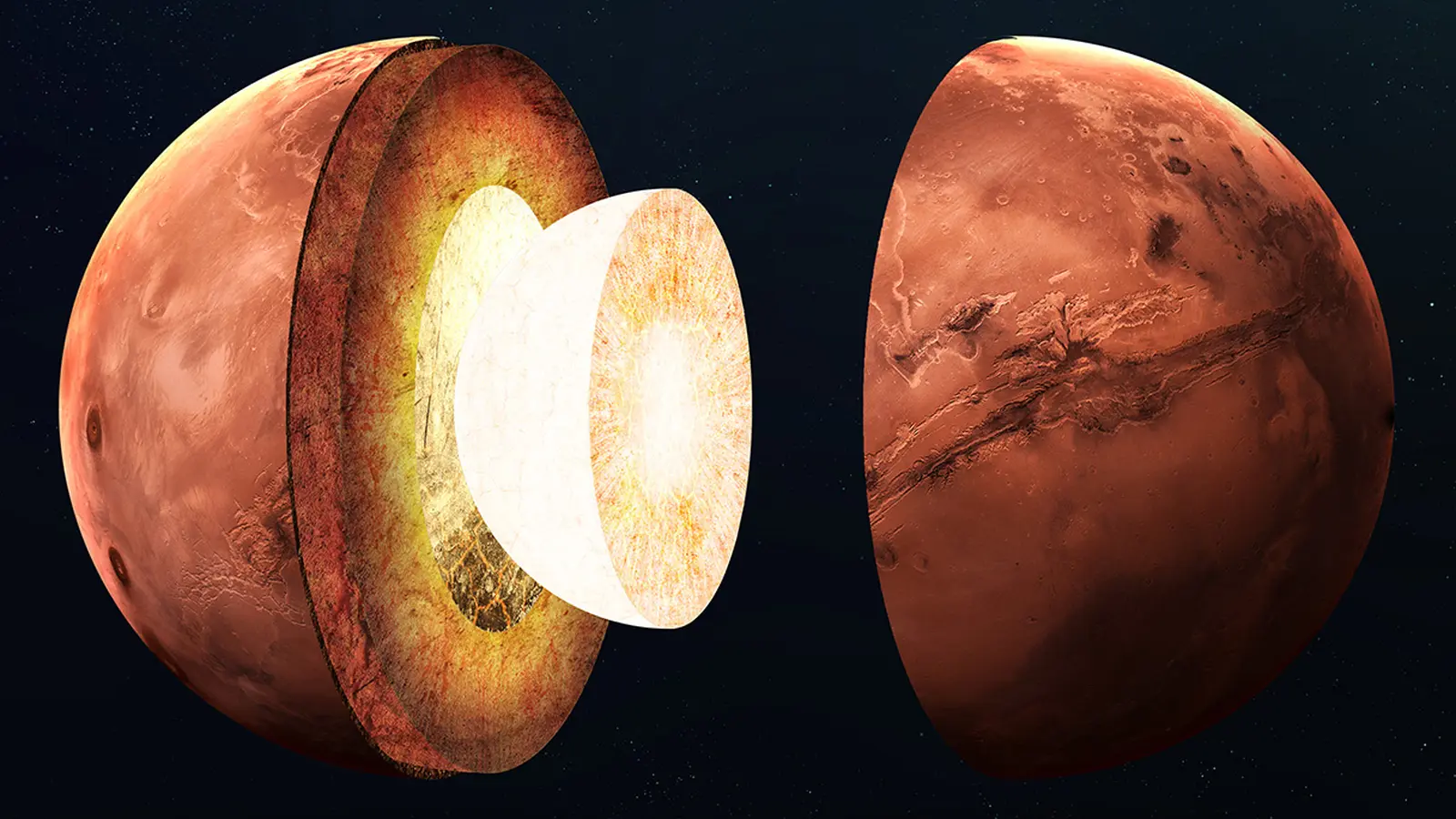
Using tiny wobbles in the orbits of three long-lived spacecraft, a team of planetary scientists has revealed that the Red Planet is not thermally uniform. The southern interior appears dramatically hotter than the north—by roughly 200 to 400 degrees Celsius—and may even be partially molten beneath the crust.
That revelation comes from a technique that treats Mars like a ringing bell. As the planet moves along its elliptical path and tilts on its axis, the Sun’s pull on Mars shifts subtly with the seasons. Those tidal nudges change the gravity field in time. By tracking minuscule variations in the velocities of Mars Global Surveyor, Mars Odyssey, and Mars Reconnaissance Orbiter, researchers reconstructed how Mars deforms and, from that, peered into its interior.
Alexander Berne, who began building this gravity model while a doctoral student at Caltech and is now a postdoctoral researcher at the University of Arizona, led the work published August 27 in Nature. The method—tidal tomography—lets scientists move beyond simple, spherical models and map three-dimensional temperature and mechanical contrasts deep under a planet’s surface.
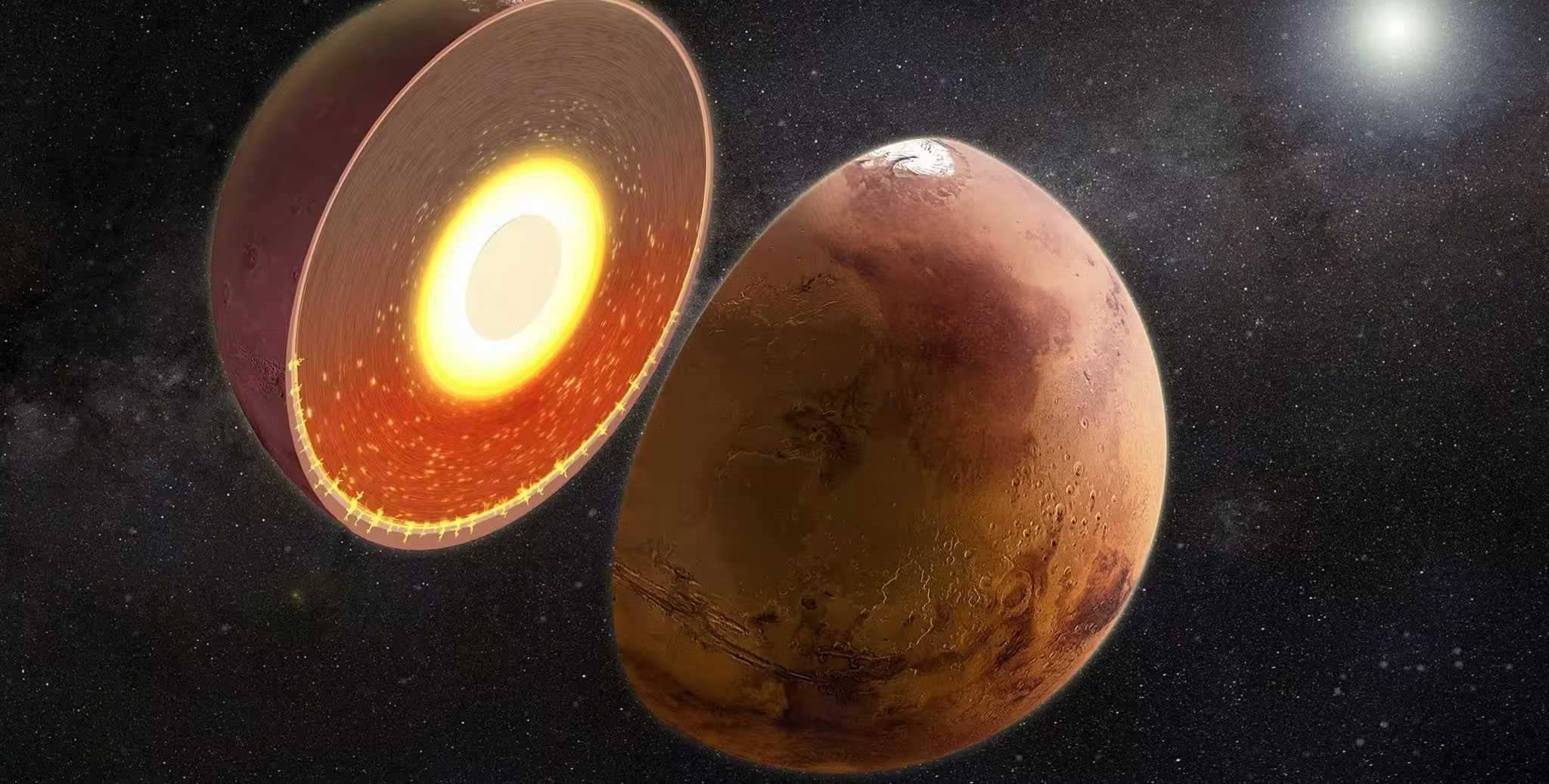
The southern mantle appears roughly 200–400°C hotter than the northern mantle and may host pockets of partial melt. Short sentence. Big implication.
Mars has always worn a split personality on the surface: high, heavily cratered southern highlands versus the low, smoother northern plains. What’s striking is that the contrast continues far below. Heat, it seems, is concentrated in the south.
Why should we care? Because temperature at depth controls everything from how rocks deform to whether a planet can sustain a magnetic field and where water might have pooled at the surface ages ago. The magnetic anomalies preserved in southern crustal rocks—long mysterious to scientists—could be a fossilized record of a stronger ancient magnetic field shaped by a hotter southern interior.
Seismic experiments tend to agree. NASA’s InSight lander previously reported that seismic waves fade faster beneath southern regions, losing energy more quickly than expected. Hotter, partially molten materials scatter and absorb seismic energy; they make the subsurface sound muffled. The gravity-based heat map supplies a tidy explanation that ties together gravity, magnetism, and seismic oddities.
How did the south get so warm? The team is cautious. A few hypotheses compete. A colossal impact early in Mars’s history might have thinned the northern crust and let heat escape there, relatively cooling that hemisphere. Alternatively, vigorous mantle convection could have concentrated heat-rich upwellings in the south. Thick, insulating lithosphere in the north could also have trapped heat in the south by contrast. Each scenario points to very different chapters in Mars’s geological biography.
Pinning down the cause matters because it affects more than geology. A hotter southern mantle could have altered patterns of surface erosion, influenced where basins formed and filled with water, and changed the chemistry available for any nascent life. In other words: the interior shapes the surface, in ways that matter for astrobiology and mission planning.
More gravity data will help. So will expanded seismic coverage and, ideally, a new generation of orbiters or landers designed to test these thermal models directly. For now, we have a striking image of Mars as a planet with an interior personality split in two.
That split raises the old, irresistible question: what other secrets are tucked beneath the dusty plains and towering southern massifs, waiting for instruments clever enough to listen?


Leave a Comment
Comments
No comments yet. Be the first.