
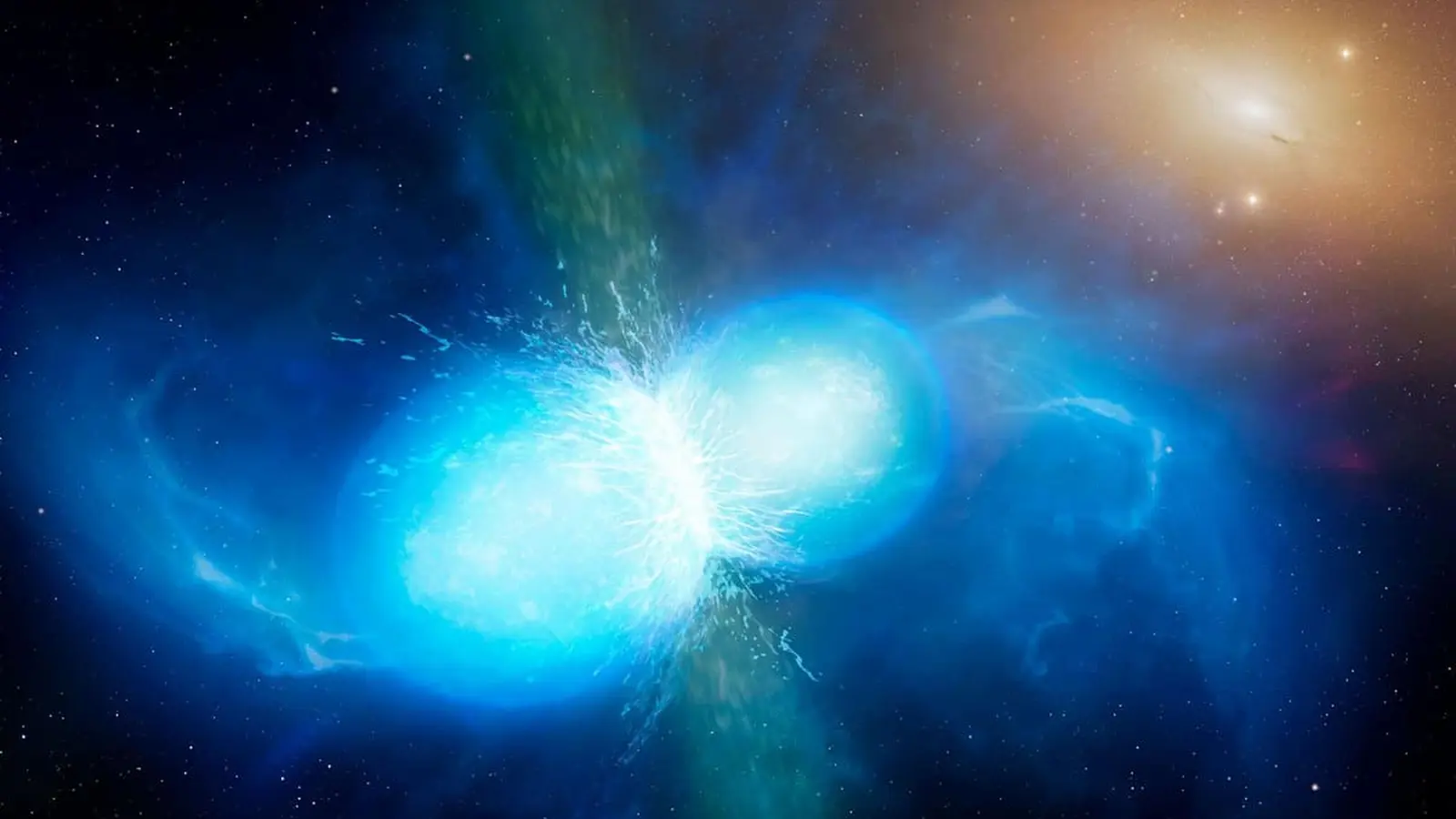
Imagine two dead stars so close they lap each other every 6.2 minutes. No slow waltz. A full, furious orbit in 374 seconds.
A compact pair cataloged as eRASSU J060839.5–704014 — shortened to eRASSU J0608 — first appeared in eROSITA X-ray scans aimed toward the Large Magellanic Cloud. Follow-up observations with NICER, Einstein Probe and XMM-Newton revealed the reason for the beacon-like pulses: two white dwarfs locked in an ultracompact embrace, trading mass so tightly that the stream from one appears to strike the other directly. Instead of a neat accretion disk, this system shows direct-impact accretion, which produces a sharp X-ray pulse every orbit.
Astronomers watched this clock for roughly 3.5 years and found the tick is getting faster. The orbital period is measured at 374.15013 seconds and is shrinking at a rate faster than similar systems like HM Cnc and V407 Vul. Why? The simplest explanation is familiar but extraordinary: gravitational waves are siphoning off energy and angular momentum. From that decay, researchers infer a chirp mass of about 0.43 solar masses, placing eRASSU J0608 among the heftier members of its class.
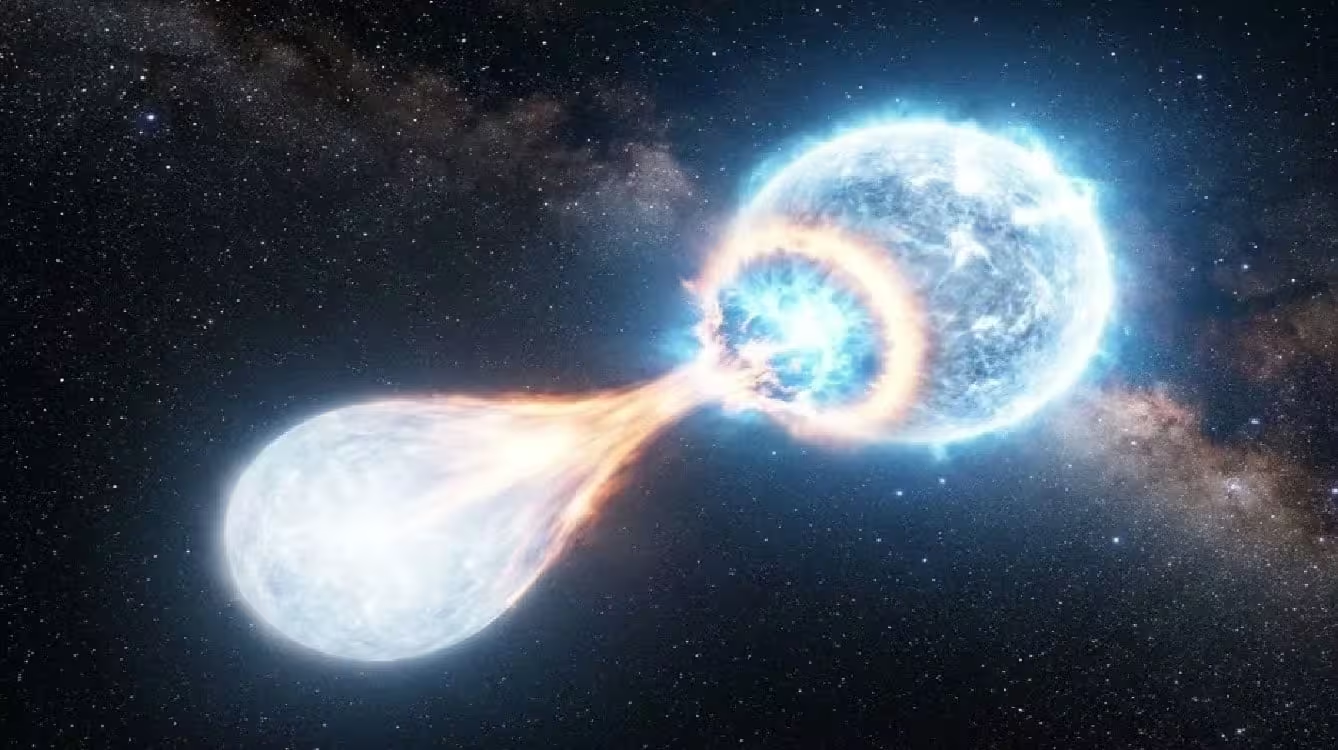
Gravitational waves from this pair would arrive at roughly 5.3 millihertz — far below the sensitivity of ground-based detectors but squarely in the band planned for space missions such as LISA. The big unknown is distance. The source lies in the direction of the Large Magellanic Cloud, yet it may be much closer. If the binary sits inside our galaxy rather than in the LMC, LISA could detect its gravitational waves directly.
There is an added bonus for future observers: the orbit is already tracked precisely in X-rays. That makes eRASSU J0608 a rare kind of prize — a potential verification source for space-based gravitational-wave detectors, one whose rhythm we can predict before the instrument even turns on. Will it be loud enough for LISA? Time — and more telescopes — will tell. For now, the system keeps ticking like a cosmic metronome, and astronomers are listening closely.

Leave a Comment
Comments
No comments yet. Be the first.