

Researchers at the University of Cambridge have uncovered unexpected genetic parallels between humans and golden retrievers that may help explain shared patterns of emotion, learning, and social behavior. The findings open new avenues for comparative psychiatry and deepen our understanding of how long-term human–dog relationships shaped behavior on both sides.
How the Cambridge team mapped behavior to genes
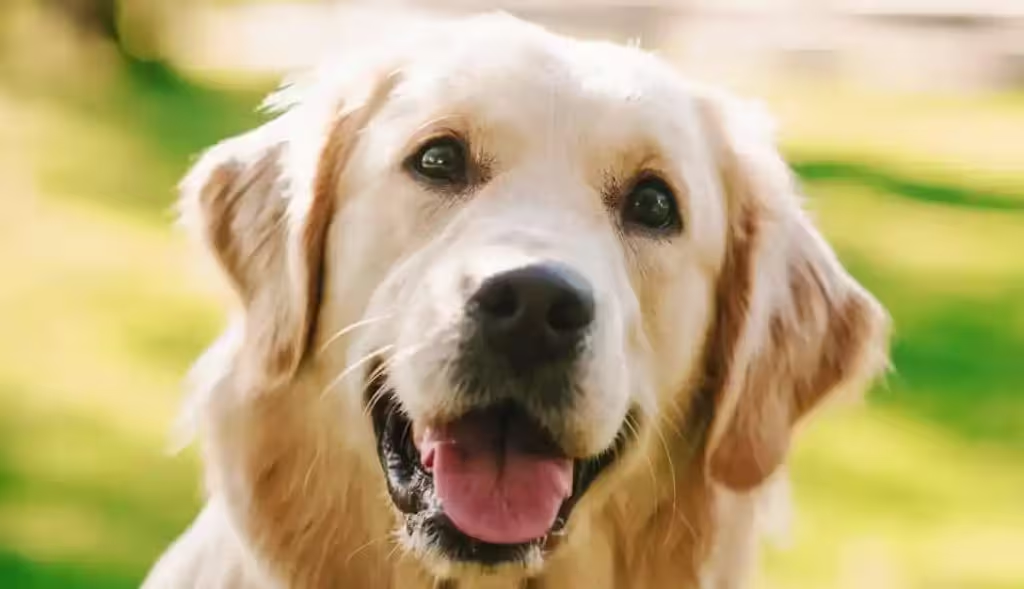
To probe the biological roots of canine behavior, the research team analyzed the genomes and behavioral profiles of about 1,300 golden retrievers. Using standardized behavioral assessments and genetic sequencing, they searched for specific genes in dogs that correlated with traits such as fearfulness, sociability, and trainability. The researchers then identified human orthologs—matching genes inherited from common evolutionary ancestors—and examined whether the same genetic regions had known links to human cognition, emotional processing, or psychiatric traits.
Twelve shared genes — concrete examples and surprises
The study highlighted 12 genes that show similar functional associations in both species. One notable example is the gene ADD2: in dogs it correlates with fear of strangers, while in humans it has been linked to forms of depression characterized by social withdrawal. Other genes were connected to responses to aversive experiences, error sensitivity during learning, and broader cognitive features.
Some of the human traits tied to these genes—like self-reflection—are uniquely complex, which prompted the team to interpret results cautiously. Rather than claiming dogs possess human-style introspection, the authors propose that shared genetic architecture may underlie more basic emotional or attentional processes that human cognition built upon. Likewise, the genes associated with trainability in dogs matched regions in humans connected to intelligence and sensitivity to mistakes, suggesting overlapping biological mechanisms for learning and social adaptation.
Context: domestication, social cognition, and mental health
Humans and dogs have a long co-evolutionary history. Early humans likely favored proto-dogs that tolerated human diets and cooperative living, creating selective pressures that favored social attunement. Psychologically, dogs excel at following human gestures like pointing—outperforming chimpanzees in some tests—and they are highly responsive to human emotional cues. This deep social synchrony provides a plausible backdrop for convergent genetic influences on behavior.
Researchers also noted contemporary relevance: modern lifestyles have increased stress-related problems in pet dogs, especially in countries with high pet ownership. The team referenced emerging evidence of autism-like syndromes in dogs and a March 2025 finding of similar genetic markers for certain social difficulties in humans. Together, these observations motivate investigation into whether comparable vulnerabilities to social and emotional disorders exist across species.
What this means for science and animal welfare
These findings offer a foundation for comparative psychiatry: using naturally occurring variation in dogs to explore the genetics of social behavior and emotional disorders could complement traditional laboratory models. Practical implications include refining breeding and training practices to support mental well-being, and informing veterinary approaches to stress-related behavior. At the same time, scientists emphasize careful interpretation—shared genetic signals do not mean identical mental states, but they do point to overlapping biological systems worth studying.
"The results indicate that humans and golden retrievers share genetic roots for some behaviors, and these genes influence emotional states and actions in both species," said Dr. Elinor Raffan, a veterinarian and lecturer in physiology at Cambridge. "This opens productive paths for studying the biology of social behavior across species, with implications for both human mental health research and dog welfare."
Future work will compare breeds, expand sample sizes, and link specific genetic variants to neural circuits and behavioral outcomes, moving from correlation toward clearer causal models that can guide both science and compassionate animal care.


Leave a Comment
Comments
No comments yet. Be the first.