

People often focus on what to say—but how you move your hands can change how your message lands. New research shows that specific hand gestures that visually match spoken ideas make speakers appear clearer, more competent and more persuasive. Small, deliberate movements act as visual shortcuts that help listeners build mental images and process information faster.
Why some gestures help and others don’t
Researchers label the most effective movements "illustrators"—gestures that directly depict the concept being described. Spread your hands to show distance, bring them together to indicate connection, or trace a curve to represent a market trend. When gesture and speech align, listeners form a clearer mental model of the idea; psychologists call this processing fluency. The easier an idea is to process, the more credible the speaker appears.
Not all motion is beneficial. Random waving, restless fidgeting, or gestures unrelated to the message can distract and reduce perceived competence. The practical rule is simple: prioritize clarity over choreography. Let your hands emphasize size, direction, or relationship only when those movements genuinely mirror the content you’re communicating.
How the study reached its findings
To test the effect at scale, the research used a two-pronged approach. First, analysts applied AI-based video tools to more than 200,000 segments from over 2,000 TED Talks, detecting and classifying hand movements frame by frame. Then they ran controlled lab experiments where 1,600 participants evaluated entrepreneurs pitching products with and without illustrative gestures.
Both lines of evidence converged. In the TED data, speakers who used illustrative gestures received higher audience evaluations—reflected in viewer behavior including more than 33 million likes across videos. In the experiments, participants consistently rated illustratively gesturing speakers as clearer, more competent and more persuasive.
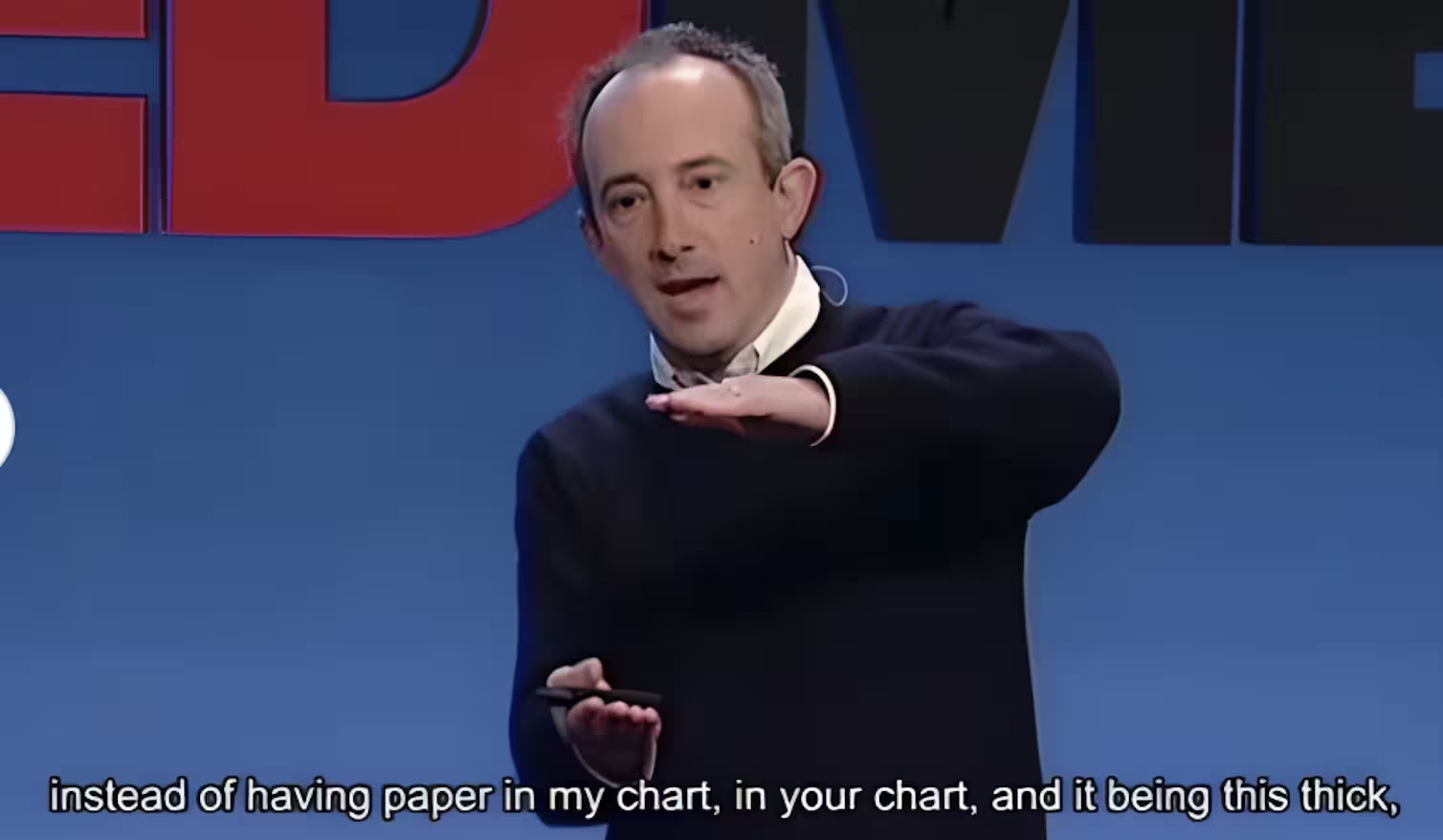
One example clip used in the analysis shows a TED speaker gesturing while explaining complex ideas (YouTube/TED – David Agus: A new strategy in the war against cancer). That visual alignment between hands and words makes abstract concepts tangible for viewers.

Scientific context and implications
The study sits at the intersection of communication science, cognitive psychology and human factors. Gesture studies trace back decades, but recent advances in computer vision and machine learning enabled researchers to analyze thousands of hours of naturalistic speech automatically. Those tools can identify patterns of sensorimotor behavior that scale beyond lab observation.
From a neuroscience perspective, gestures likely recruit sensorimotor systems that complement language networks. When a speaker illustrates an idea with their hands, listeners may simulate the movement mentally, boosting comprehension and memory. That neural coupling—sometimes called interpersonal neural synchronization—has implications for collaborative work, education and high-stakes communication.
Real-world applications
- Business and pitching: Entrepreneurs can increase persuasive impact by aligning hand movements with key claims, making product features feel more concrete.
- Education: Teachers can use illustrative gestures to clarify abstract concepts and improve learning retention in classrooms or online lectures.
- Space and mission-critical communication: In environments like mission control or astronaut briefings, clear nonverbal signals could reduce ambiguity when every second and instruction matters.
Can people learn to gesture better?
Early pilot training suggests yes. Short interventions—sometimes as brief as five minutes—help people adopt more purposeful, illustrative gestures and be perceived as clearer and more persuasive. The research team is now exploring whether a structured nonverbal "vocabulary" can be taught systematically and how gesture training interacts with vocal tone, facial expression and overall body language.
Expert Insight
"Gesture is not decoration; it is part of how the brain communicates ideas," says Dr. Elena Marquez, a cognitive neuroscientist who studies multimodal communication. "When speech and movement align, they create a richer representation in the listener's mind. For complex or technical topics—including those in science and space exploration—an illustrative gesture can bridge the gap between jargon and intuition."
Researchers are also testing AI tools that track voice, facial cues and gestures together to identify the full pattern of effective communication. This multimodal approach could help trainers, educators and mission teams understand which combinations of signals produce the best outcomes.
Whether you’re leading a meeting, teaching a class, or pitching an idea, think of your hands as tools that can make abstract concepts visible. With modest practice and attention to alignment between words and motion, gestures can strengthen persuasion and clarity—turning speech into a shared, visualized idea.


Leave a Comment
Comments (2)
Interesting study, but are likes really a good proxy for clarity? Correlation vs causation… needs more controls, and culture likely matters
Wow, didn't expect hand gestures to change credibility so much. Tried it once in a pitch, ppl actually leaned in. subtle but real lol