

5 Minutes
The biggest land animals of the Jurassic were also the most surprising prey: hatchlings no larger than a dinner plate. Think of a blue whale on legs—then imagine its babies scattered across floodplains, vulnerable and abundant. Those tiny sauropods underpinned an entire food web, the new analysis shows, turning the juveniles of giants into ecological currency for a menagerie of predators.
Snapshot from a Jurassic quarry
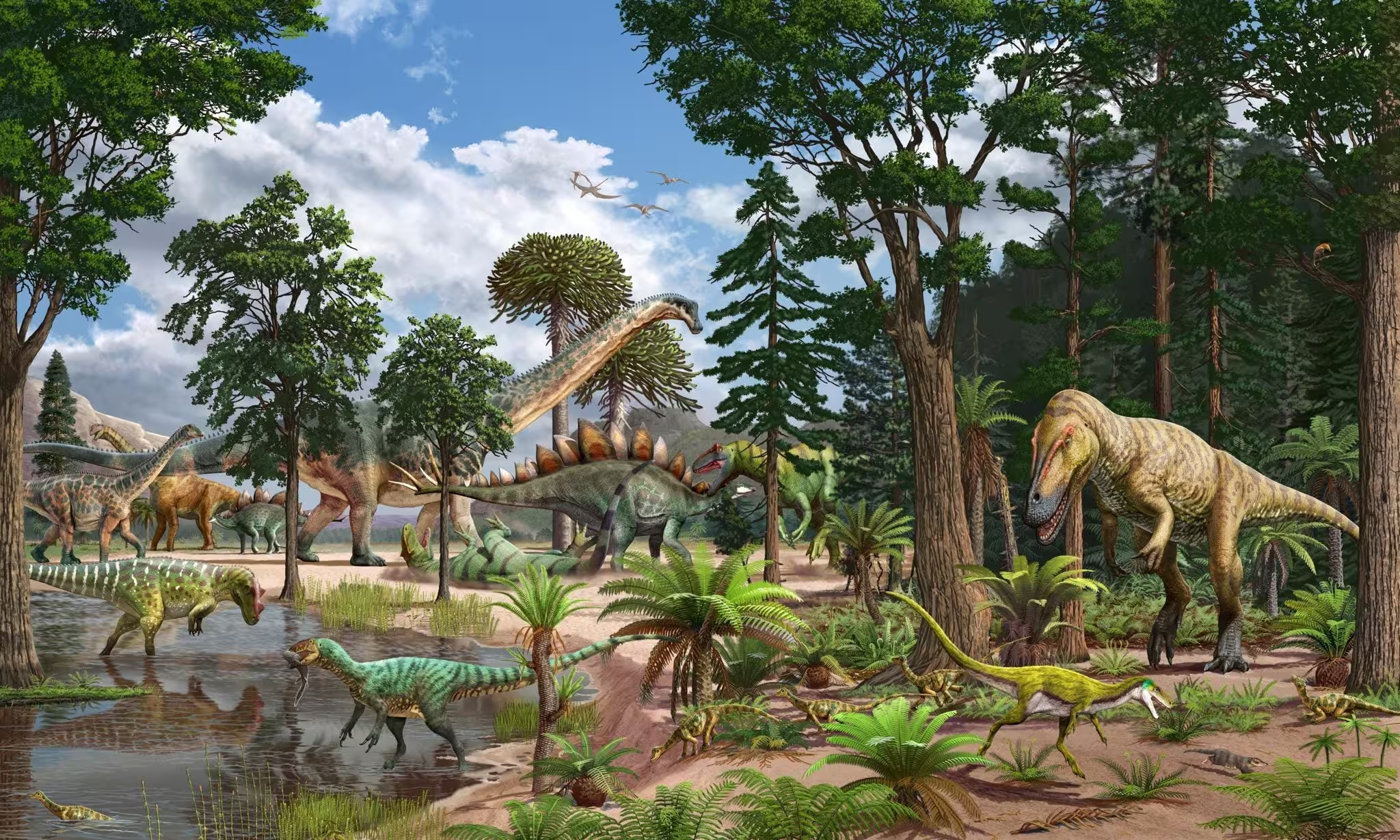
Fossils from the Dry Mesa Dinosaur Quarry in Colorado act like a time-lapse photograph. Deposited over roughly 10,000 years and preserved within the Morrison Formation, this site holds bones from several sauropod species—Diplodocus, Brachiosaurus, Apatosaurus among them—alongside the theropods and stegosaurs that shared the landscape. From those remains, researchers stitched together a surprisingly detailed food web that reveals who ate whom and why juveniles mattered more than previously thought.
How do you reconstruct an ecosystem that’s 150 million years gone? Multiple clues. Body size tells part of the story. Tooth wear patterns betray diet and feeding style. Chemical signals, like stable isotopes trapped in bone, can point to trophic roles. On rare occasions, fossilized gut contents capture a last meal in amber-like clarity. The team combined these lines of evidence with network-analysis software commonly used for modern ecology, producing a map of feeding links that reads like the menu of a Jurassic diner.
Lead author Dr Cassius Morrison of UCL Earth Sciences emphasizes the scale mismatch at the heart of the findings: adult sauropods were enormous—even longer than a blue whale—yet their eggs measured only about a foot across. That disparity, the team argues, made parental brooding difficult. Egg shells and nest structures couldn’t withstand the trampling of a giant parent. Result: many young sauropods were likely left to fend for themselves, emerging small, exposed and, crucially, plentiful.
Why juveniles became 'fast food'
It’s an uncomfortable image. But ecological systems often hinge on the easy availability of food sources. In the Late Jurassic floodplains recorded by the Morrison Formation, juvenile sauropods fit that role perfectly. Their size and abundance created a stable resource base for medium and large theropods. Predators like Allosaurus and Torvosaurus could afford to be injured and still survive—wounds seen in fossils suggest many recovered from serious trauma—because replacements for lost energy were never far away: a clutch of hatchlings, a lone juvenile, a straggling yearling.
Comparisons to modern analogues are useful. Sea turtles and some ground-nesting birds leave hatchlings unprotected; mortality is high, but sheer numbers compensate. Sauropods may have followed a similar life-history strategy: produce many small offspring, accept high juvenile mortality, and rely on long lifespans and prodigious size in survivors to maintain population numbers. That strategy reshaped predator behavior. Rather than hunting individually large, armored prey, many Jurassic theropods could specialize in snatching juveniles, a low-risk, high-reward tactic.
Quantitatively, the reconstructed network places sauropods at the center. They connected broadly to plant resources—consuming a range of gymnosperm and fern growth typical before flowering plants rose to dominance—and fed a diversity of carnivores. Other herbivores, like the plated Stegosaurus, were less central: better defended, more solitary, and therefore less frequently targeted as easy meals.

Implications for predator evolution
Jump forward roughly 70 million years. By the Late Cretaceous, ecosystems looked different. Fewer abundant juvenile sauropods meant predators could no longer rely on a steady stream of small, defenseless meals. This scarcity placed new selective pressures on carnivores. Bite force, sensory acuity, and body robustness became more important. In this light, the brutal skull and neck anatomy of Tyrannosaurus rex reads not only as an offensive toolkit but as the product of ecological change: larger, more dangerous prey demanded more powerful hunters.
Co-author William Hart of Hofstra University points to fossil pathologies to underline the contrast. He notes that earlier theropods often show healed injuries consistent with risky hunting tactics, but an abundance of juvenile prey would have softened those pressures. As juveniles became rarer, predators that could overpower thickly defended adults—horned ceratopsians or armored ankylosaurs—gained an advantage. In other words, the menu drove morphological innovation.
Methods: from teeth to networks
The study’s methodological mix is notable. Stable isotope analysis, for example, compares ratios of elements such as carbon and oxygen preserved in bone apatite; those signatures can separate browsers from grazers, freshwater feeders from terrestrial ones, and place an animal within a trophic ladder. Tooth microwear reveals whether teeth were slicing flesh, crushing bone, or cropping vegetation. Combining these datasets with spatial and taxonomic occurrence from the quarry allowed the team to build weighted feeding links—probabilities, not certainties—then simulate the network to see which nodes mattered most.
Such simulations make it possible to compare ecosystems across time. If one food web is dominated by abundant juvenile prey and another by fewer, better-defended herbivores, the models highlight the different evolutionary pressures that would follow. That comparative approach is a powerful addition to paleobiology: it moves the field beyond listing taxa toward understanding functional roles and long-term dynamics.
Expert Insight
'This study reframes how we think about Mesozoic landscapes,' says Dr Elena Vargas, a paleoecologist at the Natural History Museum who was not involved in the research. 'It’s tempting to imagine sauropods as invulnerable titans; the data show a more nuanced reality. Juveniles were ecological linchpins. Their loss or decline could cascade through the system, ultimately influencing predator morphology and population dynamics.' She adds, 'Using modern network tools on fossil assemblages opens a new window on ancient life—one that connects bones to behavior, and individual life histories to macroevolutionary trends.'
Beyond academic interest, the work offers a blueprint for future studies. By applying similar methods to other formations and time intervals, paleontologists can test whether juvenile-driven food webs were a local quirk or a common pattern, and how changes in reproductive strategies shaped the rise and fall of different clades.

In the end, the image stays: tiny sauropods, innumerable and precarious, supplying the energy budgets of a Jurassic world. Predators prowled floodplains not for giants, but for the easy meals that kept their species alive. Evolution, as ever, is a story of trade-offs—one generation’s abundance becomes the next generation’s pressure to change.












Leave a Comment
Comments (2)
Is this even true? Sounds neat, but how do they know hatchlings were that common vs taphonomic bias? Skeptical, curious.
Wait... dinosaur babies the size of plates? Mind blown, but also kinda sad. Nature's brutal math. Could nesting behavior vary though? curious about egg shell evidence.