

5 Minutes
You can run until your legs refuse, but your blood might quit sooner. That blunt image comes from a new study that tracked elite runners across two very different events: a roughly 40-kilometer race and the punishing Ultra-Trail du Mont Blanc, a 171-kilometer test of endurance. The researchers found that as distance—and cumulative stress—climbed, so did signs that red blood cells (RBCs) were aging and losing their ability to move and function efficiently.
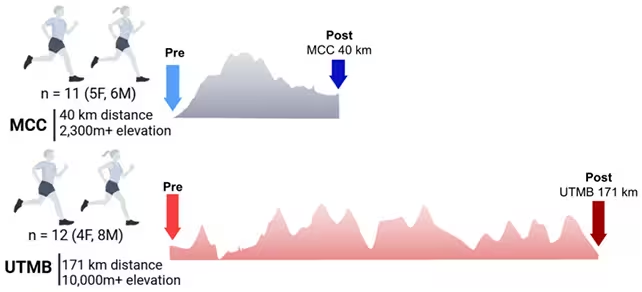
Blood samples from runners of two different races were analyzed.
Study design and key findings
The international team collected blood from 23 elite athletes before and immediately after competition. Those athletes competed either in the Martigny–Combes à Chamonix race (about 40 km) or the Ultra-Trail du Mont Blanc (about 171 km). The lab work measured many molecular markers—metabolites, lipids, and indicators of mechanical stress—to build a picture of how RBCs cope with extreme endurance.
The short version: both races produced evidence of cell damage, but the ultra-distance runners showed far greater wear. Red blood cells became less flexible. They accumulated biochemical lesions associated with faster breakdown. And one repair pathway in particular—the Lands cycle, a membrane-repair mechanism—appeared to be overstressed in the ultra runners, signaling that the body was struggling to keep pace with damage.
What does inflexibility mean in practical terms? Red blood cells must squeeze through capillaries narrower than their resting diameter. If they lose pliability, circulation suffers. Stiff cells are removed from circulation sooner, which reduces oxygen-delivery capacity temporarily. The study observed a drop in circulating RBCs only among those who ran the ultra distance, consistent with that mechanism.
Why red blood cells are vulnerable
Red blood cells are unusual. They lack a nucleus. No nucleus means no new protein synthesis and a limited ability to repair internal damage. They age and are recycled by the spleen and liver. When mechanical strain and molecular stresses pile up—oxidative reactions, lipid breakdown, membrane disruptions—RBCs can't patch themselves the way nucleated cells can.
That makes endurance stress especially relevant. Muscles adapt. Tendons adapt. Red blood cells? Not so much. The researchers argue the pattern looks like a stress-versus-repair imbalance: at a certain threshold of duration and load—somewhere between marathon-length efforts and 100-mile races—damage accumulates faster than the body can restore normal function.

Lead investigator Travis Nemkov of the University of Colorado Anschutz framed it plainly: "We don't have guidance as to whether people should or should not participate in these types of events. What we can say is, when they do, that persistent stress is damaging the most abundant cell in the body."
Another striking element of the paper is an unexpected parallel to transfusion medicine. The biochemical lesions measured in ultra-runner RBCs resemble those that develop when donor blood is stored for transfusions. Angelo D'Alessandro, coauthor and biochemist, suggested this similarity could be useful: extreme exercise may serve as a controlled human model to test interventions aimed at preserving cell function during storage.
Interpretation, limits, and what we still don't know
Important caveats apply. The sample was small—23 athletes—and the two races differed in many ways besides distance: pace, altitude change, temperature, and terrain. That complicates direct cause-and-effect claims. Likewise, the study did not follow participants long term, so whether these acute changes translate into lasting damage—or whether full recovery occurs within days or weeks—remains unknown.
There is also context from prior research: elite endurance athletes often enjoy longer lifespans and cardiovascular profiles that outperform the general population. So acute cellular stress during a single event does not automatically mean worse long-term health. Still, showing that a common, abundant cell type can be pushed toward accelerated aging in response to extreme exertion raises useful questions for both sports medicine and transfusion science.
Future investigations should track larger cohorts, include intermediate distances to find the tipping point, and map recovery timelines. They should also test whether interventions—nutrition, pacing strategies, or pharmacological approaches—can blunt the membrane and metabolic damage that the study documents.
Expert Insight
"We tend to think of endurance effects in terms of muscles and joints," says Dr. Lena Morales, an exercise physiologist who was not involved in the study. "But blood is the literal delivery system. Small deficits in red cell deformability can amplify into reduced oxygen availability in peripheral tissues during repeated bouts of stress. Monitoring these changes could help athletes optimize recovery and reduce short-term performance loss."
She adds: "If the parallel with blood storage holds up, we might see cross-disciplinary benefits—better transfusion products and better athlete care. That kind of translational insight is exactly what you want from human studies that look messy but tell a deeper physiological story."
This work lands where sports science and cellular physiology meet. It does not proscribe activity; rather, it points to a threshold phenomenon and opens paths for additional research and practical monitoring. The next step is simple in idea, hard in practice: follow more people, for longer, and ask how—and how quickly—those cells bounce back.

Run the distance if you choose. But maybe check your blood afterward. Science has just reminded us that not everything bends as patiently as the human spirit.

Leave a Comment
Comments (2)
Is this causal or just correlation? small sample, many confounders... altitude, pace, sleep? curious if recovery is complete tho
wow that image of blood quitting is wild. didnt expect RBCs to 'age' so fast in ultras. scary but fascinating, athletes might wanna check labs