
4 Minutes
Have you noticed how some risks only become visible when the lights go down? Menopause is one of those slow-shifting nights: the obvious changes fade into the background while subtler ones — chemical shifts inside the brain — quietly rearrange the furniture.
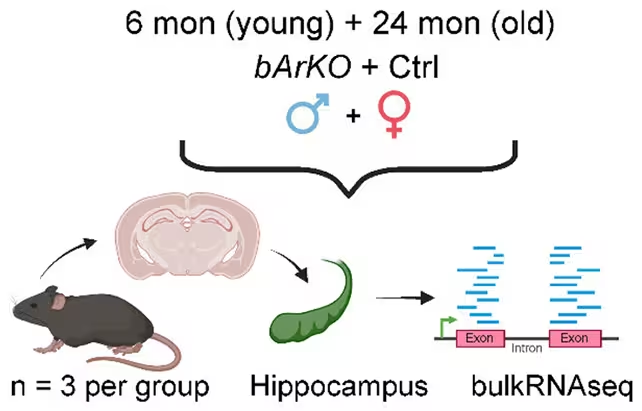
A new mouse study from Northwestern University is turning one of those subtle shifts into a sharp lead. Researchers engineered male and female mice that could not produce estrogen either throughout the body or specifically inside the brain. The result was strikingly sex-specific: female mice without estrogen developed spatial memory deficits, withdrew socially as they aged, and even showed depressive-like behaviors from a young age. Male mice, by contrast, seemed little changed.
Why does this matter for people? For starters, almost two-thirds of diagnosed Alzheimer’s cases are in women. That imbalance has long puzzled scientists. The Northwestern team dug into gene activity in young (about six months) and old (around 24 months) mice and found that estrogen loss in females corresponded with changes in genes that also show altered activity in human Alzheimer's brains. The overlap wasn’t random. It pointed, unexpectedly, at the brain’s extracellular matrix — the meshwork that fills the tiny spaces between cells.
The extracellular matrix, or ECM, doesn’t make headlines the way neurons and glia do. Yet it acts like the scaffolding and soil at once: supporting neuronal connections, regulating how cells communicate, and guiding growth and repair. In these estrogen-deprived female mice, ECM-related genes were more active, a pattern that mirrors some gene-expression signatures found in people with Alzheimer’s.
That does not prove causation. Mice are not humans. Still, the finding reframes a familiar hypothesis: maybe estrogen’s protective effects extend beyond classic neuron-focused mechanisms and into the ECM that literally holds neural circuits together.

Obstetrician and gynecologist Serdar Bulun, one of the study’s commentators, emphasizes the stakes plainly: estrogen plays a crucial role in memory and mood for the female brain. When that hormonal support fades after menopause, the brain’s resilience may change in ways we’re only starting to understand. Molecular biologist Hong Zhao, involved with the study, suggests this should inspire focused research into how the ECM changes in post-menopausal women and whether those changes could increase vulnerability to Alzheimer’s.
The implications are twofold. First, the ECM may become a new target for therapies. If estrogen loss alters ECM gene activity in ways that make neural circuits fragile, then treatments aimed at restoring normal ECM function could be beneficial. Second, the study revives questions about hormone replacement therapy. HRT has been studied before as a potential dementia-prevention strategy, but clinical trials have produced mixed and inconclusive results. This new research adds nuance: timing, tissue-specific hormone action, and downstream effects on gene networks like those governing the ECM may all matter.
Consider timing. Estrogen levels plummet during menopause, and the timing of any hormone-based intervention appears to be critical in human studies. There may be a window when restoring estrogen helps preserve circuit function; outside that window, benefits may be limited or absent. The Northwestern mice model allowed researchers to isolate brain-specific estrogen loss, which helps separate direct neural effects from those mediated by peripheral organs.
Still, caution is essential. The altered gene activity observed in mice may not be harmful by itself. Some upregulation could reflect compensatory attempts to repair or stabilize the brain. The leap from gene-expression patterns to disease causation is long. Human brains are shaped by decades of genetics, environment, lifestyle, and chance. Not every woman who loses estrogen develops Alzheimer's, and many men do develop it.
What this study does well is point attention at a relatively neglected part of the brain and provide a plausible biological link between menopause and increased dementia risk. It ties together behavioral outcomes — memory loss, social withdrawal, depressive signs — with molecular signatures that overlap human Alzheimer’s data. That convergence is what makes the research compelling, even if preliminary.
For scientists and clinicians, the next steps are clear: more targeted human studies, refined animal models that mimic the timing of menopause, and exploration of ECM-focused therapies or refined HRT approaches that consider brain-specific effects. For the public, the takeaway is measured curiosity. There’s no immediate change to clinical practice coming from a single mouse study, but there is a stronger reason to pay attention to how hormonal life stages might influence long-term brain health.
The brain is not a static organ. It is a city of connections, and when its infrastructure shifts, so does the story of memory. Perhaps menopause is less like an ending and more like a rerouting — one that deserves attention long before the first signs of dementia appear.

Leave a Comment
Comments (2)
mice studies again? are ECM gene shifts really a smoking gun for human dementia? feels premature, need human trials, pronto
wow didnt expect ECM to be front and center. menopause suddenly feels heavier. scary but also hopeful, yikes.