

3 Minutes
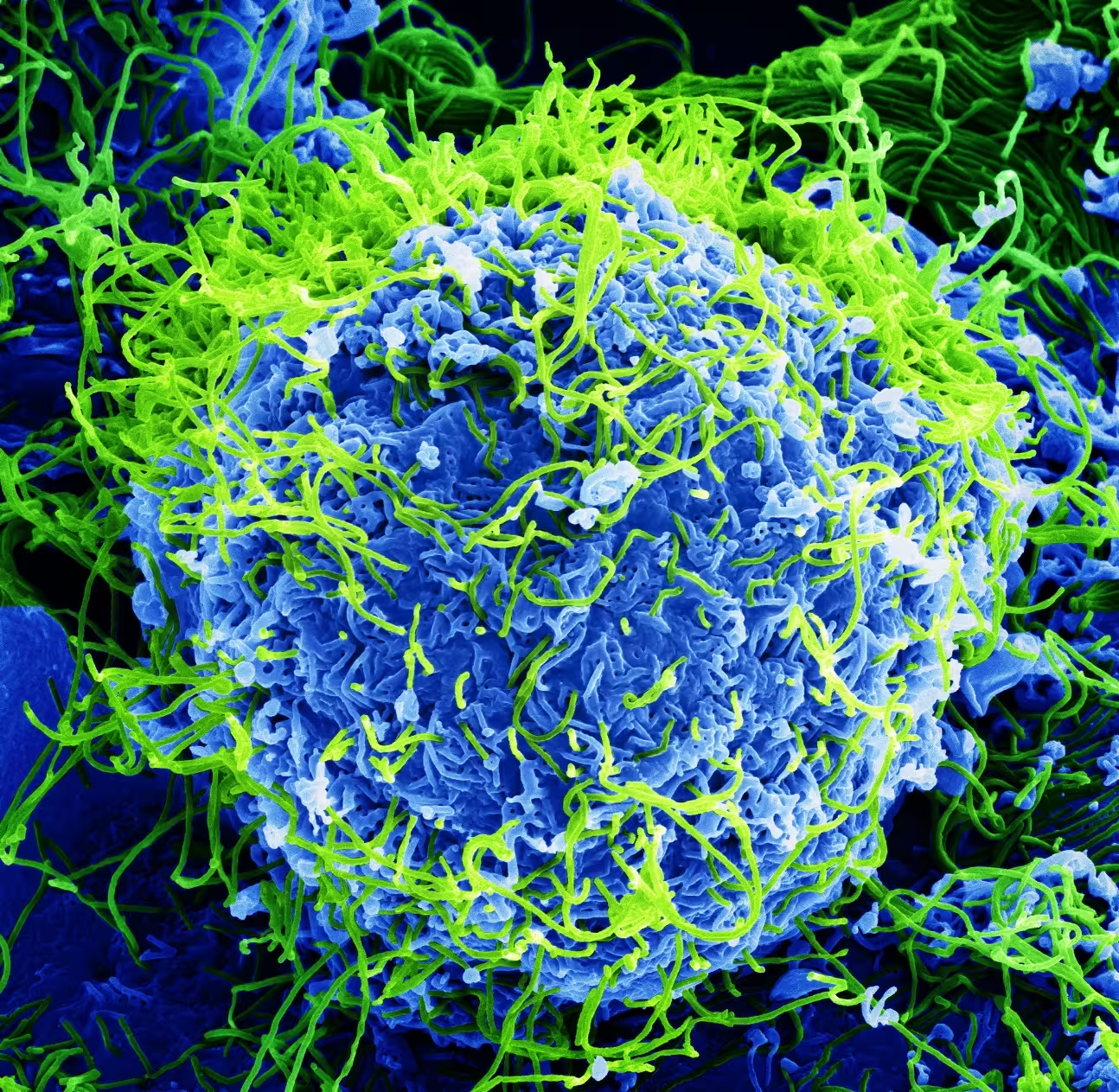
Picture a key that opens one lock but snaps in another. That’s what researchers are facing with the Bundibugyo strain of Ebola now spreading through parts of the Democratic Republic of the Congo and Uganda.
Two pieces of welcome news arrived in quick succession in early June 2026: international funders pledged up to US$62 million to accelerate vaccine development, and local authorities revised confirmed totals downward — 344 confirmed cases and 60 confirmed deaths in the DRC, and 15 confirmed cases with one death in Uganda as of June 2. Small relief. But the outbreak is far from over.
Existing licensed vaccines target a different Ebola species — Zaire — and do not offer sufficient protection against Bundibugyo. Different viral species wear different surface proteins. A vaccine built to recognize one protein may fail to lock onto another. In plain terms: we need new keys.

Three vaccine candidates have jumped to the front of the line this week. Each uses a distinct technological approach, each carries its own timeline and unknowns.
The candidate developed by the International AIDS Vaccine Initiative (IAVI), with the University of Texas Medical Branch, is a single-dose vaccine modeled on the same strategy that underlies the licensed Ervebo shot. An independent WHO expert panel called it the most promising of the three. It protected macaques in preclinical testing, but human trials have not yet begun; experts estimate clinical testing could start in seven to nine months.
Then there’s the Moderna candidate — an mRNA vaccine that encodes the Bundibugyo surface glycoprotein. Moderna’s mRNA platform proved its speed during the COVID-19 pandemic, and the company is pushing preclinical studies and human trials with the new funding. mRNA offers rapid design and manufacturing, though the cold-chain and delivery logistics that come with that technology remain practical hurdles in many outbreak settings.
The third entrant, a collaboration between the University of Oxford and the Serum Institute of India, adapts the viral-vector approach used in the Oxford/AstraZeneca COVID vaccine. Testing is at an earlier stage; WHO reviewers asked for extra animal data but suggested human trials could begin within two to three months if those data are favorable.
If any of these candidates succeed, a single dose could be enough for people who were exposed to a case, while front-line health workers and other high-risk but unexposed groups might be best served by a two-dose schedule. That nuance matters for outbreak response: a one-shot regimen is easier to deploy rapidly, but longer immunity may call for a boost.
None of this is simple. Vaccines must clear safety and efficacy hurdles, receive regulatory approvals, be manufactured at scale, and then be transported to remote and sometimes insecure locations where Ebola is circulating. Recruiting volunteers for trials is another challenge; misinformation, historic distrust and logistical barriers make enrollment difficult, especially for healthy-volunteer studies conducted far from an outbreak’s epicenter.
Still, a licensed Bundibugyo-specific vaccine would be a powerful tool — not a panacea, but a game changer. Until that day arrives, traditional infection control, rapid case finding, safe patient care and community engagement remain the backbone of outbreak containment. Watch closely: the coming months will tell whether these three contenders can turn funding and momentum into proven protection.


Leave a Comment
Comments
No comments yet. Be the first.