
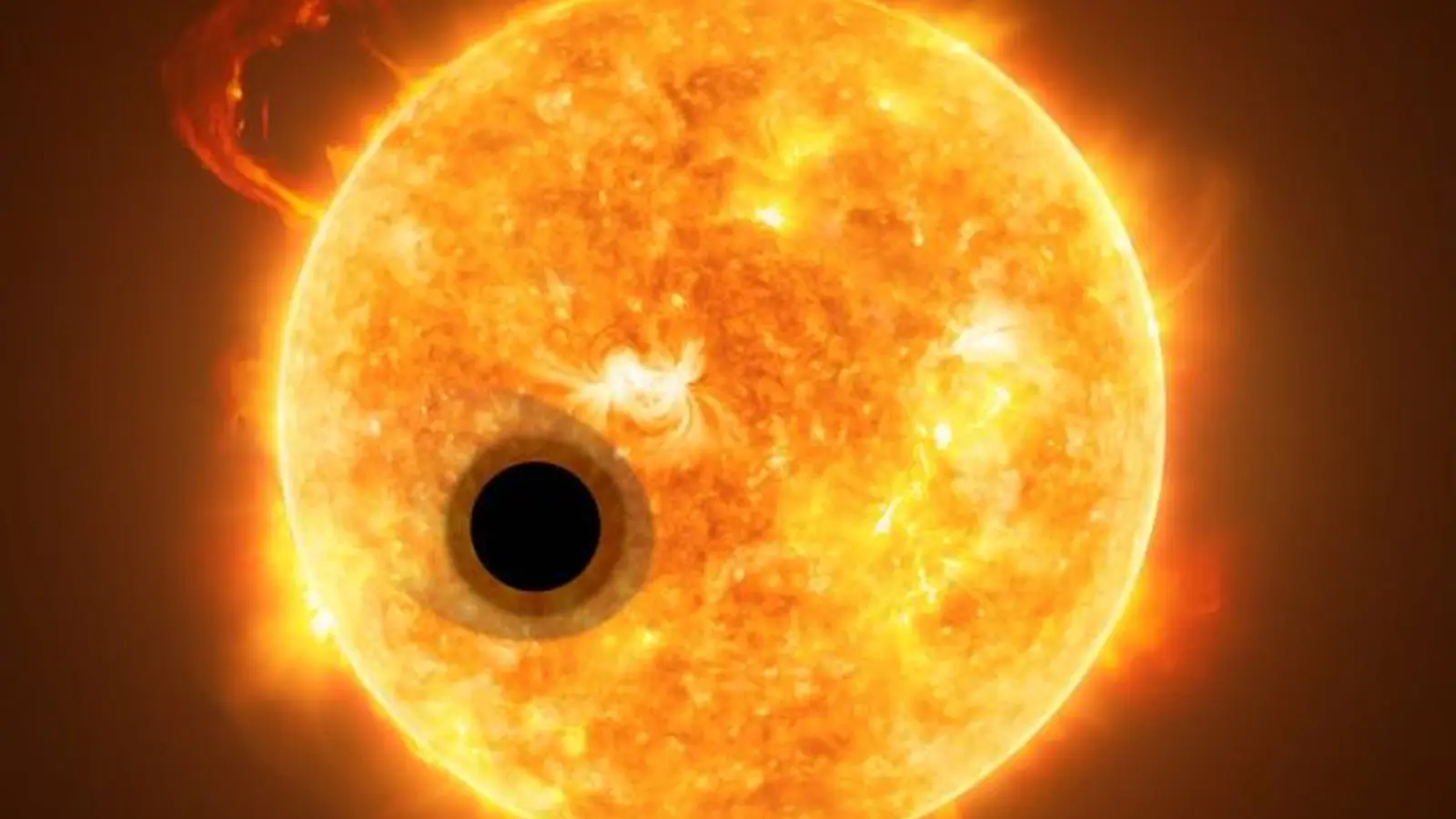
Giant planet around a white dwarf rewrites post‑stellar expectations
Astronomers using the James Webb Space Telescope have pierced the veil of a world that orbits a dead star and found something unexpected: WD 1856b, a gas giant circling a white dwarf 82 light‑years away, is far hotter and heavier than models predicted. The new measurements — published in Nature — don't just reshape how we think about planetary survival after stellar death; they also offer surprising parallels for engineers and car designers who wrestle with thermal management, longevity, and 'second‑life' applications in the automotive industry.
What the JWST saw
When WD 1856b passed in front of its white dwarf, the way starlight filtered through the planet's atmosphere produced a transit spectrum unlike anything researchers had recorded before. Most transiting planets lie entirely on the face of their host star during a transit, but WD 1856b is so large compared with its white dwarf that only part of its atmosphere overlaps the star at any instant. That geometry, combined with the white dwarf's faintness, produced an extreme transit depth — about 56 percent — lasting a mere eight minutes.

An artist's impression of WD 1856b.
The observations surprised the team in two ways: temperature and mass. Where astronomers expected a frigid gas giant with temperatures around -113 °C (comparable to Jupiter's equilibrium), JWST found an atmosphere at roughly 126 °C. Worse (or more intriguing), spectroscopic analysis and dynamical constraints suggest WD 1856b is about seven times more massive than Jupiter despite being only slightly smaller in radius.
Why this matters for the fate of the Solar System
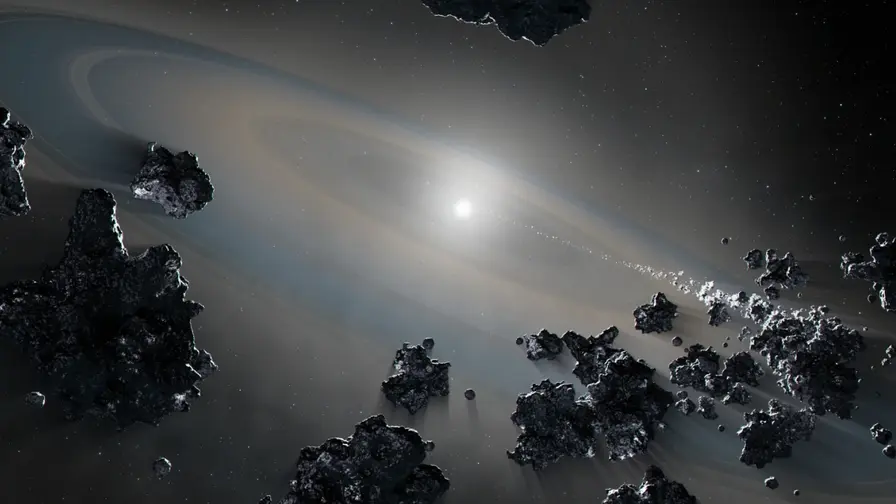
White dwarfs are the dense remnants left behind after Sun‑like stars exhaust their nuclear fuel, puff up into red giants and shed outer layers. In roughly 5 billion years, our Sun will follow this path. Understanding how planets behave before, during and after that violent transition gives scientists a window into what might happen to Earth, Jupiter and the rest of the Solar System.

An artist's impression of WD 1856b.
Key insights from the WD 1856b study:
- Giant planets can experience a 'second life' long after their star dies: heating, migration and atmospheric change can occur billions of years post‑death.
- Stellar mass loss can expand surviving planets' orbits, but secondary effects — such as tidal interactions from nearby stars — can pull planets back inward.
- The long cooling histories of giant planets act like thermal odometers: present temperatures encode the timing of past heating events.
The immediate implication is cautiously optimistic for outer Solar System worlds. Mercury and Venus will almost certainly be consumed during the Sun's red giant phase; Earth's fate is borderline and depends on subtle details of stellar physics. Jupiter and Saturn, however, are expected to survive, potentially moving outward as the Sun sheds mass. WD 1856b's history shows survival doesn't necessarily mean nothing changes — planets can be reheated and dynamically displaced later.
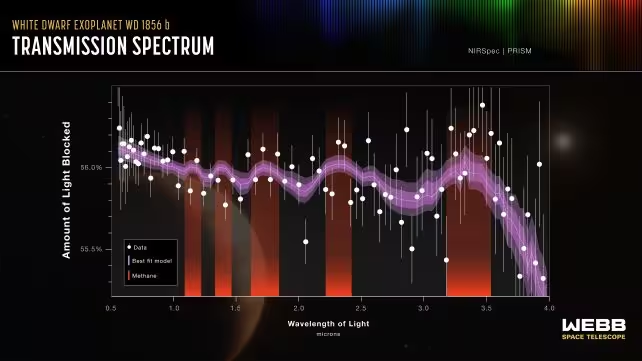
The near-infrared transmission spectrum of WD 1856b's atmosphere.
How a dead star can make a planet hot
The white dwarf at the heart of this system has been cooling for billions of years, so it couldn't have provided enough irradiation to warm WD 1856b to the observed temperature. The researchers reconstructed the planet's thermal timeline and concluded its peak heating occurred billions of years after the host star became a white dwarf. That points to an external reheating mechanism.
A plausible candidate is a nearby binary star: tidal forces from a stellar companion can inject energy into a giant planet's interior, raise atmospheric temperatures and drive orbital migration from a wide orbit into the tight configuration we now observe. This combination of tidal heating and inward migration can fundamentally alter atmospheric chemistry and physical structure, effectively giving a gas giant a dramatic second act.
Analogy for automotive engineers: thermal management and second lives
Car designers and powertrain engineers will recognize the theme. Modern electric vehicles (EVs) and high‑performance cars depend on precise thermal control. Batteries that overheat degrade faster; motors and power electronics need active cooling to sustain peak performance. WD 1856b is a natural laboratory in which timing and magnitude of heating events determine long‑term evolution — not unlike how a battery's charging patterns, thermal environment and usage profile govern its remaining useful life.
Consider these cross‑industry parallels:

- Lifecycle management: Just as a gas giant can be reheated and repurposed by its environment, vehicles can be remanufactured or repowered for a second life in new roles (fleet conversions, stationary storage). Understanding long‑term thermal and mechanical histories is critical.
- Thermal design: Planetary atmospheres preserve signatures of past heating; engineers use similar telemetry from battery management systems, coolant loops and temperature sensors to diagnose long‑term degradation and safety risks.
- Performance tuning: Tidal heating changes a planet's internal heat budget and atmospheric chemistry. In cars, software and thermal strategies tune performance and longevity — a reminder that systems are shaped by both design and environment.
WD 1856b: planetary 'specs' worth noting
To place the discovery in concrete terms, here are the observable characteristics that drove the new interpretation:
- Distance: ~82 light‑years from Earth.
- Transit depth: the largest known for any exoplanet, around 56 percent; transit duration: only about 8 minutes.
- Size: slightly smaller in radius than Jupiter but much more massive — approximately 7 times Jupiter's mass.
- Temperature: measured near 126 °C, far above the expected equilibrium for a planet around an old, dim white dwarf.
These 'specs' are evocative for a car audience: mass and size matter for dynamics, transit geometry constrains the system architecture, and temperature reveals recent environmental stressors. In vehicle terms, it's the difference between a well‑maintained sedan and a truck that's been refitted and repurposed — outwardly similar, but with a radically different internal profile.
What this means for future searches and for 'living with the dead'
The success of JWST in teasing out an atmosphere from such a challenging geometry opens a new field: post‑main‑sequence planetary atmospheres. If we can measure atmospheres around white dwarfs, the next step is to find rocky, potentially habitable worlds in those systems. Imagine a terrestrial planet orbiting a white dwarf at the right distance: a compact habitable zone, detectable atmospheric signatures and a poetic hint of life around a dead star.
For the automotive and tech communities, the broader lesson is about adaptation. Industries must design systems for longevity, for thermal resilience and for the possibility of repurposing. A car that can be efficiently reconfigured for second life — as a shared mobility vehicle, a stationary battery, or a modified light commercial unit — mirrors the planetary story: survival after dramatic change is possible, and sometimes it comes with new opportunities.
Highlights and takeaways
- JWST has provided the first atmospheric glimpse of a giant planet orbiting a white dwarf: WD 1856b is unexpectedly hot and unusually massive.
- The planet's heating history indicates significant post‑stellar processes, likely tidal interactions with a companion, that reheated and migrated the planet billions of years after the star's death.
- For the Solar System, outer planets are likely to survive the Sun's red giant phase, but their orbits and conditions could change — offering a nuanced view of planetary resilience.
'Stellar death is not the end; it is a new chapter,' one of the lead researchers summarized. For readers fascinated by cars and technology, that sentiment resonates with the growing emphasis on circular economy thinking: reuse, remanufacture and adapt systems to extend useful life.
Where science and industry meet
Astronomy rarely feeds the automotive headlines directly, but discoveries like WD 1856b do influence the mindset around engineering challenges. New materials, thermal coatings and diagnostic techniques developed for space missions often trickle down to vehicle electronics cooling, battery safety and lightweight structures. The story of a planet that gets reheated, reconfigured and kept alive by its environment is not just cosmic drama; it's a reminder that smart design and resilient systems can outlast their original conditions.

The Nature paper on WD 1856b opens both a scientific frontier and a conceptual bridge for industries thinking about longevity, thermal performance and second lives. Whether you're tracking the next EV release or imagining life on a planet orbiting a dead star, the principle is the same: understanding history matters if you want to predict the future.

Leave a Comment
Comments (3)
reminds me of refurbishing old engines, you add heat parts shift suddenley, performance changes. Not the same but same vibe, neat
Is the mass estimate solid though? 7x Jupiter sounds huge, could selection effects or tidal models be misleading? hmm
No way, a planet reheated after its star died? wild. Kinda poetic and scary, makes me think of old EV batteries getting new life..