
3 Minutes
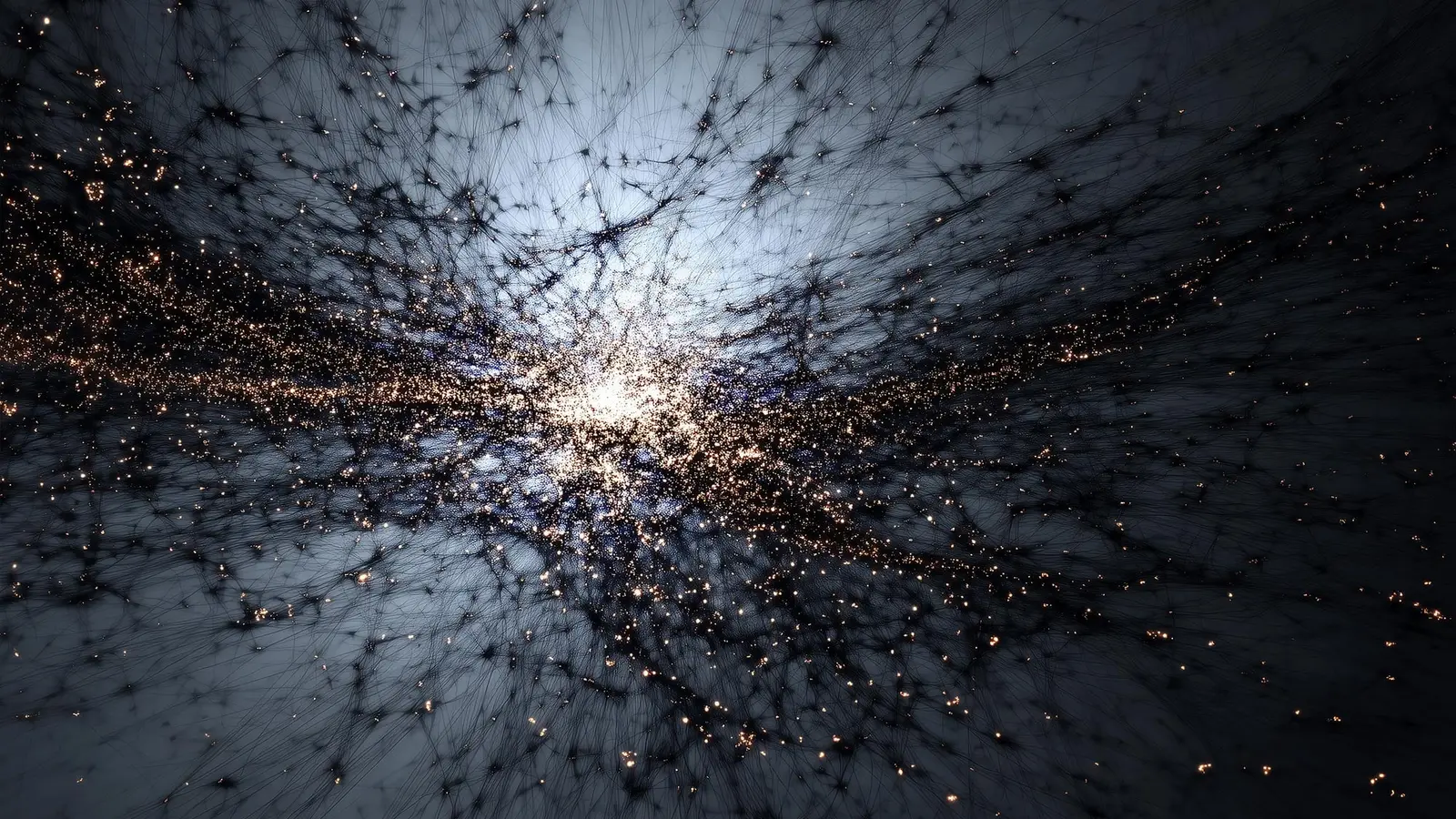
What if two invisible players in the cosmic drama have been whispering to one another all along? Researchers at the University of Sheffield now report signs that dark matter and neutrinos—both famously shy components of the cosmos—may not be as separate as textbooks assume. The finding, published in Nature Astronomy, nudges open a door to new physics.
Think of dark matter as the scaffolding of the universe: unseen, massive, and holding galaxies together. It makes up roughly 85% of the universe’s matter but refuses to reveal itself in laboratory detectors. Neutrinos are the sly cousins—almost massless, streaming through planets and people by the trillions each second with barely a whisper of interaction.
For decades, the standard cosmological framework treated these two as independent actors. But the Sheffield team took a different tack: compare how the universe looked soon after the Big Bang with how it looks now. Why? Because if neutrinos and dark matter interact, even faintly, that conversation would leave fingerprints on the way structure formed over cosmic time.

The investigators stitched together data from the cosmic microwave background—precise maps from the Atacama Cosmology Telescope and the ESA’s Planck mission—with later-time surveys that chart galaxies across the sky, including observations from the Dark Energy Camera and the Sloan Digital Sky Survey. Early and late snapshots of the universe, when read together, revealed a small but persistent mismatch in how clumpy matter appears today versus how strongly it should have grown.
In plain terms: the early-universe measurements suggest structures should have grown a bit more than what modern galaxy maps show. Not a crisis. But a nudge. The Sheffield analysis shows that interactions between dark matter and neutrinos could ease that tension, altering the pace at which matter clusters without tearing up the rest of the cosmological picture.
If dark matter talks to neutrinos, it would reshape how we search for both—pointing particle physicists toward specific properties to test in the lab and giving cosmologists a new lever to explain structure formation.
Testing this idea will fall to sharper instruments. Upcoming CMB experiments, deeper galaxy surveys and weak lensing maps—techniques that detect minute warps in distant light to reveal hidden mass—will either strengthen the case or send theorists back to the drawing board. If confirmed, the implication is simple and profound: an interaction that links the invisible threads of the cosmos, offering a clearer pathway to the nature of dark matter.
For now, the universe has handed us a clue. Will our next generation of telescopes and detectors be ready to read it?









Leave a Comment
Comments
No comments yet. Be the first.