
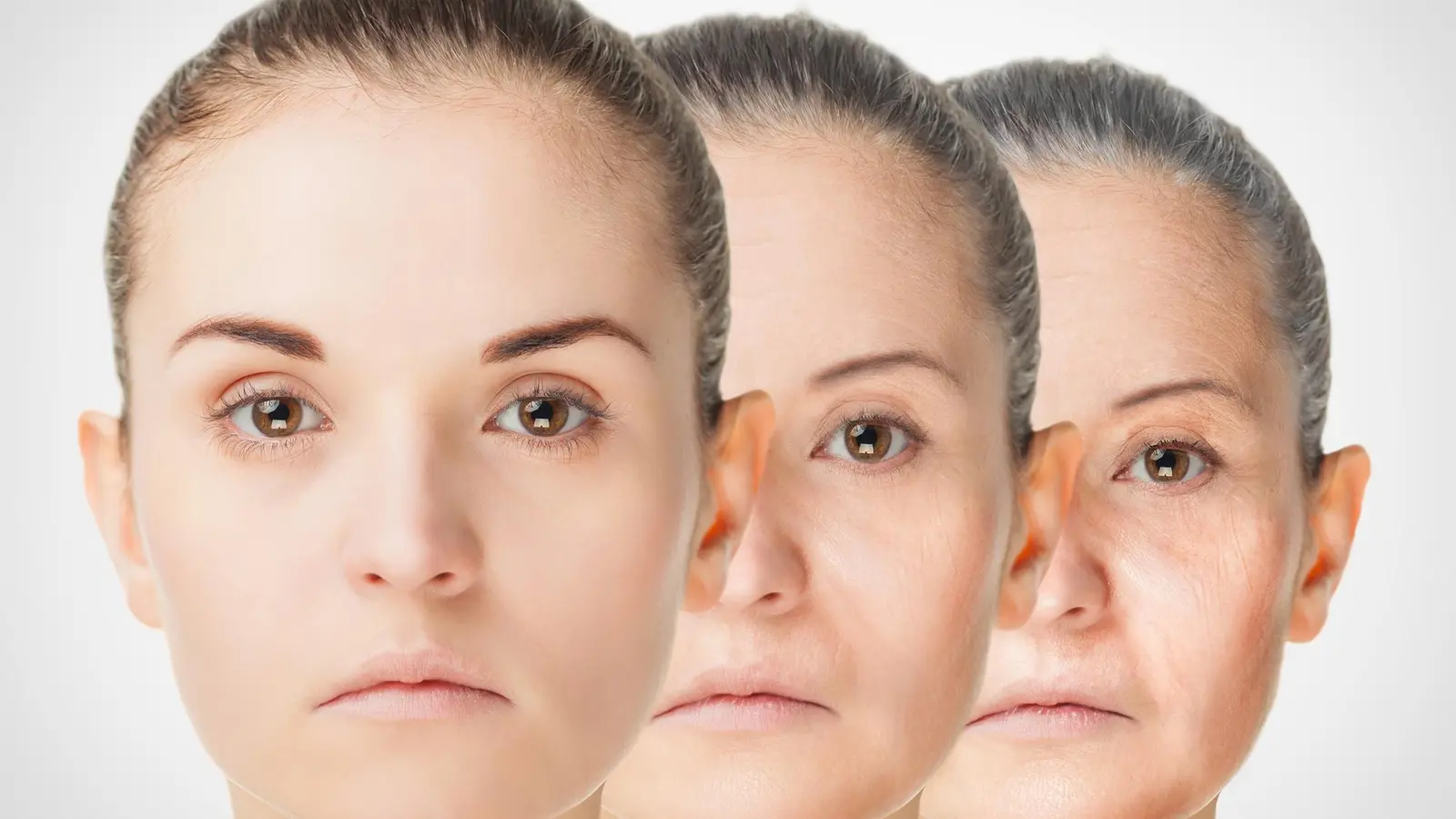
Picture a brick wall where the mortar is crumbling but the bricks still look pristine. You wouldn't notice a problem until the facade gives way. That's the image scientists now use to describe early skin aging—structural collapse that begins at a scale you can't see with your eyes.
An international team led by Hiroshima University has shown that the microscopic twist in collagen fibers—their supramolecular chirality—starts to lose coherence long before the fiber network actually thins or fragments. Their results, published July 16, 2026 in ACS Nano, suggest that skin can appear largely intact while its molecular scaffolding is quietly unspooling.
Collagen isn't just a bundle of ropes. It is a hierarchical material, organized from amino acids to triple helices to larger fibrils that knit into a supporting mesh. That ordered architecture gives skin its strength and spring. Break the pattern at the molecular level, and the tissue's mechanical behavior begins to shift even if the gross anatomy looks unchanged.

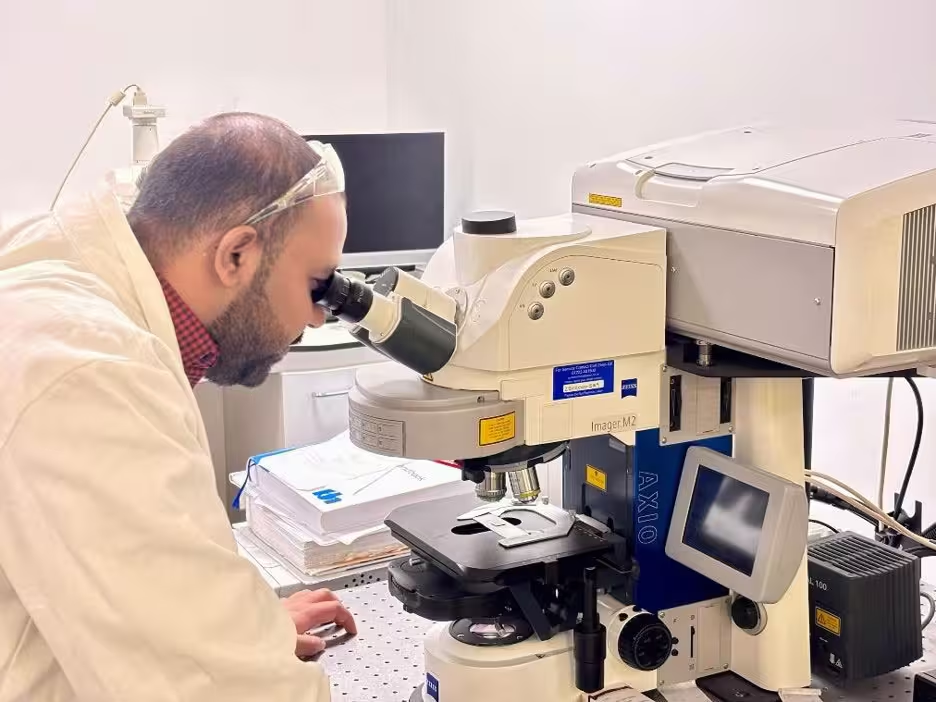
How did they spot this hidden decline? By listening to light in ways most microscopes don't. The researchers combined high-resolution optical imaging with chiroptical spectroscopy—methods that detect handedness in molecular arrangements. Two techniques were central: synchrotron radiation vacuum-ultraviolet circular dichroism (SR-VUVCD) and multi-dimensional quantum cascade laser vibrational circular dichroism (MultiD-QCL-VCD). Together, these tools reveal both how much collagen is present and, crucially, how coherently its molecules are organized within the same tissue slice.
The findings were surprising in their clarity: collagen quantity and collagen organization can fall out of step. Samples kept much of their collagen coverage while their chiral coherence had already deteriorated markedly. In plain language: the visible fiber network can remain apparently whole even as the molecular order that gives those fibers function has eroded.
Ali Haider, the study's lead author and a graduate fellow at Hiroshima's WPI-SKCM2, likens the effect to spotting changes in sentence structure before any pages of a book are torn. Katsuya Inoue, one of the corresponding authors, emphasizes that viewing collagen only as a visible fiber mesh misses the deeper, multiscale story of tissue integrity.
Why does this matter beyond a neat scientific insight? Because earlier detection of structural disarray opens new windows for intervention. If clinicians or material scientists can measure the loss of chirality and supramolecular organization, they may be able to diagnose tissue remodeling earlier, refine wound-healing strategies, and design biomaterials that restore not just mass but the correct molecular order. Instead of waiting for fibers to snap or thin, we could act when the architecture first begins to falter.
The work also reframes how researchers think about 'healthy' collagen. It's not enough to count fibers. The spatial coherence and optical signatures tied to molecular twisting carry functional information. Technologies that read those signatures could become part of a future toolkit for dermatology and regenerative medicine.
This study is an invitation to look deeper. The next questions are practical: can these chiroptical approaches be adapted for clinical diagnostics? Can treatments be evaluated by their ability to restore chirality as well as mass? The answers will determine whether early molecular alarms translate into better skin care and smarter medical interventions.
For now, the take-home is both simple and unsettling: skin can betray you from the inside out, and light may be the earliest witness.


Leave a Comment
Comments
No comments yet. Be the first.