
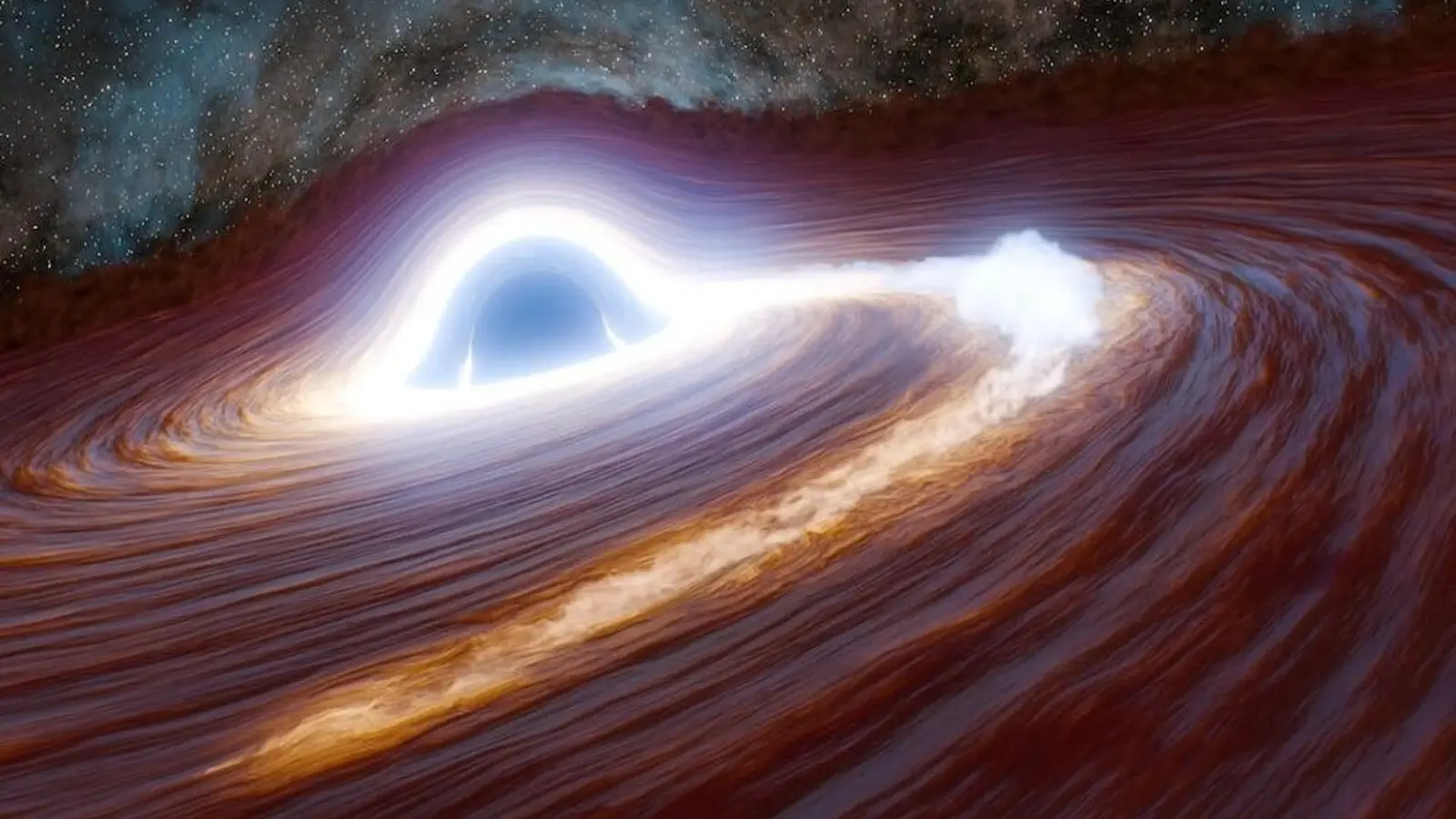
A faint, electric-blue flash at the edge of a galaxy was enough to make astronomers sit up. It arrived on October 13, 2025, and brightened over the following month, but its behavior refused to fit the usual suspects.
Automated pipelines flagged the source as a candidate tidal disruption event in early November, triggering a rapid follow-up campaign. Observatories from Chile to Hawai'i joined the hunt: the SOAR telescope, Keck, the Lowell Discovery Telescope, and NASA's Swift satellite all trained their instruments on the mystery object. The combined dataset quickly showed this was not a garden-variety supernova or routine active galactic nucleus activity.
Spectra carried a clear signature. The light was bluer than typical explosive transients and displayed broad hydrogen and helium lines, the kind of fingerprint often seen when a star is torn apart by a black hole. Temperature measurements barely budged for roughly 70 days. Supernovae age into redder light as they cool; this source did not. Swift also detected soft X-rays from the same spot, and crucially the X-ray flux dropped by about a factor of three in just four hours. Fast variability like that is odd for an exploding star, but it matches expectations when hot material swirls near a compact object devouring a star.
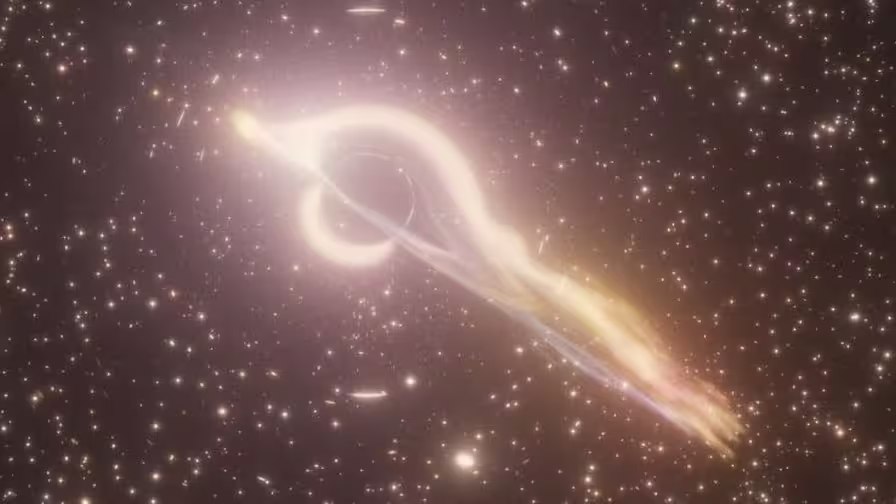
There were other absences too. The host region shows no sign of intense star formation, so a young, massive star ending its life seems unlikely. Nor did researchers find the steady radio emission, persistent X-rays, or the clear spectral hallmarks usually associated with an actively feeding galactic nucleus. Taken together, the evidence points toward a tidal disruption event—named TDE 2025abcr—where a star was shredded and its remnants briefly lit up a previously quiet black hole.

But the scene raises a new question: how did a black hole capable of producing this flare end up far from the galaxy center? By modeling the light, astronomers estimate the disrupting black hole has a mass near one million times that of the Sun. The host galaxy, by contrast, has a stellar mass of about 150 billion Suns. Given that host mass, you would normally expect a far more massive, central black hole—hundreds of millions to several billion solar masses—lurking in the nucleus. The mismatch suggests the culprit was not the galaxy's main engine.
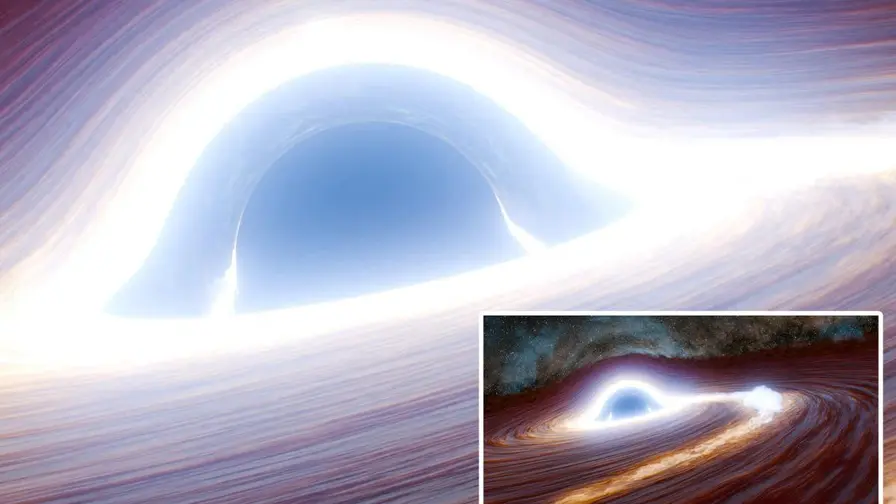
Two plausible backstories emerged. In the first, the galaxy swallowed a dwarf companion long ago. During that merger most of the dwarf's stars were dispersed into the larger system, but its central black hole survived, stranded in the outskirts and still accreting from any nearby stars. The second scenario is more dramatic: a past merger left three black holes dancing in the galactic center, gravitational interactions ejected the lightest partner, and it sailed out to the galaxy's rim where it later encountered and tore apart a star.
Archival images reveal no bright dwarf galaxy or dense stellar cluster at the explosion site, but that absence is not damning—remnants can be faint and easily hidden from current instruments. Researchers consider both the dwarf-remnant and ejection hypotheses the most likely explanations, while alternatives like a globular cluster origin or the ejection of the main central black hole fit the data less well.
If confirmed, TDE 2025abcr joins a tiny but growing list of off-nuclear tidal disruptions. Until recently, almost every optically discovered TDE was found close to its galaxy's center. A notable outlier in 2024 sat roughly 2,600 light years from its nucleus; this new event is much farther out, around 30,000 light years. Preliminary statistics suggest transients happening more than about 3 kiloparsecs, or 9,800 light years, from the nucleus might account for under 10 percent of nuclear TDE rates—but that estimate may be biased. Most surveys have been tuned to hunt flares near galactic centers, so wanderers at the edges could have been overlooked.
Why does this matter? Because dormant black holes are almost invisible until they eat. A tidal disruption is a momentary flare that betrays the presence of an otherwise hidden compact object. The discovery of TDE 2025abcr demonstrates how changing search strategies and a willingness to follow oddballs can reveal a population of roaming black holes that standard surveys miss.
Upcoming facilities will widen the net. The Vera C. Rubin Observatory will scan large swaths of sky repeatedly and is expected to find dozens of similar, off-center transients each year. NASA's Nancy Grace Roman Space Telescope will push detections to much greater distances, catching events whose light began traveling toward us roughly nine billion years ago. When Rubin, Roman, Swift and ground-based telescopes work in concert, astronomers may finally be able to census how many black holes drift in galactic outskirts.
The origin of the black hole that produced TDE 2025abcr remains unresolved, but the event itself has already done what only such flares can do: it illuminated a hidden actor on the cosmic stage and forced astronomers to rethink where black holes can hide. Will more castaway black holes show up as short-lived flares? The sky is about to tell us.

Leave a Comment
Comments
No comments yet. Be the first.