
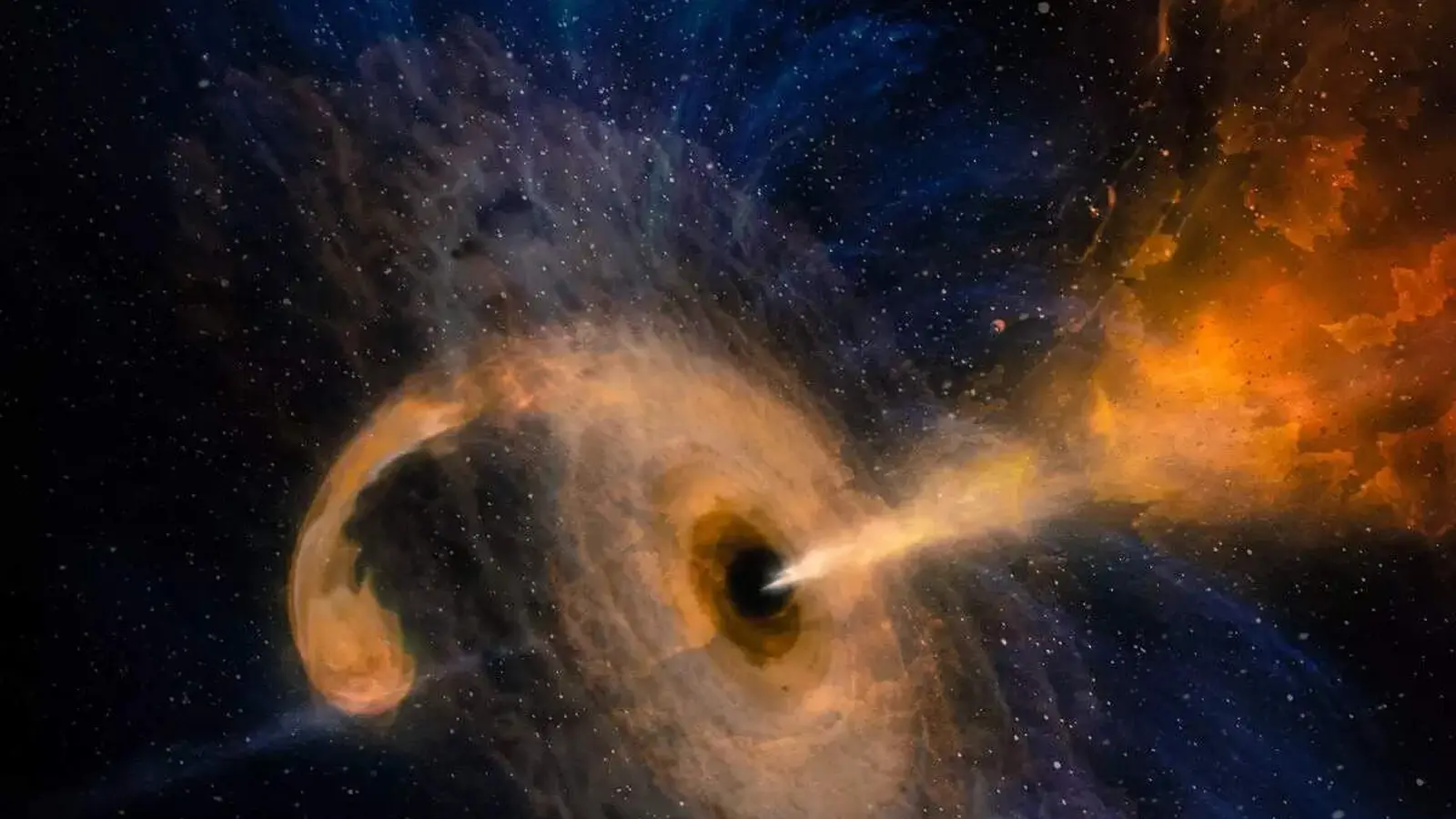
Imagine spotting a cosmic beast not where you expect—out in the galactic suburbs, not at the luminous downtown. That’s what happened when a violent stellar flare lit up a patch of sky roughly 30,000 light-years from the center of a nearby galaxy, betraying the presence of a massive black hole nobody had seen before.
The flare, cataloged as TDE 2025abcr, is a tidal disruption event: a star wandered too close to a black hole and was torn apart by tidal forces. Debris heated to searing temperatures and flashed across the cosmos. For a brief window, an otherwise invisible object announced itself in visible light.
This flare pinpoints a million-solar-mass black hole wandering some 30,000 light-years from its galaxy’s core.
Most tidal disruption events are found at galactic centers, where supermassive black holes normally sit. That made TDE 2025abcr exceptional. The discovery team at the University of North Carolina at Chapel Hill used a mix of machine learning and follow-up observations to place the flare far from the nucleus—an offset record for visible-light TDEs.

How did this black hole end up in the wrong neighborhood? There are a few plausible stories. It could be a remnant of a long-ago galaxy merger, flung away from the center when two black holes danced and recoiled. Or repeated gravitational encounters with other compact objects might have nudged it outward over cosmic time. We can’t know for sure yet, but the flare gives astronomers a rare chance to study a loner that usually sits in the dark.
Black holes don’t emit light on their own. They hide. Tidal disruption events act like cosmic flashbulbs, briefly illuminating where these hidden objects live. Researchers at UNC caught this one with the help of an AI classifier called tdescore, which was adapted to search for TDEs that occur away from galaxy centers. After the algorithm flagged a promising candidate, the Southern Astrophysical Research (SOAR) Telescope in Chile confirmed its telltale spectral fingerprints.
The finding carries two practical lessons. First, off-center black holes are real and recoverable with visible-light surveys. Second, AI-assisted searches that relax the assumption that TDEs only happen at centers can uncover unusual—and scientifically valuable—events. As telescopes collect more data, these methods will matter more.
Beyond methodology, the implications touch on galaxy evolution. Wandering black holes provide clues about past mergers, dynamical friction, and how black holes grow and move through their stellar environments. Each flare hands astronomers a snapshot of extreme gravity and accretion physics that can’t be reproduced on Earth.
Telescope projects on the horizon promise to multiply discoveries like TDE 2025abcr. The Vera C. Rubin Observatory, the Nancy Grace Roman Space Telescope, and instruments such as UNC’s Argus Array will push transient hunting into overdrive—turning rare events into routine detections and mapping black holes across much larger volumes of space.
When a star dies violently, it sometimes writes the biography of an invisible giant. Keep watching; the cosmos still has surprises hiding in its quieter neighborhoods.

Leave a Comment
Comments
No comments yet. Be the first.