
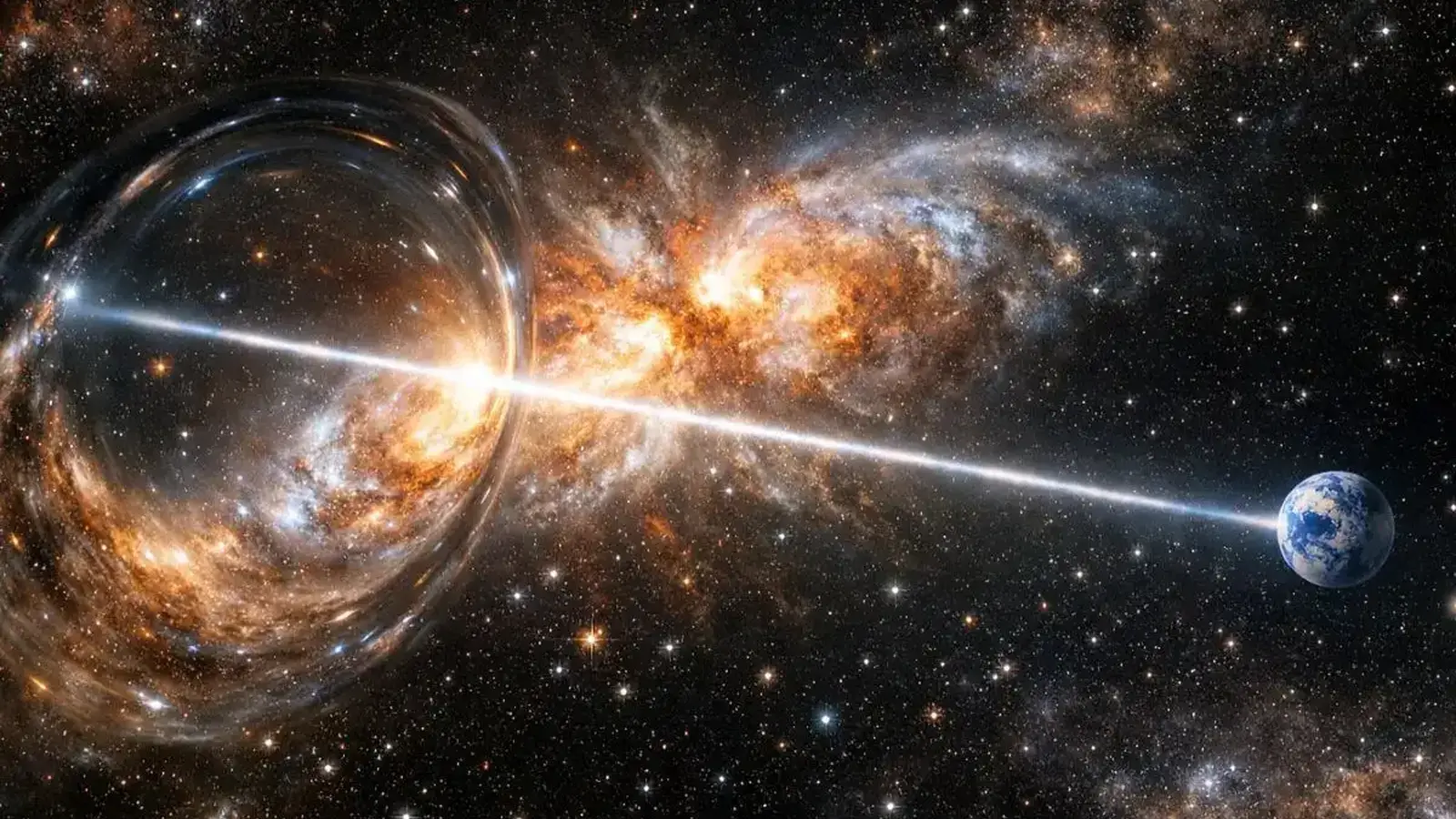
Imagine a beacon so bright it punches through eight billion years of darkness. Short sentence. Big idea.
South Africa’s MeerKAT radio telescope has caught a rare kind of cosmic laser — a hydroxyl maser blazing from a merging galaxy when the universe was less than half its current age. The signal comes from a system so distant that its light left long before our planet formed, a whisper from a chaotic epoch of collisions and furious star birth.
These hydroxyl masers are not the small, local phenomena astronomers sometimes find in nearby star-forming clouds. They’re megamasers — radio lasers amplified to millions of times the power of ordinary masers — and in this case the emission edges toward the gigamaser regime, a billion-fold amplification that turns a galaxy into a radio powerhouse. The discovery, led by Thato Manamela and Roger Deane, sets a new distance record for hydroxyl emission and expands the toolbox for studying the early universe.
How did the team spot something so faint? Two ingredients: raw sensitivity and a cosmic magnifying glass. MeerKAT’s wide frequency coverage allowed the telescope to sweep a large chunk of the radio spectrum in a single observation, catching both the hydroxyl fingerprint and neutral hydrogen absorption without needing separate pointings. Then gravity lent a hand. A foreground galaxy acted as a natural lens, amplifying the distant signal and turning an otherwise invisible source into a detectable one in just a few hours of observing time.

Illustration of the distant galaxy 8 billion light-years away (red), magnified by an unrelated foreground disk galaxy, resulting in a red ring. Splitting up the radio light into different colours, as a prism does, reveals the hydroxyl gigamaser (top-right rainbow-colored line).
Data processing did the heavy lifting behind the scenes. MeerKAT pours out gigabytes every second. The Inter-University Institute for Data Intensive Astronomy (IDIA) used high-performance pipelines to remove interference, calibrate the array and extract the faint spectral line buried in noise. Think of it as polishing a long-buried gem: trillions of calculations, supercomputers working for days, and suddenly a clean spectral trace emerges.
This detection proves we can now eavesdrop on extreme, heavily obscured star-forming environments billions of years in the past.
The scientific payoff goes beyond a neat record. Hydroxyl megamasers are tightly linked to galaxy mergers and the furious, dusty star formation those collisions trigger. That matters because merging galaxies often host pairs of supermassive black holes that will eventually spiral together and stir the fabric of space-time. Finding and cataloguing distant megamasers gives astronomers a way to pinpoint the environments where these dramatic finales begin.
There’s also a technological preview here. If MeerKAT can detect such a signal in a handful of hours — aided by lensing — then systematic deep surveys will likely turn these one-off finds into a statistical population. The upcoming Square Kilometre Array Observatory (SKAO) and complementary arrays like the next-generation Very Large Array (ngVLA) will broaden that reach, each covering different radio frequencies and together mapping the radio sky with unprecedented depth.
On a geopolitical note, this discovery underscores South Africa’s growing leadership in data-intensive radio astronomy. MeerKAT is already a world-class instrument; paired with local expertise at institutions like IDIA, it’s enabling discoveries that shape international projects and training a generation of astronomers fluent in both signals and software.
There’s a final, enticing twist: every new distant megamaser is a time capsule. We don’t just measure brightness or frequency; we reconstruct conditions in dusty galactic hearts when the cosmos was young. Each detection peels back a layer of hidden star formation and black hole growth that optical telescopes struggle to see. Keep listening — the radio sky still has loud secrets to tell.


Leave a Comment
Comments
No comments yet. Be the first.