
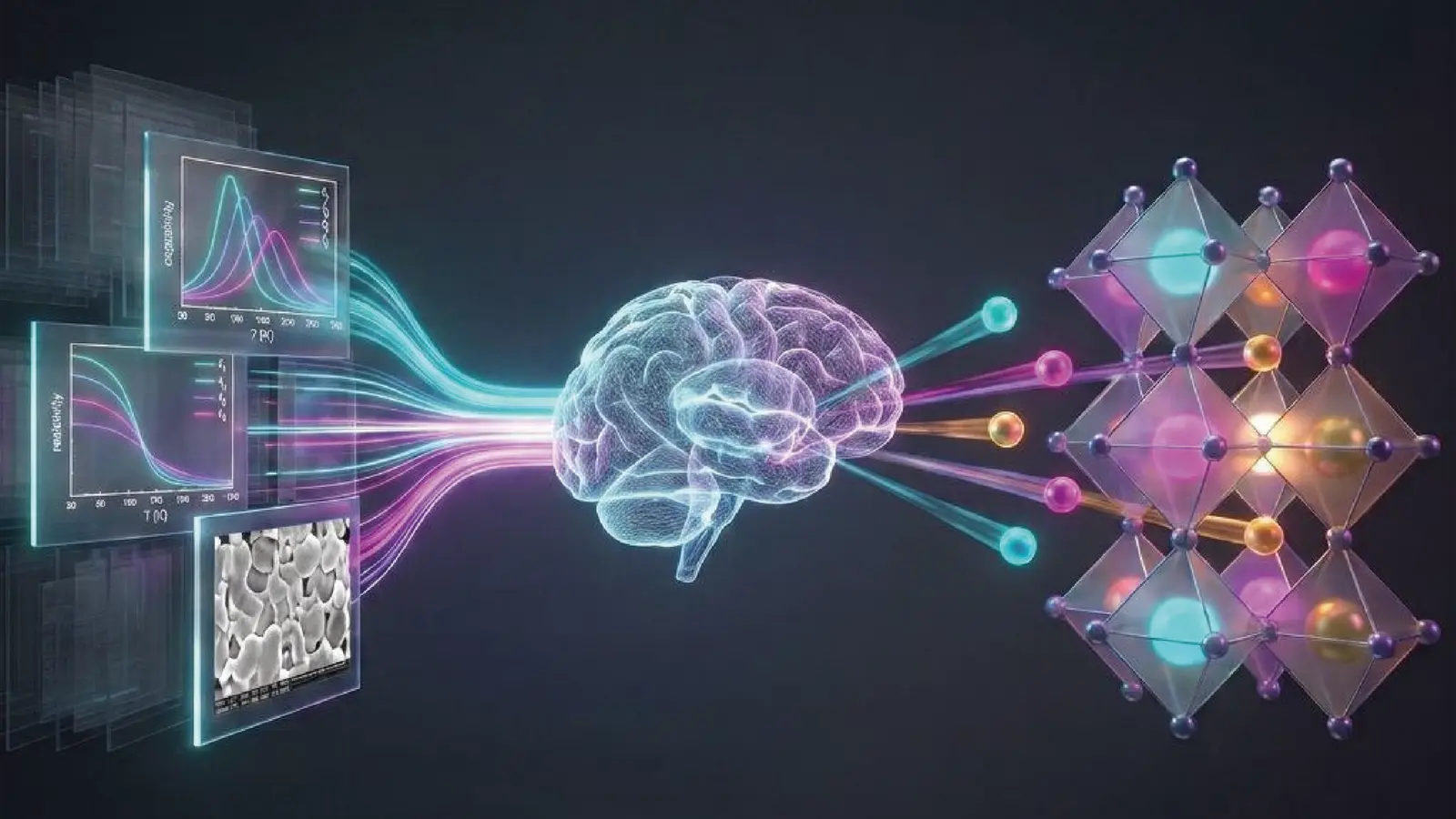
Imagine sifting through 150 million possible chemical mixes by hand. You would likely give up, or hire a small army of PhD students. The team at Seoul National University did something better: they taught machines to read the literature and think like materials scientists.
What looks like a numbers game is really a data-integration problem. Measurements of dielectric properties—how well an insulating material stores electrical charge—are scattered across tables, graphs, and paragraphs in hundreds of papers. Conditions differ from lab to lab: temperature, frequency, sample processing. Those inconsistencies are a headache for conventional data-driven searches. So the researchers built a bridge between messy human reporting and predictive models.

They mined 448 published studies and assembled 1,202 curated records of composition, processing history, and temperature-dependent dielectric behavior. Language models pulled compositions and conditions from text and tables, while figures were digitized so temperature curves could be recovered as numbers. The dataset was then enriched with 22 physical descriptors—atomic-level fingerprints and microstructural markers that make apples-to-apples comparisons possible across disparate experiments.
What followed was an inverse design workflow: specify the performance you want, and the algorithm suggests compositions that can deliver it. Thirty independently trained models formed an ensemble that predicted dielectric strength and temperature stability simultaneously, while an agreement metric ranked candidates by how consistently the models converged on the same answer. Physics-based constraints weeded out compositions that were chemically implausible before any laboratory time was spent.
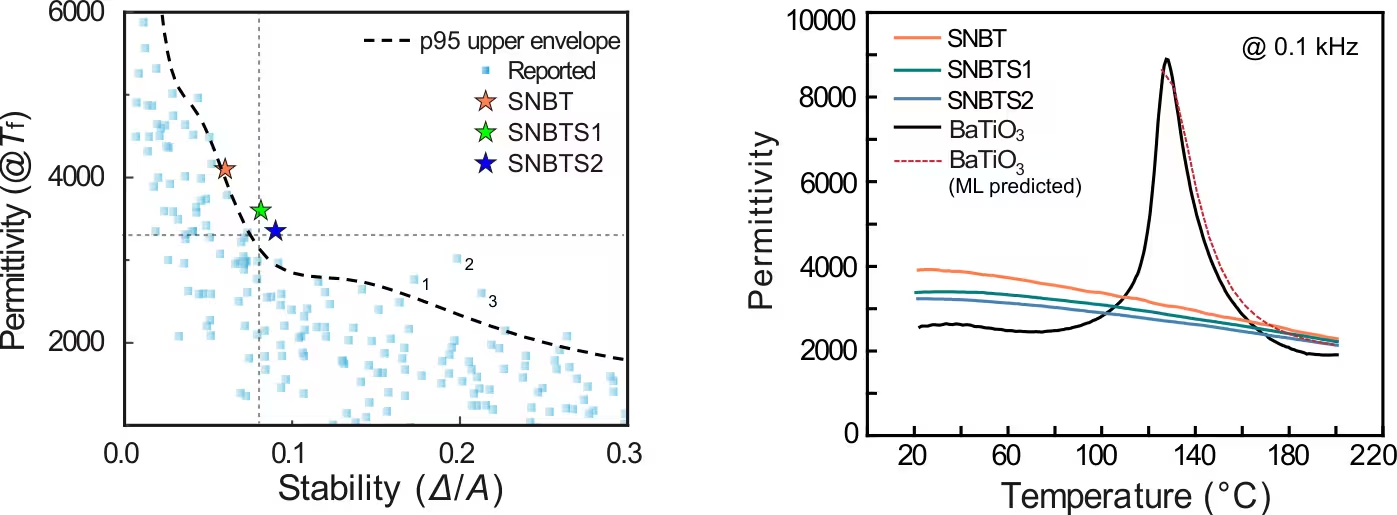
From roughly 150 million virtual compositions the pipeline flagged 37 promising candidates. The researchers refined composition ratios in the most fertile family and chose two formulations for synthesis and testing. Both contained tiny substitutions of tin—1 mol% and 2 mol%—dosed into a lead-free dielectric matrix.

The results were striking. At room temperature the materials recorded dielectric constants of 3,422 and 3,307, respectively. More important, those high values held steady across a wide temperature range rather than collapsing as heat rose—a common weakness for many high-permittivity oxides. Compared with barium titanate, a staple dielectric used in multilayer ceramic capacitors (MLCCs), the new formulations kept their energy-storage capability much more consistently up to elevated temperatures.
Both tin-substituted samples met the X5R, X6R and X7R stability standards used for MLCCs while ranking among the highest dielectric constants reported for their compositional family.
Why did a pinch of tin make such a difference? The team combined the model insights with microscopy and spectroscopy—piezoresponse force microscopy, Raman, and atomic-resolution electron imaging—and found a consistent story. Small Sn substitutions subtly expand the crystal lattice and increase electrical heterogeneity at the atomic scale. That heterogeneity appears to smear the sharp phase transitions that normally wreck dielectric performance with temperature, producing a more forgiving, stable response.

Beyond the two validated materials, the study demonstrates a practical route for turning fragmented scientific literature into a training corpus that actually guides synthesis. By merging multimodal literature mining with physics-informed machine learning and a model-agreement filter, the researchers turned an almost infinite search space into concrete laboratory targets. It’s a workflow that could apply to other functional oxides, thin films, or any material class whose useful data live across many papers and formats.
Possible beneficiaries include electric-vehicle electronics, power converters, and aerospace systems—any application that needs capacitors to survive heat without losing energy density. The study, published in Nature Communications, also showcases the human–machine partnership: researchers designed the constraints, validated the chemistry, and interpreted the microstructure; algorithms did the heavy lifting of reading, integrating, and prioritizing millions of virtual permutations.
Kwanwoo Song, who led dataset construction and model development as first author, is continuing work that applies the same machine-driven search to other electronic materials. The message from the team is clear: when machines read the scattered pages of science and engineers impose physical sense on the output, discovery accelerates. Want better materials? Feed the models good data—and then go make them in the lab.


Leave a Comment
Comments (2)
is this even true? 150M combos trimmed to 37 sounds miraculous. did they include failed data, or just positives? hmm.
wow, this is wild. machines reading papers and finding tiny tin tweaks? if that's real then… lab work just got a huge boost, but curious about reproducibility and long-term aging tests