
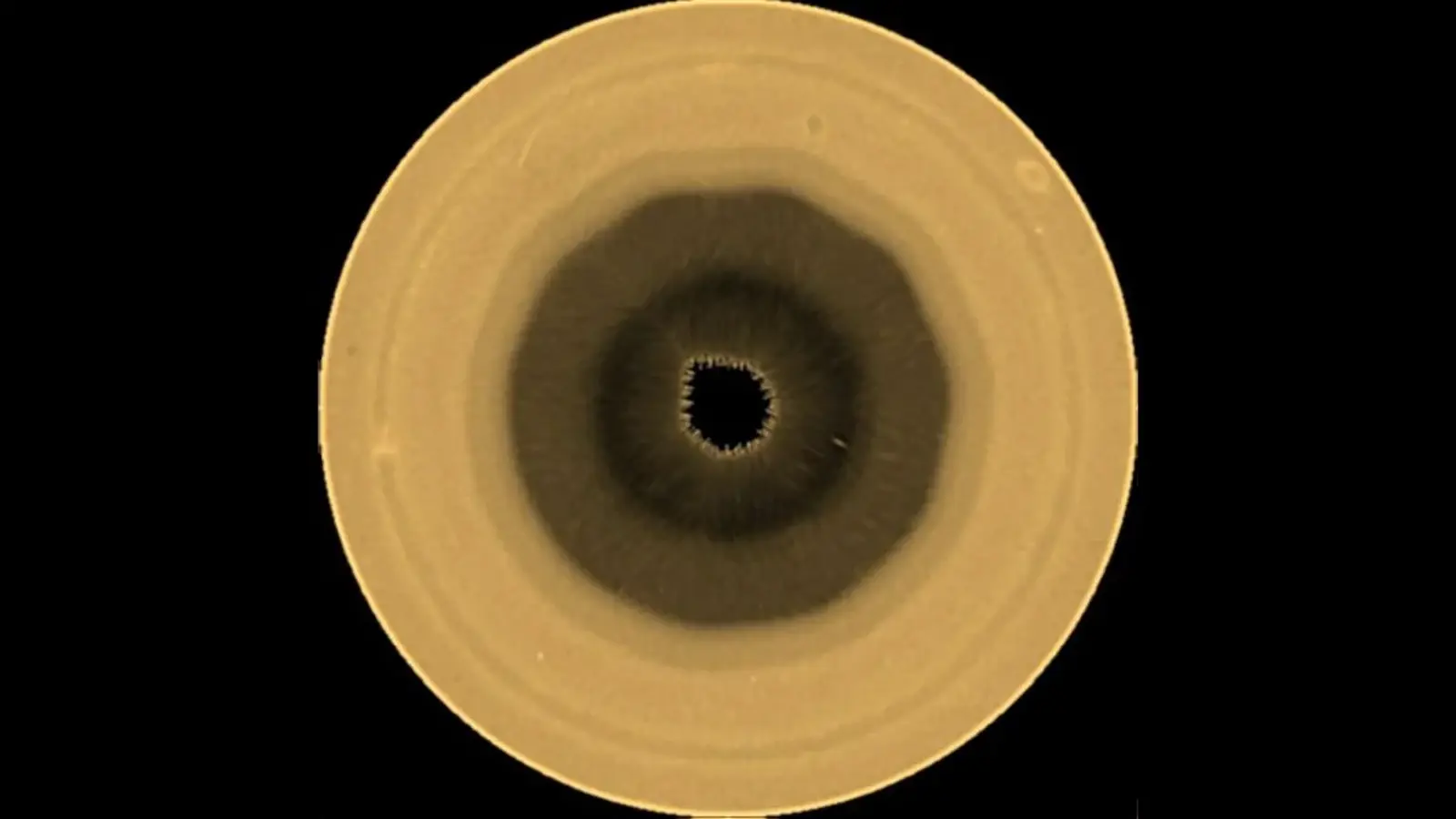

Imagine a ten-sided storm the size of a continent, quietly circling a world a billion kilometres away. Hard to picture? Now stop imagining. Astronomers have found exactly that on Saturn: a decagon—a ten-sided atmospheric wave—wrapping the planet's south pole.
The finding, led by Agustín Sánchez-Lavega of the University of the Basque Country, began not in a major lab but with backyard telescopes. Amateur observers Trevor Barry and Jean‑Paul Oger caught a wavy dark line near the south pole in 2024. When professional teams stitched those observations into polar projections, the shape snapped into focus. Hubble then filled in the details, allowing researchers to trace the pattern back to 2023.
Saturn is already famous for its hexagon, a six-sided jet stream first glimpsed by Voyager in 1980 and 1981 and steadfast for at least 44 years. The decagon differs in almost every obvious way: it sits farther from the pole—around 60 degrees south—rides a different jet, and has ten sides where the north sports six.

Hubble observations showing the emergence of Saturn's south-polar decagon between 2023 and 2025.
Think of Saturn's atmosphere as a layered, whirling cake. The decagon shows up not only at the bright cloud tops but in infrared and other wavelengths too, hinting at a vertically stacked phenomenon that threads multiple atmospheric layers together. The fast eastward jet that hosts the wave races around the planet at roughly 420 kilometres per hour. The decagon itself, however, creeps along at about 10 kilometres per hour—almost leisurely by planetary standards.
Why ten sides? Why now? Those are the fun questions. The team explored several scenarios with fluid dynamics simulations, including the influence of a nearby 4,000‑kilometre anticyclone—dubbed a Red Spot—that sits just north of the decagon. The polygon seems strongest close to that vortex and faintest on the opposite flank, suggesting a possible link. Yet none of the simulated set-ups reproduced the observed decagon perfectly.

Saturn, seen in natural color by the Cassini spacecraft in 2016. Its famous hexagon is visible around the north pole.
That mismatch is a reminder that planetary atmospheres are messy laboratories. A similar hypothesis once tied the north hexagon to a neighbouring vortex, but that vortex vanished while the hexagon endured. So cause and effect are slippery. The decagon may be born from latitude-dependent wind profiles, a neighboring storm, or some combination of background conditions we don't fully understand.
The discovery flips a long-standing assumption: Saturn may favour polygonal patterns around both poles, not just a lone, enigmatic hexagon.

Simulations of three decagon formation scenarios.
Seasonal change will be a natural experiment. Saturn tilts as it orbits the Sun every 29.5 years, and the southern hemisphere is edging toward summer. Increased solar input could strengthen or destabilise the decagon, giving telescopes an unrivalled chance to watch a planetary polygon form and evolve in real time.
Published in Science Advances, the work opens a new chapter in comparative planetary meteorology. We’ve spent decades puzzling over a single six‑sided mystery; now the planet is handing us a front‑row seat to another. Keep your eye on Saturn—this is one atmospheric performance still unfolding.

Discussion
Leave a Comment
Comments
No comments yet. Be the first.