
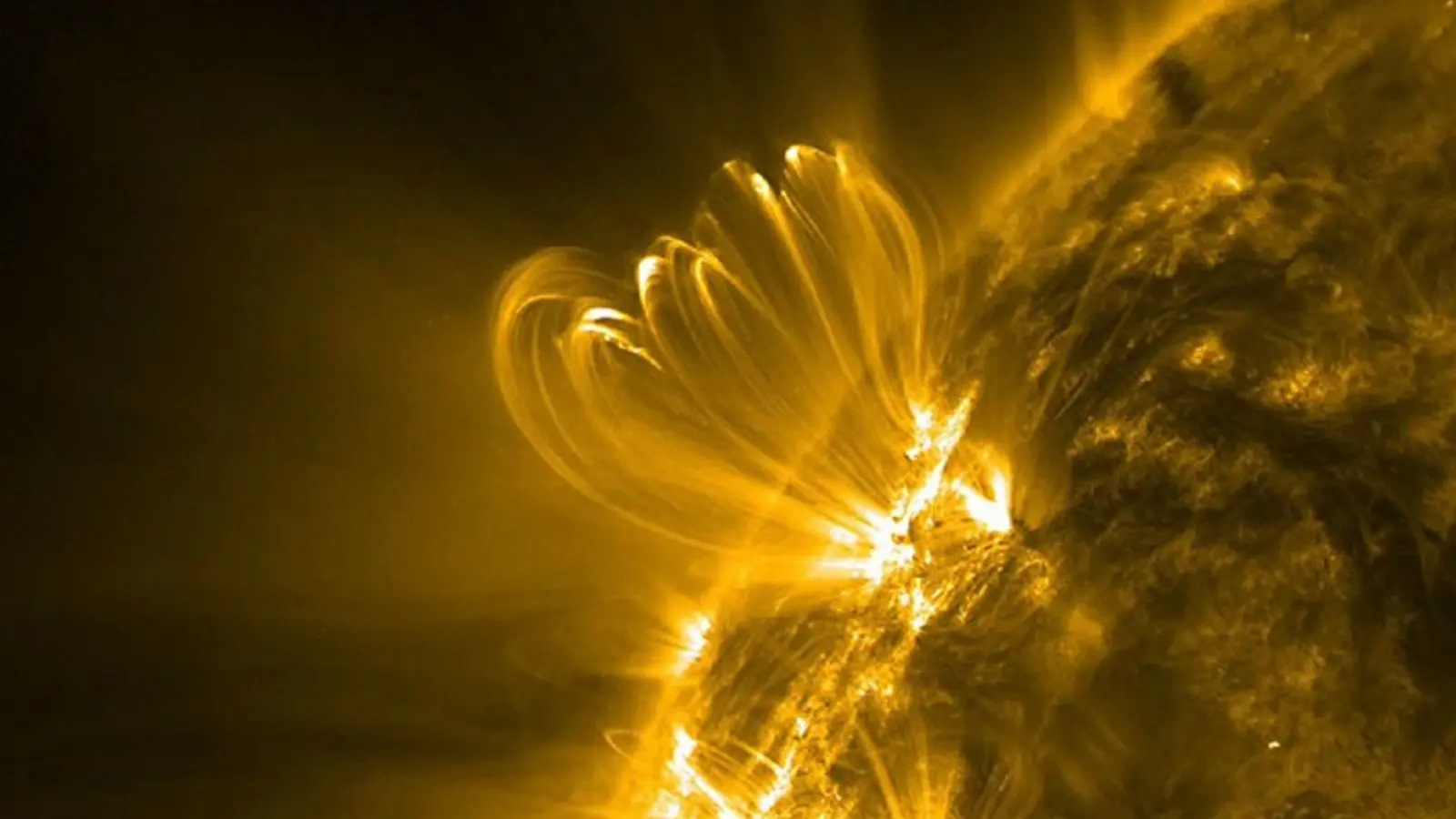
Can an algorithm hear the Sun before our eyes can? Scientists at the New Jersey Institute of Technology have trained one to do just that — to pick up the faint tremors and magnetic murmurs that herald a new solar active region hours before a dark sunspot shows itself.
The tool, nicknamed EarlyDetect, combs two kinds of solar data: subtle changes in acoustic power — the Sun’s internal vibrations recorded by NASA’s Helioseismic and Magnetic Imager — and delicate shifts in the magnetic field measured across the visible surface. Researchers fed the model years of Solar Dynamics Observatory observations, and the results surprised them. On average, the system flagged signs of emerging active regions roughly 9.24 hours before they appeared on the solar disk.
That lead time won’t make headlines like an instant warning system, but it matters. Satellite operators, power-grid managers, and mission planners are most vulnerable to sudden space weather; even a handful of hours to prepare can change outcomes. Still, detection of an emerging region is not the same as predicting an eruption. Many active regions never produce major flares or coronal mass ejections. This is an early alarm, not a guarantee.

EarlyDetect is built on a Transformer-style neural network — similar in architecture to models used for language, yet trained to recognize temporal and spatial patterns in solar signals instead of grammar. The team expected that careful pre-filtering of noisy measurements would help the model. It didn’t. Removing what researchers assumed was noise actually erased the faint fluctuations that carried the earliest warnings. A filter that calmed the data made the model less perceptive. In short: the whisper mattered.
Development was led by NJIT undergraduates and faculty in collaboration with scientists from Princeton University and NASA’s Ames Research Center. Jonas Tirona, the lead student on the project, describes the work as an exercise in listening closely — and differently — to the Sun. Alexander Kosovichev, co-principal investigator, compared the task to spotting a change of rhythm in a crowded orchestra: the signal is tiny, and the background is loud.
The researchers also prioritized openness. They published the Solar Active Region Emergence Dataset (SolARED), the first public collection focused on emergence events, and launched the Solar Active Region (SAR) Portal so others can explore the same observations. By sharing data, the team hopes to accelerate new forecasting strategies from both heliophysicists and machine-learning groups.
Performance-wise, EarlyDetect outpaced baseline methods in controlled tests using unseen events — but it is not ready for operational, real-time forecasting. The model was trained on known emergence cases and still produces false positives and late calls. It also cannot yet estimate whether an emerging region will spawn a major flare or a coronal mass ejection. More validation, and many more events, are needed before this becomes a routine space-weather tool.
The work was supported by NJIT’s Grace Hopper AI Research Institute and NASA heliophysics grants, including funding tied to studies of fields and flows inside the Sun. For now, the paper and the shared datasets represent a new waypoint: machine learning can reveal precursors the human eye and traditional methods tend to miss.
Listen closely enough, and the Sun starts to speak in a language we’re only beginning to understand — and that alone may change how we prepare for its next outburst.

Leave a Comment
Comments
No comments yet. Be the first.