
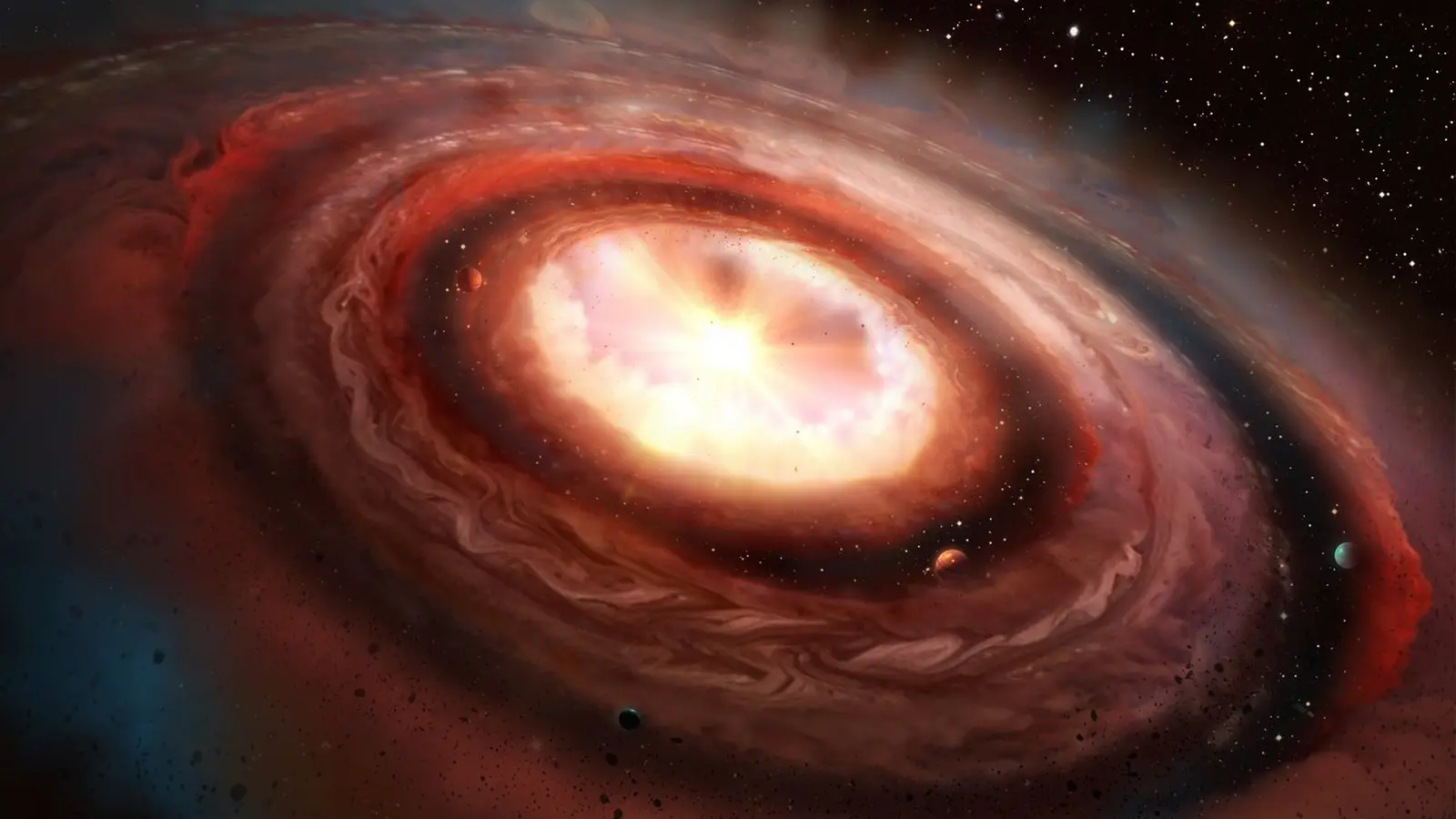
They watched a world grow. Not from a textbook diagram, but from faint light tucked inside a dusty ring 450 light-years away.
Named Elias 2-24 b, the object is a gas giant roughly the mass of Jupiter — and astonishingly young, younger than a million years. It still wears the raw material of its birth: a swath of gas and dust that feeds the planet as it carves a gap in the surrounding disk. The sight feels like stumbling on a cosmic construction site mid-build.
How unusual is this? Very. Until now, the youngest planets we could study in any detail were several million years old. Current models of planet formation struggle to explain how a Jupiter-mass planet can assemble so quickly at such a large distance from its star. Put simply: our simulations are missing moves.
The discovery emerged from careful detective work across multiple observatories. Years earlier, ALMA revealed a conspicuous gap in the protoplanetary disk around Elias 2-24. The Very Large Telescope later picked up a faint point of light inside that gap. Suspicion arose. Was it a forming planet or a mirage?
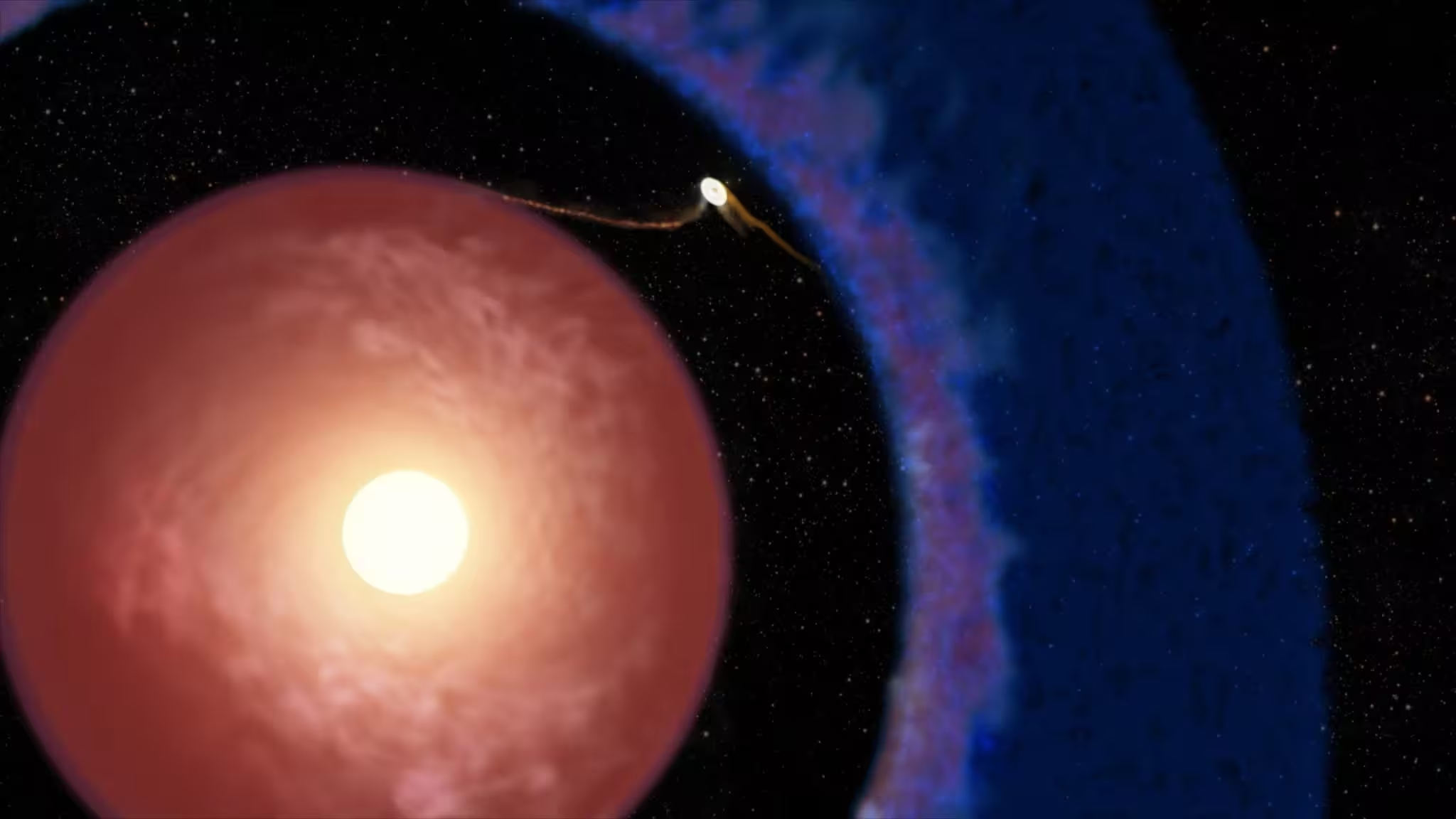
Andrea Bernardi, a doctoral candidate in Chile, and colleagues returned to archival images from the W. M. Keck Observatory. Keck’s coronagraph suppresses starlight, making dim companions easier to spot. The same faint source appears in Keck frames from 2018 and 2020. Its motion over time matches what you would expect from something orbiting the star — not a background star, not an imaging artifact. The evidence stacked up, and Elias 2-24 b earned confirmation.
Observing a protoplanet tucked inside a disk is rare. Young planets are often obscured by the very dust they accrete. Transit surveys — the method that has found the bulk of the roughly 6,000 confirmed exoplanets — tend to miss these newborn giants because they are hidden or orbit far from their stars and therefore transit rarely. Direct imaging, aided by coronagraphs, gives us a different window: the chance to see planets where they form, not just where older systems have settled.
“This object is pushing our theories,” says Lucas Cieza, a co-author on the study and professor at the Instituto de Estudios Astrofísicos in Chile. Models that explained earlier young planets already strained under the weight of observation. Elias 2-24 b demands new ideas about how gas giants accrete mass so quickly and at such distances.
The implications ripple outward. If gas giants can assemble in under a million years, planetary systems might evolve far faster and with different architectures than we assumed. Disk clearing, migration, and the eventual placement of smaller rocky worlds could all follow different scripts. Observations like this force theorists to rewrite parts of the narrative.
There is also a technological story. This confirmation was possible only because teams stitched together data from different instruments and epochs. Keck’s archive revealed motion. ALMA showed the disk structure. The VLT gave the initial hint. Collaboration matters.
And soon, instruments will make such finds less rare. NASA’s Nancy Grace Roman Space Telescope — launched recently — carries a coronagraph built to isolate faint planets even closer to their stars. Roman should be able to detect many more newborn giants and true Jupiter analogs that current facilities struggle to see. The observational gap between models and reality is about to shrink.
We are, quite literally, watching planets being born. That single image of Elias 2-24 b does more than add one name to a catalog; it opens a window onto a formative stage of planetary life that we have hinted at but rarely seen. Keep your eyes on the skies — the galaxy is still building worlds, and we are finally beginning to read its blueprints.


Leave a Comment
Comments
No comments yet. Be the first.