

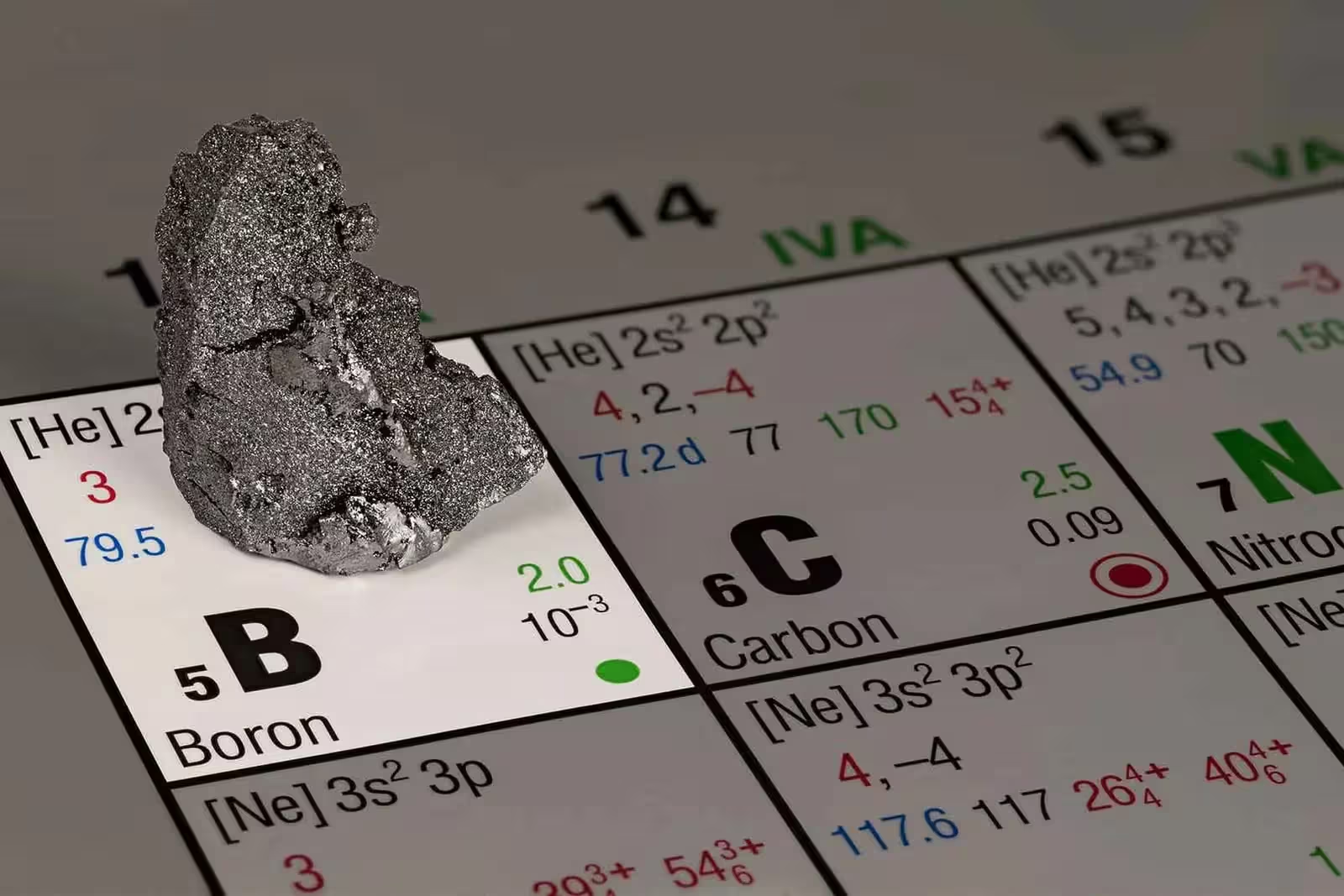
Forget everything you thought you knew about boron. Once pigeonholed as a hard, brittle oddity of the periodic table, this element has just been coaxed into a new personality: flexible, porous and astonishingly better at conducting electricity.
Researchers have synthesized a previously theoretical boron allotrope called Imma-B60 by starting with a sodium-containing precursor and carefully removing the sodium to leave a novel boron scaffold behind. The trick was both chemical and mechanical: grow Na4B60 crystals on intermediate seed layers to get large, well-ordered grains, then heat them in a vacuum furnace at about 900 °C for two days so the sodium atoms diffuse away and the boron framework survives.
The result is not the dense, diamond-like packing we normally associate with boron. Instead, Imma-B60 builds an open, cage-like network. Think of 12-atom boron cages linked by three-atom connectors—tiny rooms joined by narrow hallways. That empty space gives atoms a little wiggle room under stress, so the material can deform rather than shatter.
How much deformation? In bulk samples the new boron endured roughly 23% strain before breaking. In microscopic test pieces the number climbed to about 32%. Those figures matter because most hard, brittle materials crack long before reaching such strains. Here, porosity and topology rewire mechanical response.
Mechanical surprises are only half the story. Imma-B60’s electronic behavior departs sharply from conventional boron. Where common boron allotropes show band gaps larger than about 1.5 electron-volts—making them poor conductors—Imma-B60 has a band gap under 0.2 eV. Put plainly: electrons face a far smaller barrier.
At room temperature Imma-B60 conducts roughly 10 million times better than ordinary boron, with a measured conductivity near 900 siemens per meter.
That doesn’t turn boron into a classic metal. Instead, the material behaves like a high-conductivity semiconductor—an in-between state that could be precisely what designers seek when balancing weight, strength and electronic performance. Imagine a lightweight structural piece that also carries current; imagine new electrode architectures or components in niche electronics where density and radiation resilience matter.
Why did this allotrope behave so differently? The explanation lives at the atomic scale. The open network reduces overlap between localized electron states that normally lock electrons in place. With the cage-and-connector motif, bands broaden and the energetic gap narrows, enabling more free carrier movement at ordinary temperatures. Removing the sodium wasn’t merely a purification step; it was a structural revelation.
The work is early-stage. Imma-B60 was reported in Nature Chemistry, and practical hurdles remain before devices incorporating this boron arrive. Scalability, processing, interfaces with other materials, and long-term stability under operating conditions all need careful study.
Still, the study underscores a larger lesson: an element’s destiny isn’t fixed by its box in the periodic table. Slight rearrangements of the same atoms can flip mechanical and electronic behavior, opening pathways for materials that are both tough and electronically useful. That idea will keep materials scientists up at night—in a good way.


Leave a Comment
Comments
No comments yet. Be the first.