
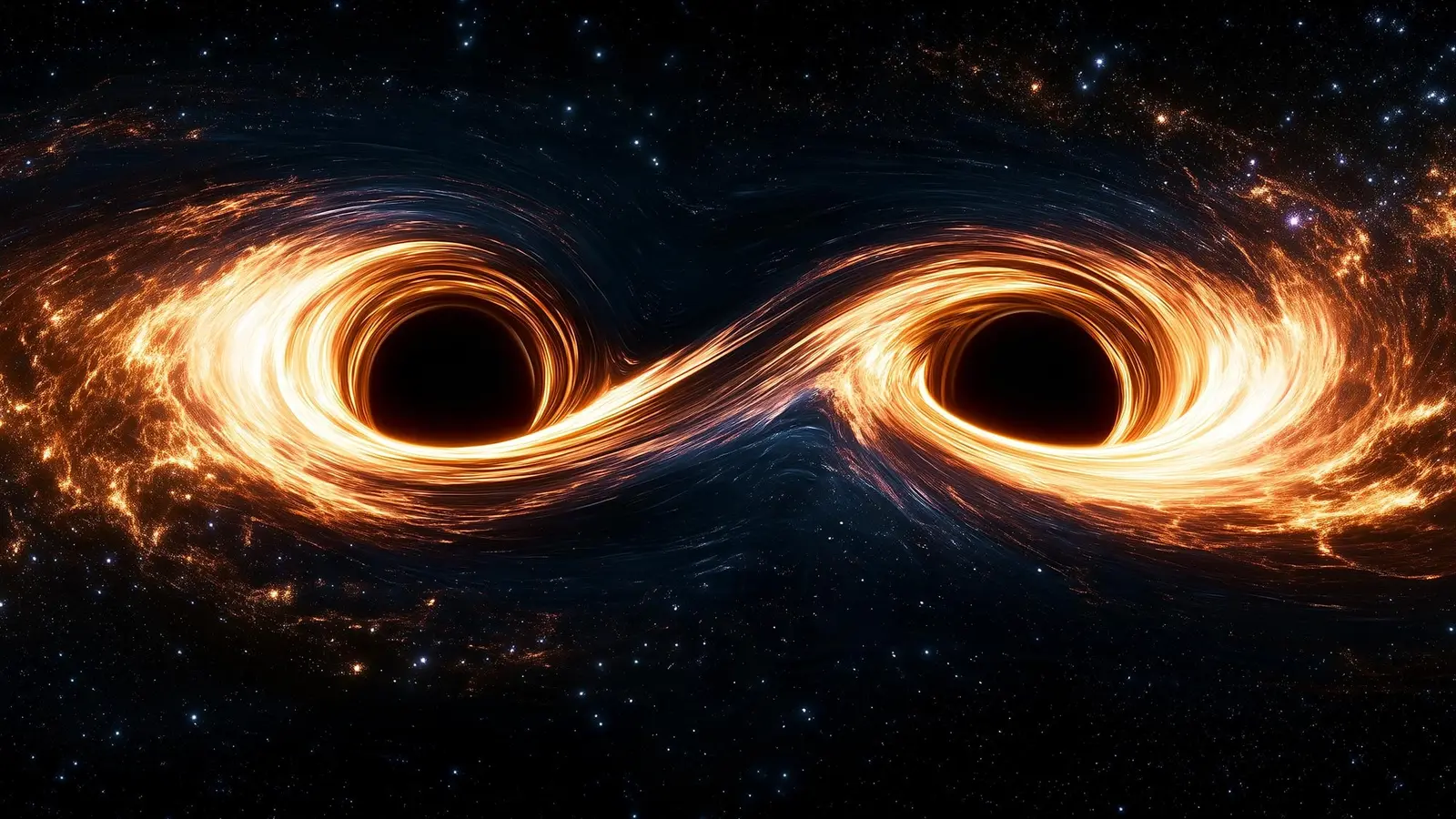
Could a black hole rip itself in two? A provocative new theoretical study says it might — but only under very particular circumstances.
We know black holes can collide and fuse into a larger single object. Reversing that process, however, runs headlong into thermodynamics. Entropy — a count of the microscopic ways a system can be arranged while appearing the same from the outside — usually blocks a solitary, nonrotating black hole from dividing into two smaller ones. The combined entropy of two smaller holes typically falls short of the original, and nature frowns upon decreases in total entropy for an isolated system.
The new paper, titled 'When Black Holes Admit Pair-of-pants Topologies,' explores what a split would look like in spacetime. Think of the event horizon tracing a pair of trousers: one waist that splits into two legs. It's a vivid image, and it helps capture the topology of a branching horizon as time marches on.
Authored by Francesco Sannino and colleagues at the University of Naples Federico II, the University of Southern Denmark, and CNRS/Sorbonne, the work asks blunt questions: which laws forbid splitting, and under what loopholes might nature allow it? The calculations reveal an intriguing possibility — rapid spin.
Illustration of black hole splitting in two creating the shape of pants.
Angular momentum changes everything. A black hole rotating near its theoretical maximum can stash extra energy and change how entropy budgets add up. Under those extreme rotation rates, the thermodynamic barrier may loosen, opening a narrow window where a split becomes allowed on entropy grounds. But there's a second hurdle: the two offspring must escape one another's pull rather than collapsing back into a single hole. Add that requirement and the safe zone shrinks dramatically, surviving only for black holes spinning very close to their extremal limits.
What about physics beyond Einstein? The team also examined higher-dimensional gravity models, where black-hole-like objects are known to fracture under instability. In some of those scenarios a split can be entropically favorable, particularly when one resulting hole is tiny compared with the other. Still, entropy permissibility is not the same as dynamical inevitability; a favorable thermodynamic ledger doesn't guarantee the process will run to completion.
Primordial black holes — hypothetical relics formed in the universe's first instants — may be the likeliest candidates for any real-world splitting. Small mass and exotic formation histories could make them more vulnerable to fragmentation than the gargantuan black holes found in galactic centers. If tiny fragments are produced, they might betray themselves with high-energy signatures. Gamma-ray observatories such as Fermi-LAT could, in principle, catch flashes from evaporating black-hole fragments or other transient phenomena tied to fragmentation.
So where does this leave us? The idea that a single spacetime pit might bifurcate turns a familiar picture on its head. It nudges researchers to test gravity's limits and to hunt for subtle observational fingerprints. And it reminds us that even in the most extreme corners of the cosmos, surprises may still be hiding in the math, waiting for sharper eyes and bolder telescopes.


Leave a Comment
Comments
No comments yet. Be the first.