
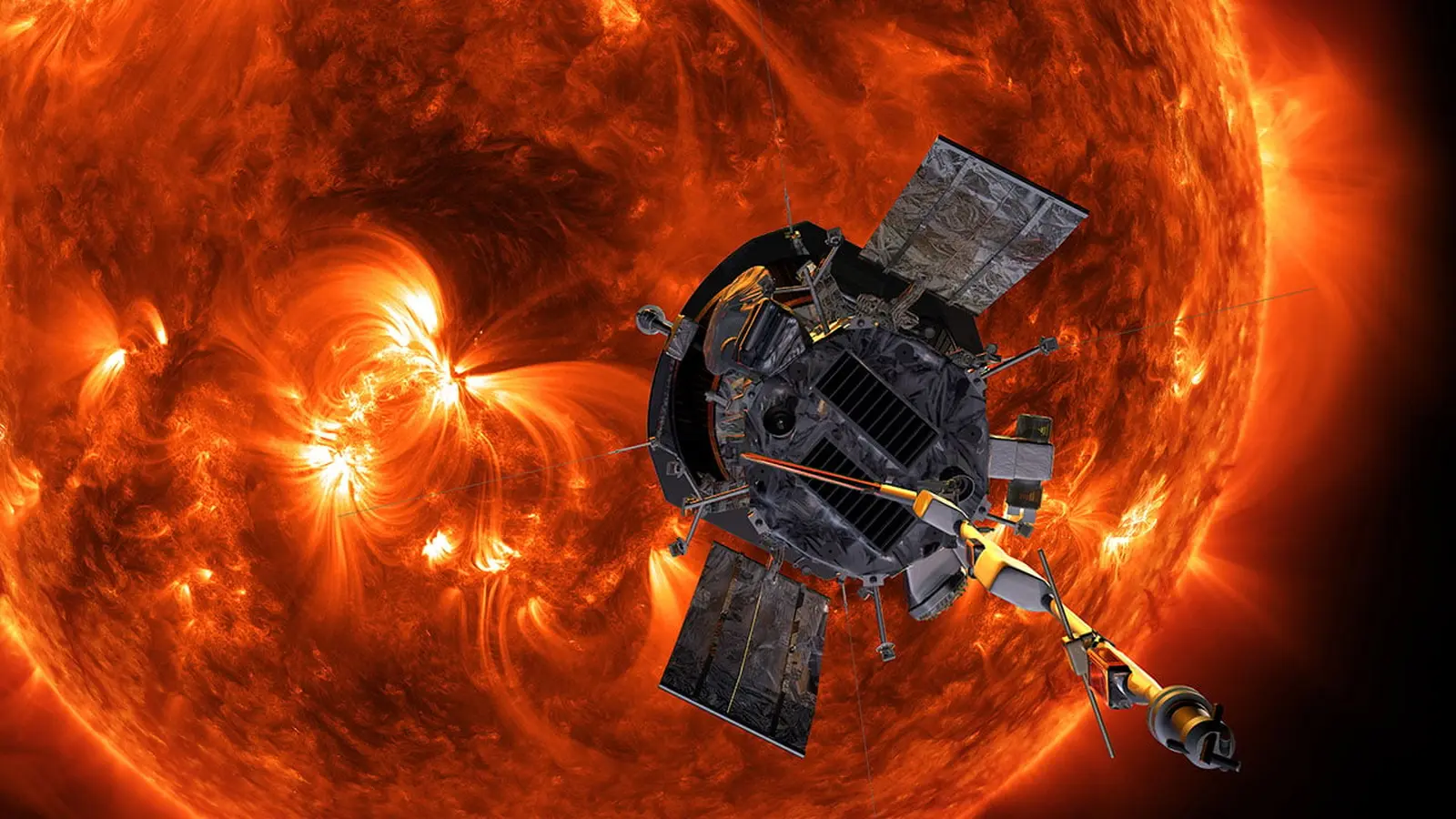
Close your eyes and picture the curl of smoke from an incense stick: a thin ribbon that suddenly folds, loops, and dissolves into chaos. Now imagine that ribbon made of charged particles and magnetic fields, stretched across millions of kilometers. That is the solar wind—turbulence writ large, messy and beautiful, and not as random as we thought.
Space plasma is unlike air. Its particles rarely collide. Electric and magnetic forces, not friction, dictate motion. For decades, physicists have puzzled over how turbulence behaves in such a collisionless medium: does it smear energy uniformly, or is there hidden structure? New measurements from NASA’s Parker Solar Probe have exposed a surprising pattern embedded inside that apparent disorder.
Using ultra-precise magnetic and particle instruments, researchers found that the way magnetic fields twist and rotate changes with scale. At larger scales—where the plasma flows like a fluid—the field vectors tend to rotate one way. Zoom in, and that preferred sense of rotation flips. Left-hand turns become right-hand turns. The flip marks the boundary where fluid-like eddies give way to dynamics controlled by individual particles.
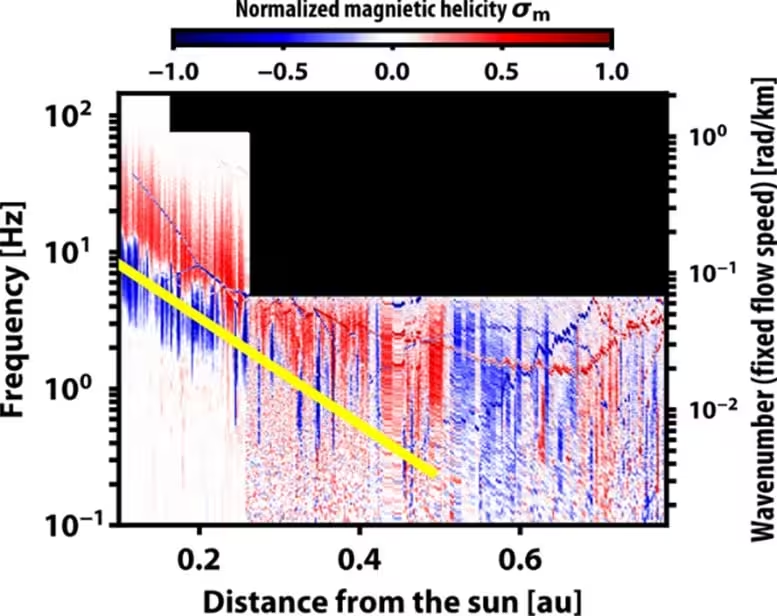
Reversal of the field rotation from left-handed rotation (blue) to right-handed rotation (red), plotted on the frequency spectrum (y axis) against distance from the Sun x axis). Analysis based on the data from the Parker Solar Probe. A low frequency corresponds to a long wavelength in the spectrum.
It’s a subtle effect, but clear in the data. The reversal appears at a characteristic wavelength, and as the probe moves farther from the Sun the switch becomes more pronounced and shifts to longer wavelengths. In other words, the scale at which particle behavior takes over grows with distance from the Sun, painting a picture of evolving turbulence across the heliosphere.
These findings didn’t come from a single lab. The study is the product of an international collaboration led by researchers at Technische Universität Braunschweig and the University of Tokyo, with partners from institutions across ten countries. Their paper appears in The Astrophysical Journal Letters (2026).
Why does this matter? Turbulence in the solar wind controls how energy moves through interplanetary space. It affects the shocks and magnetic clouds thrown off by solar eruptions and helps determine how those disturbances interact with Earth’s magnetosphere. Better models of turbulent mixing and scale-dependent behavior could sharpen forecasts of geomagnetic storms and space weather, with consequences for satellites, power grids, and astronauts.
Beyond our neighborhood, the result touches on fundamental plasma physics and astrophysical flows everywhere: from the hot gas threading accretion disks to the diffuse plasmas between the stars. What looked like chaotic motion now reveals a hidden choreography—one that changes as you change your lens.
The Sun’s wind is messy, but it keeps a secret order; finding that order is a step toward predicting the storms it sends our way.

Leave a Comment
Comments
No comments yet. Be the first.