
4 Minutes
Moments after the Big Bang, the infant Universe may have been a surprisingly busy place. New research argues that in the fraction of a second between inflation and the formation of the first nuclei, particle clumps could have collapsed into exotic compact objects: tiny black holes, boson stars and even 'cannibal stars' fueled by particle annihilations. This possibility rewrites part of our story for the Universe's first second.
A chaotic cradle: the Early Matter-Dominated Era and tiny halos
Cosmologists can now trace the Universe from inflation through primordial nucleosynthesis with growing detail, yet the short interval in between remains a frontier. Several theoretical models posit a brief Early Matter-Dominated Era (EMDE) after inflation, when non-relativistic particles temporarily dominated the cosmic energy budget. In an EMDE, small density fluctuations grow faster than during radiation domination, allowing tiny halos of matter to form well before atoms existed.
Researchers at SISSA, working with INFN, IFPU and the University of Warsaw, used simplified but insightful models to explore what happens if the particles inside those halos interact with one another. Their calculations show that self-interactions can trigger gravothermal collapse: heat flows outward, the core contracts and central density skyrockets, providing fertile conditions for compact-object formation.
How cannibal stars, boson stars and primordial black holes could appear
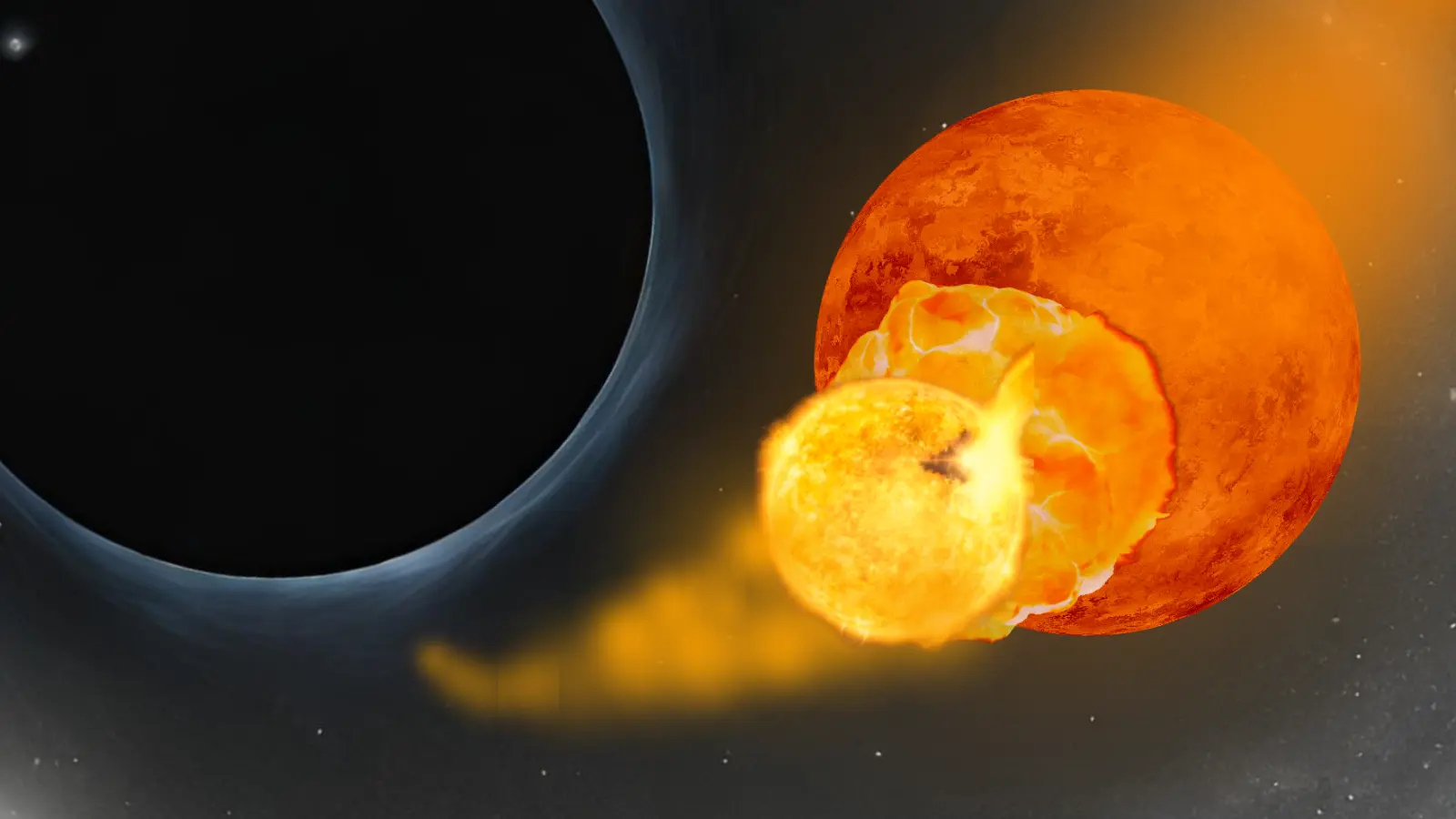
The study outlines several possible outcomes of halo collapse. In one scenario, halos evolve into cannibal stars, objects powered not by nuclear fusion but by ongoing self-annihilation of the particles that compose them. Think of a star that literally consumes itself for energy; the name captures the idea and highlights how different physics in the early Universe could mimic familiar astrophysical forms.
Another route produces boson stars, sustained by quantum effects rather than thermal pressure. If dark-sector particles are bosonic and light, they can form macroscopic, coherent quantum states where wave-like behavior supports the object against gravity. These structures may be ephemeral in the newborn Universe, surviving only a few seconds before further collapse.
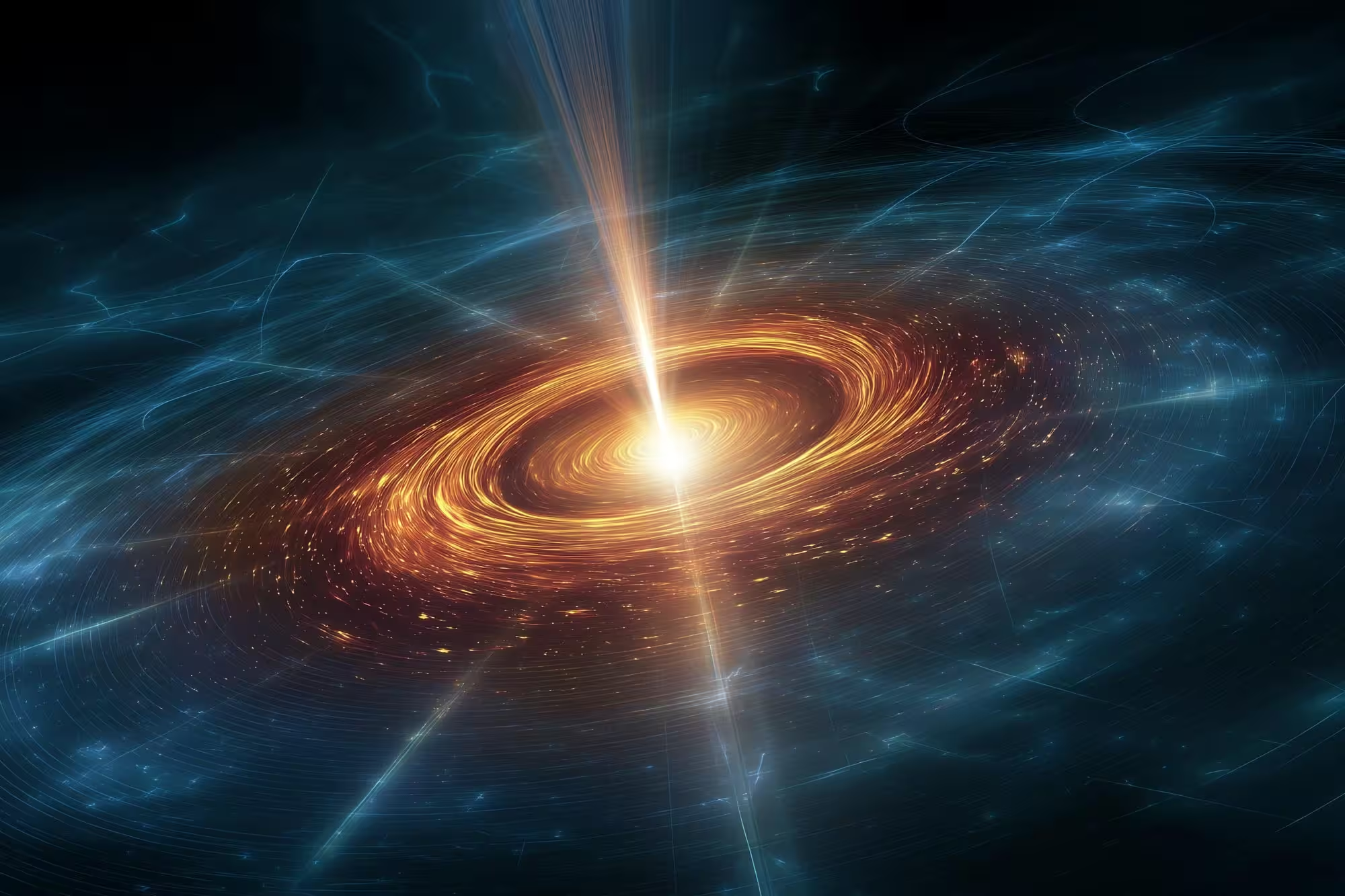
Finally, the densest cores can undergo runaway collapse to primordial black holes (PBHs). The researchers' estimates indicate the halos formed during an EMDE would be small in cosmic terms — masses below about 10^28 grams. After gravothermal collapse, some resulting PBHs could be even smaller, entering mass ranges that either evaporate quickly via Hawking radiation or survive as asteroid-mass relics.

Why these tiny objects matter for cosmology and dark matter
There are three striking implications. First, PBH production in an EMDE is a double-edged sword: in some model parameter ranges, they would be overproduced and conflict with observational limits, constraining those theories. Second, in other regimes the process naturally produces asteroid-scale PBHs that could account for all or a portion of dark matter, opening an observationally testable alternative to particle dark matter. Third, many of the lightest PBHs evaporate before primordial nucleosynthesis, meaning they could have influenced the early thermal history without leaving long-lived remnants.
Beyond black holes, a population of cannibal stars or boson stars in the early Universe would alter energy injection, expansion and small-scale structure in ways that might be probed indirectly through precise cosmological measurements or gravitational-wave signatures from later mergers.
Observational prospects and theoretical questions
Testing these ideas is challenging but not impossible. Searches for asteroid-mass PBHs use microlensing, wide-field transient surveys and constraints from cosmic background radiation. Laboratory and astrophysical probes of dark-sector self-interactions can also narrow the parameter space that allows gravothermal collapse. The authors highlight the need for more detailed numerical studies that couple particle physics with halo dynamics to refine production estimates and compare with limits from the cosmic microwave background, big-bang nucleosynthesis and gravitational-wave detectors.
As the team notes, the concept could be flipped to ask whether similar processes happen today: might self-interacting dark matter halos form cannibal or boson stars in the present Universe, and could such objects be hiding in galaxies as unusual compact sources?
Expert Insight
Dr. Lina Ortiz, an astrophysicist who studies compact-object formation, emphasizes that the study blends particle physics with classical dynamics in a useful way. She explains that even a short EMDE dramatically enhances small-scale growth, making gravothermal collapse far more plausible than in a purely radiation-dominated early Universe. According to Ortiz, the most exciting outcome is testability: if future surveys constrain asteroid-mass PBHs or reveal unexpected compact transients, we may gain a direct window into physics that acted in the Universe's first second.
These ideas stretch our imagination about the earliest cosmic epochs. Whether cannibal stars, fleeting boson stars or tiny black holes truly populated the young cosmos remains an open question — but the possibility reshapes how we think about structure formation when the Universe was younger than a heartbeat.







Leave a Comment
Comments (2)
Is this even true? sounds pretty speculative, microlensing and CMB limits worry me. neat concept tho, but needs heavy sims and better constraints
wow, tiny black holes and cannibal stars in the first second? mind blown. if true, early cosmos was way more chaotic, but also exciting… need sims asap