
5 Minutes
Deep below Greenland's surface, something unexpected is folding the ice: rising plumes that behave more like hot rock than frozen water. Radar scans have been recording these plume-like distortions for more than a decade, and recent computer modeling now points to a surprising culprit — thermal convection inside the ice sheet itself.
Hidden wrinkles in an enormous archive of snow
The Greenland ice sheet is a vast, layered record of past climates and snowfall. It covers roughly 80 percent of the island and stores enough water to raise global sea level by several meters if it were to disappear. Scientists probe that archive with ice-penetrating radar. Radio waves pass through the glacier and reflect off internal layers — the compacted snow, dust, ash and chemical signatures that mark each season and century.
In 2014, researchers noticed anomalous features deep in northern Greenland: large, upward-buckling structures in the radar records that did not line up with bedrock topography. For years the origin of those structures was debated. Could liquid water refreezing at the base warp the layers? Could migrating zones of lubricated sliding create such buckling? Those hypotheses were plausible. But none fit the full set of observations.
Enter thermal convection: a process familiar from Earth's interior, where hot, ductile rock rises while cooler material sinks, producing plumes and cells. At first glance the idea seems counterintuitive for solid ice. Ice is cold and brittle, right? The twist is that ice under the immense pressure of an ice sheet and warmed slightly at its base becomes far more deformable. In that state, slow, buoyant overturning becomes physically possible.
Simulating a boiling pot of ice
To explore the idea, glaciologists led by Robert Law at the University of Bergen adapted a geodynamics modeling package normally used for mantle convection. They created a simplified vertical slice of the Greenland ice sheet — a slab roughly 2.5 kilometers thick — and varied realistic parameters: snowfall accumulation, ice thickness, basal temperature, ice softness, and surface velocities.
Under a limited but plausible set of conditions, the model produced rising columns of warmer, softer ice that folded the overlying layers into plume-like shapes. The synthetic radar signatures from those simulated upwellings matched the real radar observations strikingly well. The implication: if those radar plumes are indeed convective upwellings, the ice at the base of northern Greenland must be warmer and far softer than conventional assumptions allow.
Where would the heat come from? The modeling did not invoke exotic sources. Instead, the warmth required is consistent with steady geothermal heat flowing upward from Earth’s crust — heat produced by the slow decay of radioactive elements and leftover heat from planetary formation. Small as that flux is compared with surface heating, shielded beneath kilometers of insulating ice it can create a basal layer that is warm enough, over long time spans, to become ductile and mobile.
Climatologist Andreas Born, also at the University of Bergen, likened the process to a slowly boiling pot — not a sloppy puddle, but solid ice behaving like a viscous fluid on timescales of thousands of years. That distinction matters. Convective motion at depth does not mean the ice is slushy today or will vanish tomorrow. Instead, it reveals a subtle internal mechanism that can rearrange internal layering and change how the ice sheet evolves over centuries to millennia.
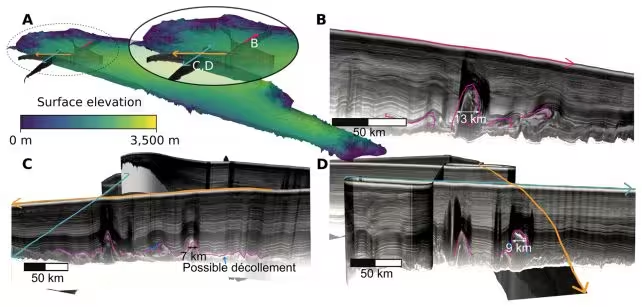
Example plume structures from northern Greenland, mapped from radar surveys.
Implications for ice dynamics and sea-level forecasts
Discovery of thermal convection inside an ice sheet forces a rethink of basal conditions and internal ice rheology. If portions of the Greenland ice sheet host convective cells, those zones may transport heat and impurities differently than previously modeled. Layers of dust and chemical markers could be uplifted or folded, complicating the climatic record interpreted from ice cores. Basal softness also affects how stress is transmitted through the ice, altering long-term flow patterns.
What does this mean for sea-level rise? That question is urgent but unresolved. Convection at depth changes internal structure rather than directly increasing meltwater production. Still, modified flow patterns could influence outlet glaciers or grounding-line dynamics over long time spans. The research team stresses that more work is needed — targeted measurements of basal temperatures, direct sampling where possible, and refined models coupling basal thermodynamics with large-scale ice-sheet flow.
There are practical challenges. Measuring conditions at the ice-bed interface is difficult and expensive. Remote sensing provides hints, but ground truth — boreholes, seismic surveys and geothermal measurements — will be required to confirm the modeling results and to map where convection might occur. Until then, the idea that an ice sheet can host slow, plume-like overturning remains a provocative explanation that fits the data better than competing hypotheses.
Expert Insight
"This is a reminder that ice sheets are more than inert storage boxes for snow," says Dr. Maya Khatri, a glaciophysicist at NASA Goddard who was not involved with the study. "Basal conditions can produce emergent behaviors that are invisible from the surface until you look with radar and models. Convective overturning is slow, but over centuries it can change the internal landscape of an ice sheet, and that matters when you're trying to predict its long-term response to climate warming."
Dr. Khatri adds a caution: "We need coordinated campaigns — boreholes, high-resolution radar, and coupled ice–heat models — to translate these elegant simulations into robust constraints for sea-level projections."
Radar, modeling and fieldwork have taken us a step closer to understanding Greenland’s inner life. The discovery that ice can roll and boil in place, driven by tiny but persistent geothermal warmth, is both a reminder of the complexity beneath our feet and a call to refine the tools we use to forecast the future of ice and sea level.

The more we listen to the signals buried in the ice, the better prepared we will be to read what they mean for coastlines and communities worldwide.









Leave a Comment
Comments (2)
Is this even true? Radar + models look neat, but without boreholes or direct heat readings can we be sure. Feels plausible, still wanna see field data..
Wow, ice "boiling" deep under Greenland? Mind blown. Who knew geothermal heat could make ice act like soft rock... kinda eerie, imagine layers folding over centuries. wild