
3 Minutes
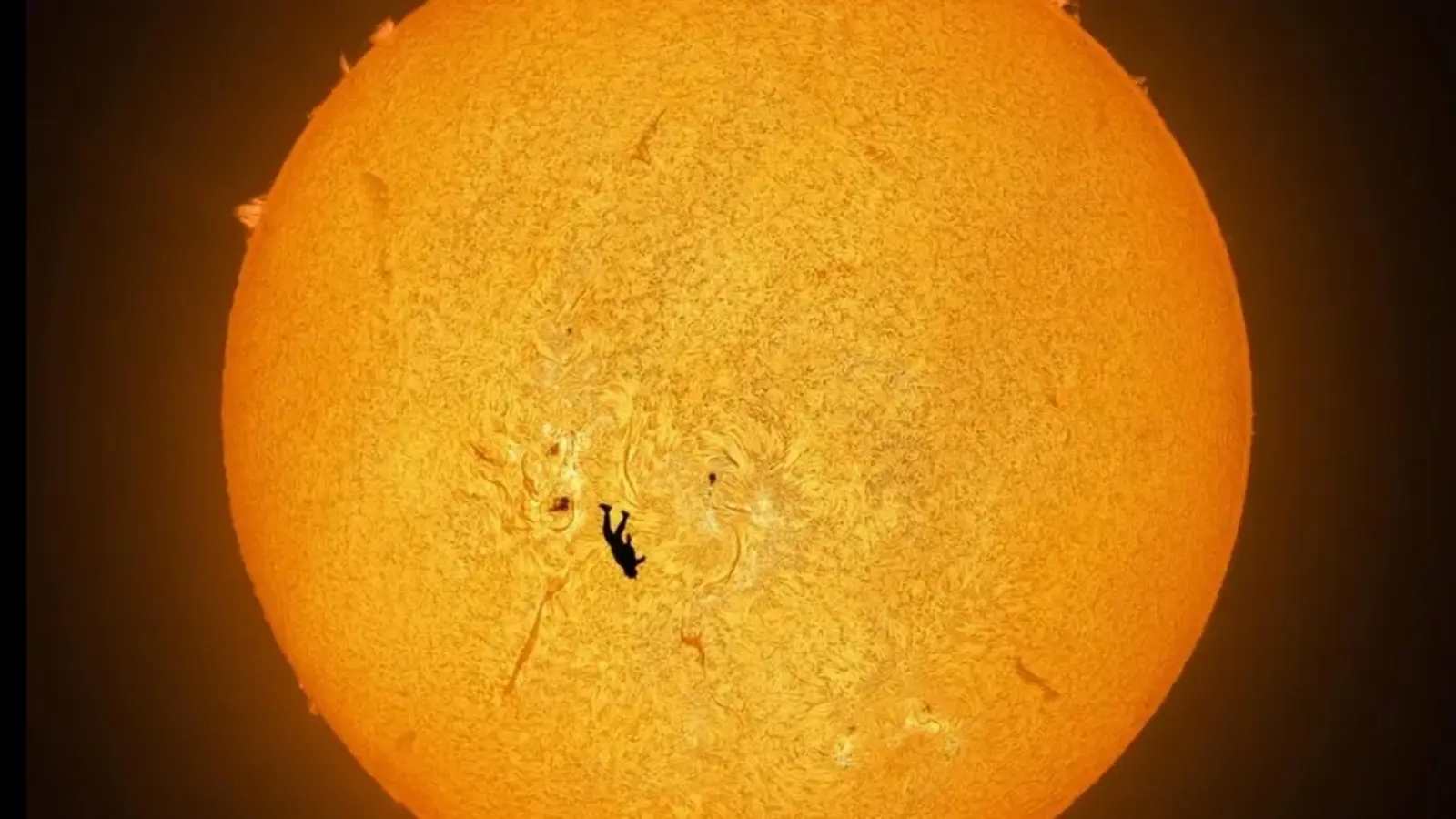
Astrophotographer Andrew McCarthy captured an extraordinary moment: a skydiver, silhouetted against the Sun's fiery disk, tumbling through Earth's atmosphere in perfect alignment with our star. The image, described by McCarthy as 'absolutely preposterous (but real),' required meticulous planning, split-second timing and cooperation between pilot, photographer and skydiver.
A one-in-a-million alignment
McCarthy tweeted that the shot took 'immense planning' — and he meant it. The team had to coordinate the Sun's angle, the aircraft's position and glide profile, the jump timing and the telescope's location so that the falling human would transit the solar disk at the precise moment the camera was ready.
After six failed attempts the Arizona-based photographer and musician–skydiver Gabriel C. Brown (also known as BlackGryph0n) succeeded on Sunday 8 November 2025 at 09:00 local time. Brown leapt from a propeller aircraft at roughly 1,070 meters (about 3,500 feet). With the photographer positioned about 2 kilometers away, the window to capture Brown crossing the Sun was measured in single seconds.
How they pulled it off: timing, comms and craft
Brown later described the logistics on Instagram: they had to pick the right location and time, factor in the aircraft's power-off glideslope for optimal Sun angle and safe exit altitude, and align the shot using the opposition effect from the aircraft. The team used three-way communications to synchronize the jump with the photographer's telescope and camera shutter.
'I still can't believe we pulled this off!!' Brown wrote. 'We had to find the right location, time, aircraft, and distance for the clearest shot ... then we had to align the shot using the opposition effect from the aircraft (shout out to the pilot @jimhamberlin) and coordinate the exact moment of the jump on 3-way coms!'
McCarthy himself is known for exceptionally detailed solar and lunar photography. In 2022 he captured an enormous coronal mass ejection that stretched about a million miles. He has also compiled a 174-megapixel mosaic of the Moon from some 200,000 images taken over nearly two years.
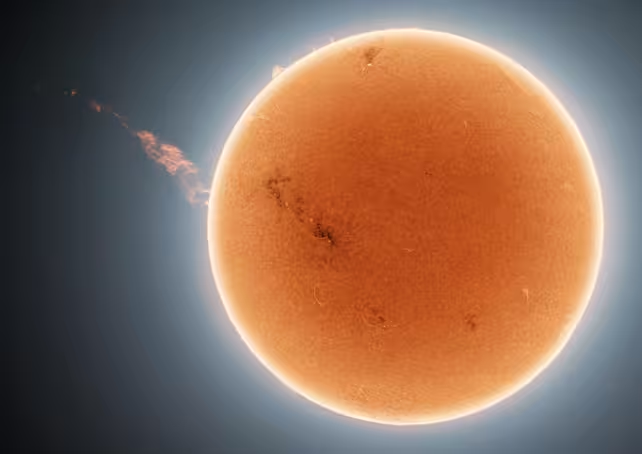
A false-color composite image of a coronal mass ejection, measuring around 1 million miles in length.
Why this image matters to science and outreach
At first glance the photograph is a showpiece of timing and technique, but it also highlights the challenge of scale in astrophotography. The Sun is nearly 150 million kilometers from Earth; the skydiver was only a couple of kilometers from the camera. Capturing a person as a sharp silhouette against the textured solar photosphere — with limb darkening, granulation and sunspot detail visible — requires a telescope with high resolution, a stable mount, precise tracking and a camera capable of very fast exposures.
Beyond the technical feat, the image is a potent outreach tool: it translates the abstract scale of the solar system into an instant, visceral image. People can grasp how tiny human presence is compared with the Sun, while also appreciating the precision of modern amateur and semi-professional astrophotography.

A 174 megapixel image of the Moon.
McCarthy's past work, from dramatic solar eruptions to long-term lunar mosaics, shows a pattern: pushing photographic technique to reveal phenomena across extreme distance and scale. This skydiver transit sits squarely in that tradition — a playful yet technically rigorous experiment that captured the public imagination.
The team and the wider astrophotography community will likely study and replicate parts of the method: precise GPS timing, precomputed sun-angle windows, high-frame-rate capture and coordinated airspace use. For now, the image stands as a rare intersection of human drama and solar detail, a reminder that even in an age of massive space telescopes, bold creative experiments on Earth still produce unforgettable photographs.









Leave a Comment
Comments (1)
Wait they actually timed a skydiver to cross the Sun? insane and kinda risky, tho. Six tries sounds credible but, what about refraction, turbulence, parallax??