
4 Minutes
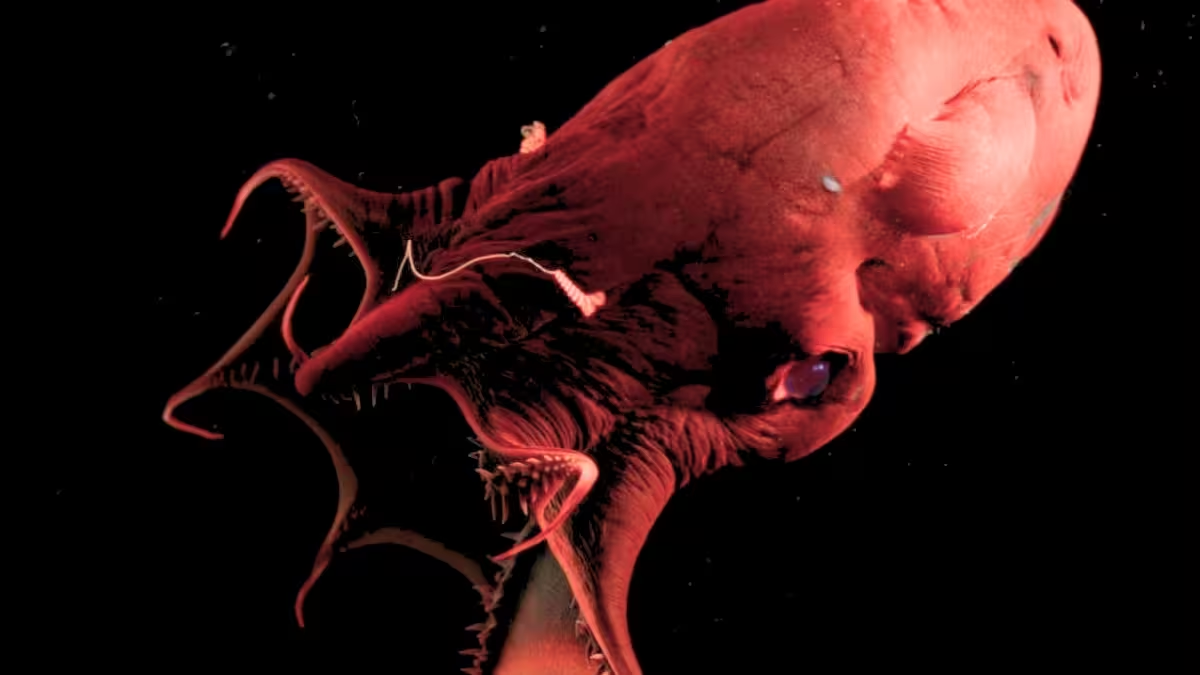
Scientists have just decoded the largest cephalopod genome on record from the elusive deep-sea creature commonly called the "vampire squid." The new draft — an immense 11–14 gigabase genome — reveals unexpected genomic architecture that links this oddball species to both squids and octopuses and illuminates the early steps of cephalopod evolution.
A genomic giant from the abyss
Vampyroteuthis infernalis is not a true squid, an octopus, or a vampire — yet its DNA is enormous compared with its cephalopod cousins. Researchers sequencing this deep-sea scavenger found a genome between 11 and 14 gigabases, more than double the size of many squid genomes and several times larger than typical octopus genomes. For context: the longfin inshore squid (Doryteuthis pealeii) clocks in at roughly 4.4 Gb, cuttlefish (Sepia officinalis) at about 5.5 Gb, and octopus species at roughly 2.2–2.7 Gb.
What inflates this genetic landscape? Some 62% of the vampire squid genome consists of repetitive DNA — sequences that reappear over and over. These repetitive elements expand genome size without necessarily adding new protein-coding genes, but they can influence regulation, genome architecture, and evolutionary potential.
Chromosomal echoes of ancient relatives
Beyond sheer size, the genome preserves a surprising chromosomal layout that resembles ten-armed cephalopods (decapodiforms) more than the typical eight-armed octopuses (octopodiforms). Comparative analysis with other cephalopod genomes — including squids, cuttlefish, nautilus, and the odd argonaut (Argonauta hians) — shows that the vampire squid kept much of the ancestral chromosomal organization that predated the major split between squid-like and octopus-like lineages.
Fusion-with-mixing: how octopus chromosomes diverged
In contrast, octopus genomes bear signs of an early, dramatic chromosomal reshuffling process researchers call "fusion-with-mixing." During this irreversible remodeling, chromosomes compacted and fused while their content was mixed and rearranged, likely contributing to the unique adaptations of octopuses — from flexible limbs and camouflage to complex neural circuitry. The vampire squid appears to have largely escaped that early genomic upheaval, retaining a more ancestral arrangement even as repetitive elements ballooned its genome size.
From bycatch to breakthrough: how the sample was obtained

Getting DNA from a species that lives deeper than 600 meters is no small feat. The specimen used for sequencing was collected accidentally as bycatch by Tokai University’s research vessel T/V Hokuto in Suruga Bay. Despite its shy, deep-ocean lifestyle, this chance capture gave scientists a rare window into cephalopod history.
Genome sequencing demanded high-coverage methods and careful comparative genomics. Teams compared the vampire squid’s chromosomes to those of decapodiforms and octopodiforms and sequenced an unusual octopus with an external shell, the muddy argonaut, to help anchor evolutionary inferences.
Why this matters for evolution and biology
These results position Vampyroteuthis infernalis as a genomic Rosetta Stone for cephalopod evolution. By preserving chromosomal features that predate the split between squid and octopus lineages, the vampire squid provides direct evidence of early cephalopod genomic organization and the genetic starting point from which highly divergent body plans and behaviors emerged.
Understanding repetitive elements and large-scale chromosomal patterns can also inform studies of gene regulation, neural development, and the evolutionary mechanisms that produced cephalopods’ extraordinary abilities — from sophisticated camouflage to advanced problem-solving.
Implications and future directions
- Comparative genomics: The vampire squid genome helps calibrate evolutionary timelines and ancestral states for cephalopods.
- Genomic architecture research: Studying fusion-with-mixing events sheds light on how chromosomal rearrangements drive morphological innovation.
- Conservation genetics: Deep-sea species are poorly understood; genomic data can inform resilience assessments under climate and human pressures.
- Neurobiology and development: Insights into genome organization may reveal how cephalopod nervous systems evolved separately from vertebrates.
Expert Insight
"The vampire squid offers a rare genomic snapshot of an ancestral cephalopod state," says Oleg Simakov, a genomicist at the University of Vienna, whose team contributed to the analysis. "Its genome reveals deep evolutionary secrets on how two strikingly different lineages could emerge from a shared ancestor."
Emese Tóth, also of the University of Vienna, adds: "It gives us a direct look into the earliest stages of cephalopod evolution."
Dr. Lina Morales, a marine genomics researcher not involved in the study, comments: "This genome is a powerful tool. Large amounts of repetitive DNA complicate assembly, but they also offer clues about regulatory architecture that could underlie cephalopod novelty. Follow-up functional studies will be crucial."

As sequencing technologies improve and more deep-sea species are catalogued, scientists expect to refine the evolutionary tree of cephalopods further and trace how genomic rearrangements fueled the rise of some of the ocean’s most intelligent and adaptable invertebrates.










Leave a Comment
Comments (2)
Is this even true? One bycatch specimen, complex assembly... can that really reflect ancestral chromosomal layout? curious but need more data
Whoa 11-14 Gb?? That's wild. 62% repeats, like a genomic junkyard with secret switches. How'd they untangle that? excited but skeptical, haha