
5 Minutes
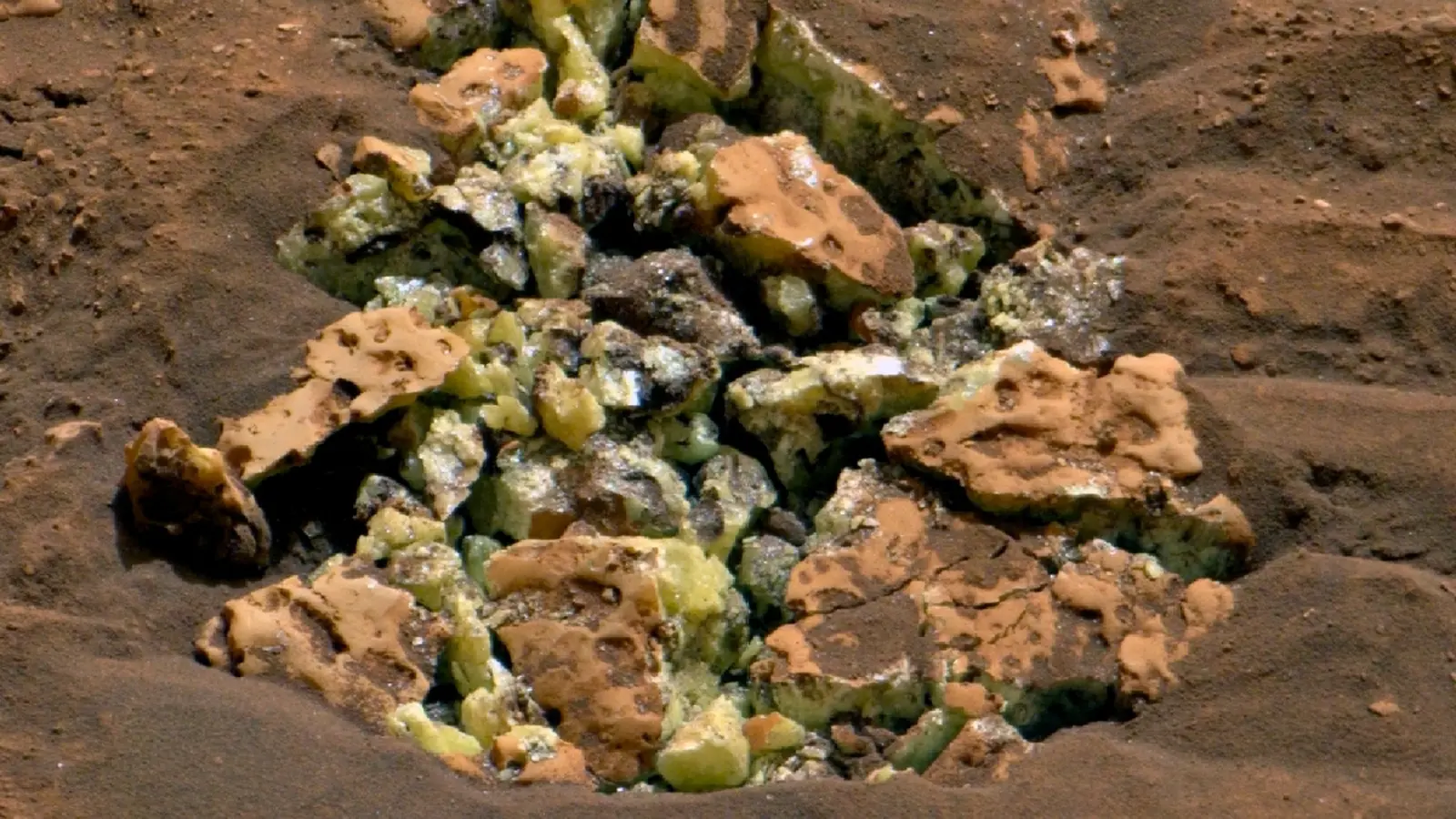
When NASA's Curiosity rover accidentally crushed a seemingly ordinary rock on the floor of Gediz Vallis, it exposed a bright, unexpected prize: pure yellow crystals of elemental sulfur. The discovery changes how scientists think about local Martian chemistry and raises new questions about the red planet's geologic past.
An accidental reveal: how a wheel became a geologist
In May 2024, Curiosity — a 899-kilogram rover prowling Gale Crater — rolled over a fragile lump of mineral that promptly crumbled beneath its wheels. Cameras and spectrometers captured the freshly exposed interior: vivid yellow crystals identified as elemental sulfur, or brimstone. While sulfate minerals are common across Mars, finding sulfur in its pure, elemental form is unprecedented for this neighborhood of the planet.
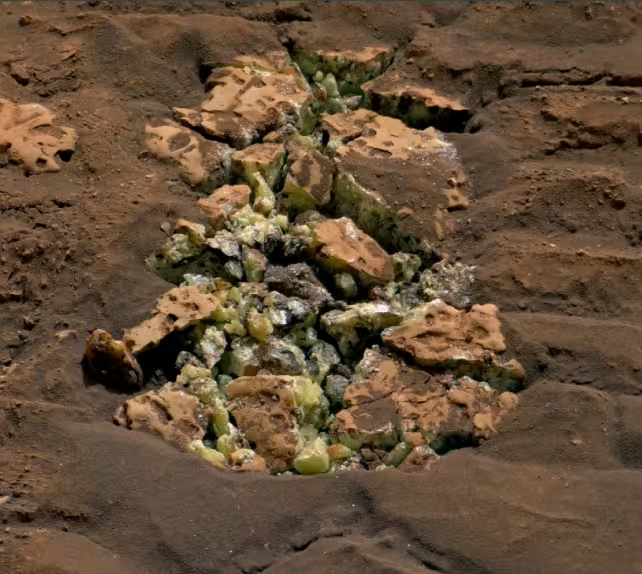
The sulfur Curiosity found on Mars
What makes the find striking is not only the sulfur itself, but the context: Gediz Vallis appears littered with other stones that resemble the unbroken lump Curiosity accidentally fractured. That pattern hints that elemental sulfur might be more abundant locally than previously thought — a possibility that demands explanation.
Why pure sulfur is a geological surprise
Sulfur commonly occurs on Mars as sulfates: minerals that form when sulfur combines with oxygen and other elements in water and then concentrates as the water evaporates. Sulfates have been a key line of evidence that Mars once hosted liquid water and habitable chemical conditions.
Pure, elemental sulfur forms under a narrower set of circumstances. On Earth, it often appears around volcanic fumaroles, hydrothermal vents, or through chemical reactions where hydrogen sulfide is oxidized leaving behind sulfur. Those processes typically require specific temperature, redox, and gas conditions. None of the broadly accepted models for Gediz Vallis had predicted local formation or deposition of elemental sulfur in visible, near-surface deposits.
'Finding a field of stones made of pure sulfur is like finding an oasis in the desert,' said Curiosity project scientist Ashwin Vasavada of NASA's Jet Propulsion Laboratory. 'It shouldn't be there, so now we have to explain it. Discovering strange and unexpected things is what makes planetary exploration so exciting.'
What the instruments told us
Curiosity carries a sophisticated suite of instruments for identifying chemistry from afar and at arm's reach: Mastcam imaging, ChemCam laser spectroscopy, APXS elemental analysis, CheMin X-ray diffraction and SAM for volatile analysis. Using a combination of imaging and spectroscopic signatures, mission scientists confirmed the bright yellow grains are elemental sulfur rather than a sulfate coating or a different mineral phase.
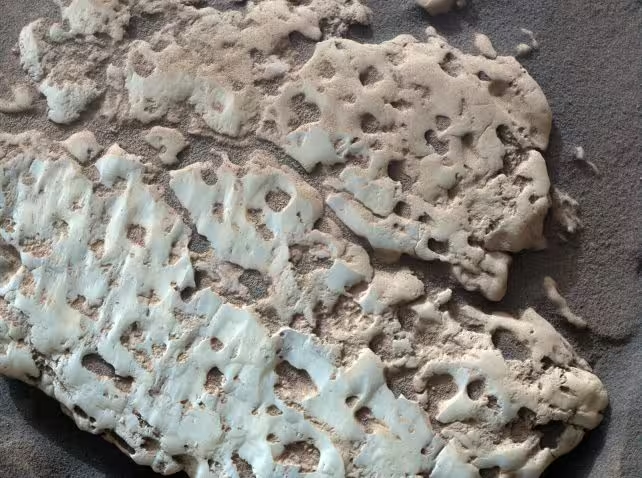
A rock very similar to the one broken by Curiosity, photographed nine days after the sulfur discovery
Because the rover accidentally fractured the rock, mission engineers and scientists were offered a rare, fresh surface to analyze without having to drill or grind. If the rover had taken a different route, these clues might have stayed hidden for months or years.
Implications for Martian chemistry and habitability
Elemental sulfur is biochemically significant: on Earth it is part of cycles that support microbial life, and sulfate-bearing minerals are one of the ways organisms acquire sulfur for amino acids and proteins. The presence of sulfates on Mars has long been a piece of the puzzle that suggests past habitable chemistry. The new detection of elemental sulfur does not prove life, but it expands our awareness of the red planet's chemical inventory and the diversity of processes that have shaped its surface.
Possible formation scenarios include:
- Local volcanic or hydrothermal activity in the past, producing sulfur-rich gases that later condensed as the planet cooled.
- Oxidation-reduction reactions where sulfur-bearing fluids precipitated elemental sulfur under unusual redox conditions.
- Transport and deposition from a distant source, followed by localized chemical alteration on the surface.
Each hypothesis requires detailed geochemical modeling and more data from the field. Some scenarios imply transient warm or chemically reducing environments in Mars history, which would be important for reconstructing the planet's evolution.
Next steps for Curiosity and researchers
Scientists will continue mapping the distribution of sulfur-like stones along Gediz Vallis and comparing their textures and compositions. Laboratory modeling, experiment, and computational geochemical simulations will be used to narrow down formation mechanisms. Curiosity will keep collecting close-up images and spectra; where safe and feasible, team members may target similar stones for additional analysis or drilling.
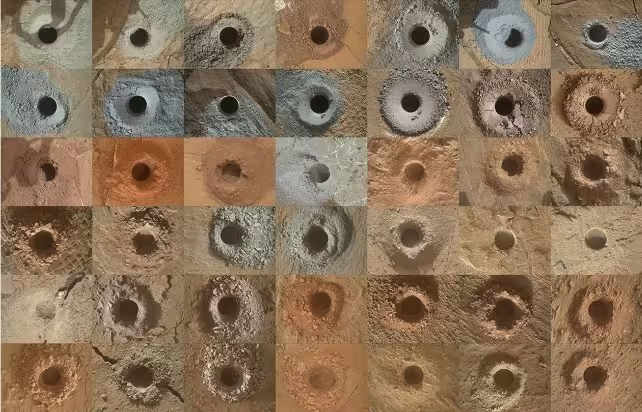
Curiosity has collected 42 powderized rock samples with the drill on the end of its robotic arm. All 42 holes made by the drill are shown here.
Expert Insight
'This kind of unexpected mineralogy is a reminder that Mars is still a dynamic archive,' said Dr. Elena Marquez, a planetary geochemist at the Imaginary Planetary Institute. 'Elemental sulfur points us to localized chemical factories in Mars' past — perhaps hydrothermal pulses or sulfur-rich gas releases. The path from discovery to explanation will combine rover data, lab experiments, and models. It may also guide where future sample-caching missions target rocks for return to Earth.'
In practical terms, the find underscores the value of mobile fieldwork on other worlds. Rover mobility, coupled with a broad instrument suite, lets scientists serendipitously discover and rapidly investigate anomalies that static landers would likely miss.
What this means for future exploration
Understanding how and why elemental sulfur occurs in Gediz Vallis will help refine landing-site selection and sampling strategies for future missions. If elemental sulfur deposits indicate past hydrothermal environments, they could become high-priority targets for sample return and the search for biosignatures. Meanwhile, Perseverance and other missions continue to expand our picture of Martian diversity — and Curiosity keeps delivering the surprises that push planetary science forward.








Leave a Comment
Comments (2)
is this even real? elemental sulfur on the surface sounds odd, could be contamination or a sensor quirk, right? idk but we need rock samples back here asap
Whoa, pure sulfur on Mars?! That’s wild. If those stones are common there, hydrothermal vents maybe? Or strange redox chemistry. Must be checked tho, makes me giddy