

3 Minutes
On 29 July 2025 a powerful earthquake off Russia’s Kuril-Kamchatka trench generated a Pacific-wide tsunami, and a satellite happened to be looking. New observations from NASA and CNES's Surface Water and Ocean Topography (SWOT) mission captured the event in unprecedented detail — revealing that large tsunamis can fragment into a dominant leading pulse followed by smaller waves, a behavior that challenges long-held assumptions.
New eyes on ocean swells: what SWOT brings
SWOT, launched in 2022 to track changes in sea-surface height, was designed for mapping currents, lakes and coastal flooding. It works differently from single-point sensors: instead of a narrow line, SWOT scans a broad swath of ocean — roughly 120 kilometers (75 miles) wide — delivering high-resolution elevation maps of the sea surface.
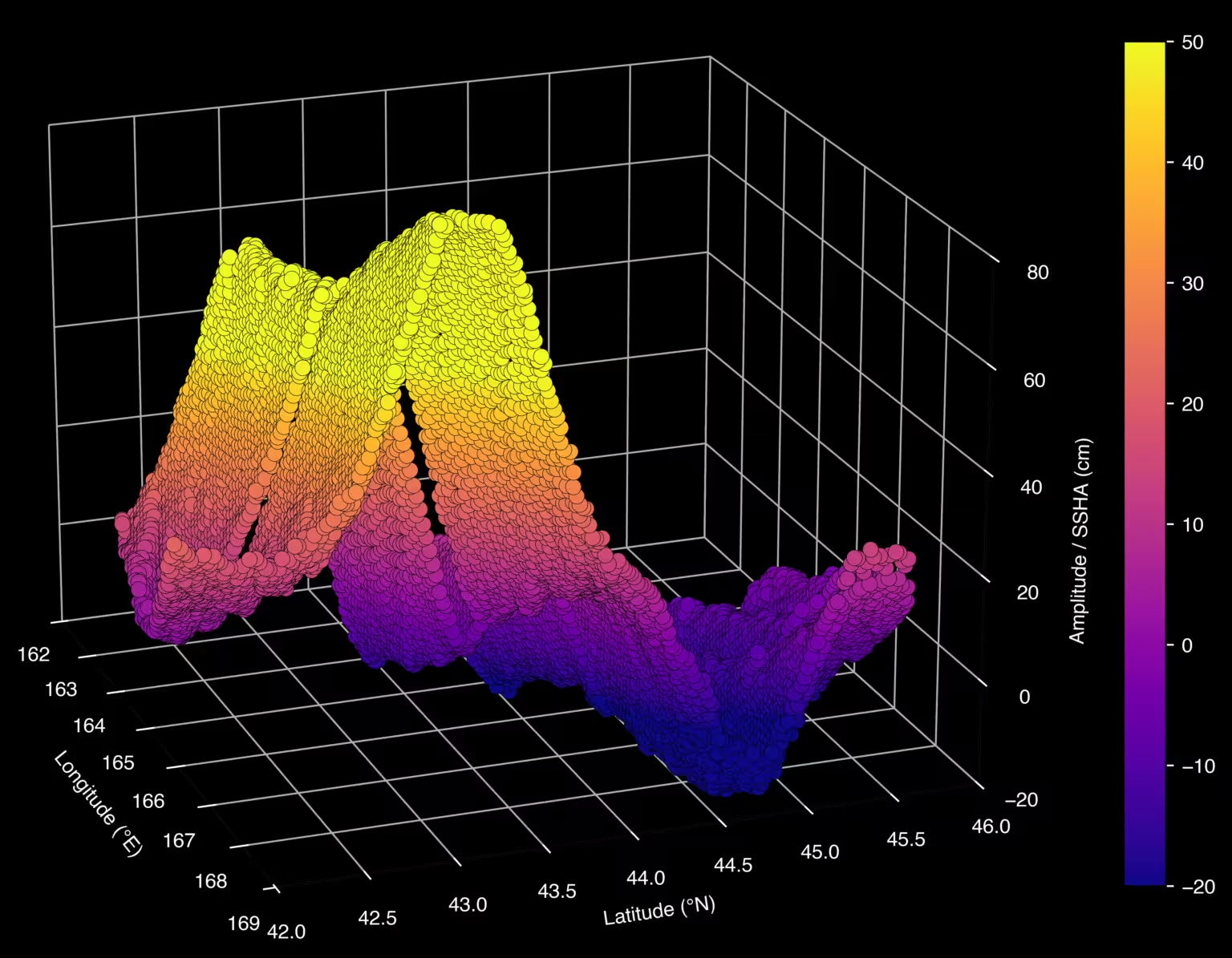
That wide view turned out to be fortuitous. As the 8.8-magnitude quake sent a tsunami radiating across the Pacific, SWOT passed over the wave train and recorded the sea-surface profile across a large cross-section. Scientists combined those satellite measurements with data from three Deep-ocean Assessment and Reporting of Tsunamis (DART) buoys in the region to reconstruct how the tsunami propagated and scattered.
Breaking the wave: an unexpected pattern
Conventional theory treats long-traveling tsunamis as largely non-dispersive: the wave keeps its shape and speed, with the entire trough and crest moving together. The SWOT observations tell a different story for this event. The satellite data show a pronounced leading wave — exceeding 45 centimeters (1.5 feet) at the sea surface — followed by a series of smaller trailing waves. In other words, the tsunami partially broke up instead of remaining a single coherent pulse.
"I think of SWOT data as a new pair of glasses," said Angel Ruiz-Angulo, lead author of the study and a physical oceanographer at the University of Iceland. “Before, with DARTs we could only see the tsunami at specific points in the vastness of the ocean. There have been other satellites before, but they only see a thin line across a tsunami in the best-case scenario. Now, with SWOT, we can capture a swath up to about 120 kilometers [75 miles] wide, with unprecedented high-resolution data of the sea surface.”
Why this discovery matters for forecasts and warnings
Understanding whether tsunamis disperse or remain intact affects arrival-time predictions and estimates of coastal impact. If a tsunami divides into multiple pulses, coastal areas might face a strong first surge followed by damaging ebb and subsequent waves that arrive at different intervals — complicating evacuation timing and damage forecasts.
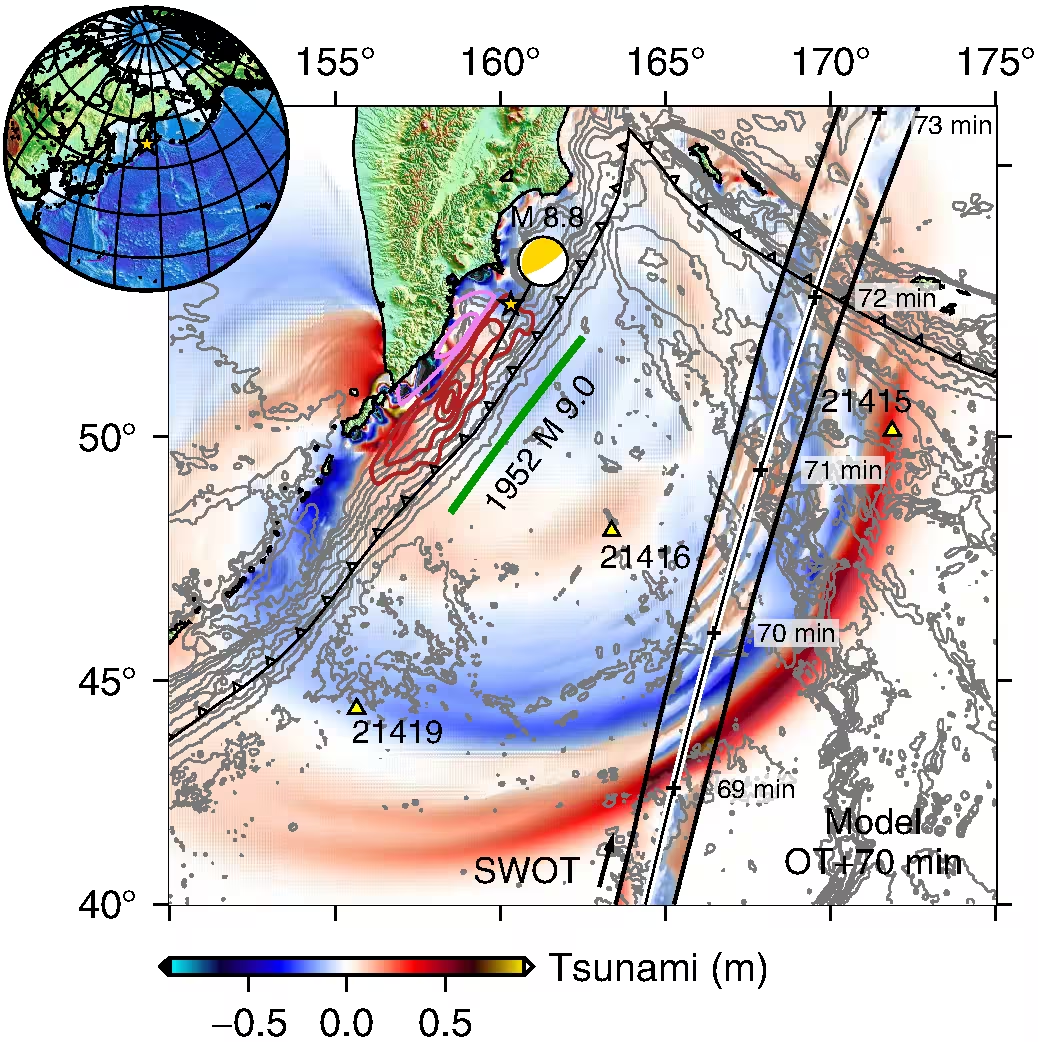
Combining SWOT's swath measurements with DART buoy time series offers a richer, spatially continuous picture that can be fed into numerical models to refine wave propagation and scattering algorithms. In practical terms, that could translate into improved early-warning products and better-targeted advisories for communities across the Pacific.
Looking ahead: real-time monitoring and operational use
SWOT was not designed as an operational tsunami detector, but this serendipitous pass highlights how wide-swath altimetry and other satellite assets could augment ocean monitoring networks. Future missions with faster revisit times, real-time downlinks, and synergy with coastal radars, GNSS reflectometry and in situ sensors would make spaceborne tsunami tracking a practical complement to existing systems.
The findings were published in The Seismic Record and mark a step toward more nuanced tsunami science — where satellite swath imagery helps reveal the true complexity of the ocean's response to seismic shocks.










Leave a Comment
Comments
No comments yet. Be the first.