
5 Minutes
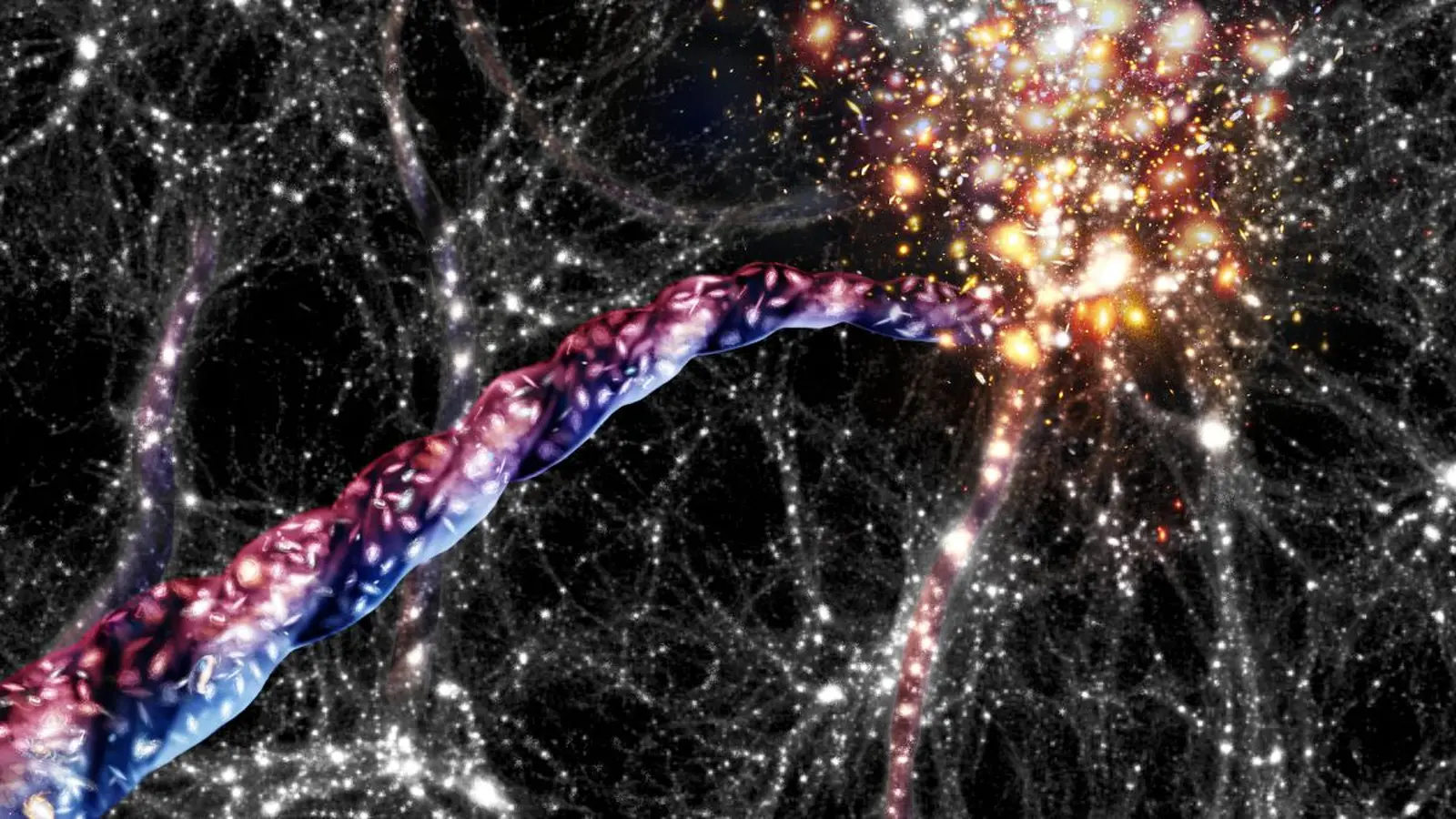
A team of astronomers has identified a colossal, twisting strand of galaxies that appears to be rotating like a slow-motion cosmic tornado. Stretching tens of millions of light-years, this newly characterized filament is not only the longest rotating structure yet observed, it also offers fresh clues about how galaxies acquire their spin and how the invisible scaffolding of the Universe shapes visible matter.
A needle of galaxies with a surprising twist
At roughly 440 million light-years from Earth, researchers first noticed an unusual alignment of galaxies in radio observations from the MEERKAT telescope as part of the MIGHTEE survey. Fourteen galaxies appeared arranged in an unusually straight, needle-like line about 5.5 million light-years long and 117,000 light-years across. Their orientations were correlated along the length of the structure, a pattern too regular to be statistical fluke.
To test whether this arrangement was a local oddity or part of a larger feature, the team cross-checked the field with public optical and infrared datasets: the Sloan Digital Sky Survey and the Dark Energy Spectroscopic Instrument survey. The result was striking. An additional 283 galaxies at essentially the same distance were found along the same axis, and they too showed a persistent alignment along the filament.
Rotation on a cosmic scale: redshift tells the story
Orientation alone would have been interesting. What transformed this discovery into a headline-grabbing result was the kinematic information. By measuring redshift differences across the filament, astronomers found a systematic pattern consistent with rotation. On one side of the strand, galaxy light was shifted slightly toward blue wavelengths, indicating motion toward us. On the opposite side, galaxy light was redshifted, indicating motion away. Modeling yielded a tangential velocity of about 110 kilometers per second, similar to the relative approach speed of the Milky Way and Andromeda.
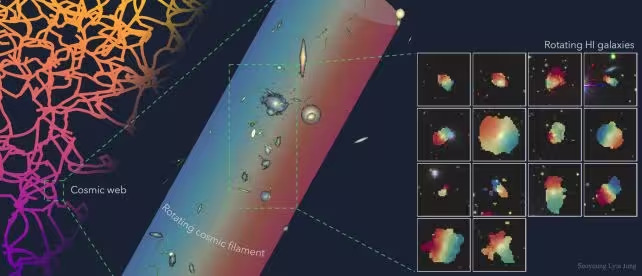
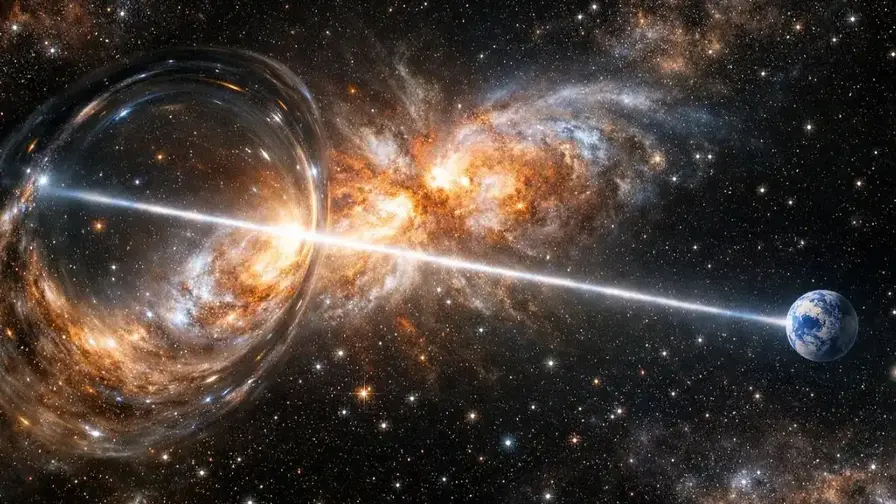
A diagram illustrating the filament
That pattern implies the entire filament has vortical motion around its spine. If confirmed, this structure becomes the longest coherent rotating filament discovered to date, offering direct observational evidence that large-scale cosmic structures can carry angular momentum.
Why this matters: link to cosmic web and galaxy formation
The filament lives in the cosmic web, the vast network of dark matter and gas that organizes galaxies into filaments, sheets, and voids. Though invisible directly, the cosmic web governs where matter congregates and how galaxies grow. The finding supports theoretical expectations from tidal torque models, where asymmetries in the early Universe transfer angular momentum to forming filaments and, in turn, to the galaxies within them.
Angular momentum transfer and Tidal Torque Theory
Tidal Torque Theory predicts that gravitational interactions during early structure formation impart spin to collapsing regions. The observation that galaxies in this filament share both alignment and rotational motion implies that filaments can act as conveyor belts of angular momentum, helping to set galaxy spin early in their lifetimes.
Fuel for star formation
The filament also contains diffuse, cold neutral hydrogen gas, and member galaxies are rich in hydrogen — a reservoir for star formation. Cosmic filaments may therefore play a dual role: channeling matter into galaxies and imprinting rotational dynamics that influence galactic evolution.
Observations and instruments behind the discovery
This result is a good example of multi-wavelength astronomy in practice. The initial detection used MEERKAT radio data from the MIGHTEE survey to identify an unusual concentration of hydrogen-rich systems. Optical and infrared coverage from SDSS and DESI expanded the census of galaxies and provided precise redshifts needed to map velocities along the structure.
Combining radio, optical and spectroscopic records allowed the team to move from a curious alignment to a robust kinematic measurement. Future follow-up with other facilities may probe the filament's dark matter distribution, gas temperature, and detailed rotation profile.
Implications for cosmology and galaxy evolution
Finding such a long, rotating filament constrains models of large-scale structure formation. It demonstrates that angular momentum can be coherently organized on scales far larger than individual galaxies, potentially affecting galaxy mergers, disk formation, and star formation histories. If filaments routinely transfer spin to galaxies, this could explain some of the large-scale correlations in galactic orientation seen in surveys.
The researchers note that this filament is an ideal laboratory to study the relationship between low-density intergalactic gas and galaxy growth, since the reservoir of cold hydrogen points to ongoing accretion and star formation fuel.
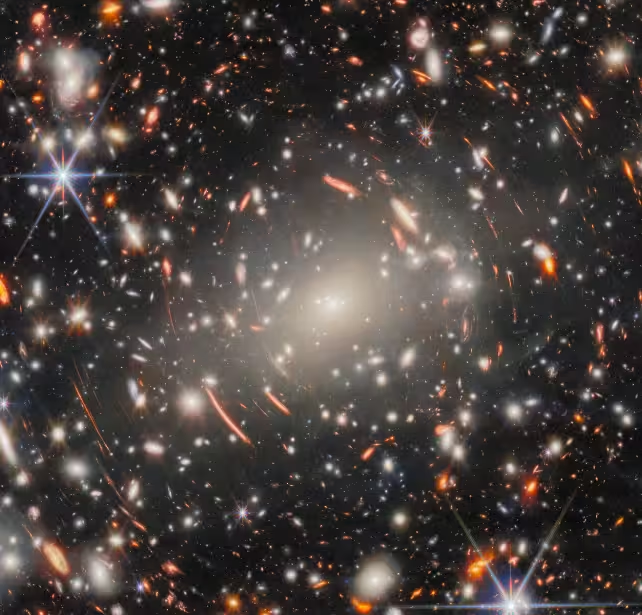
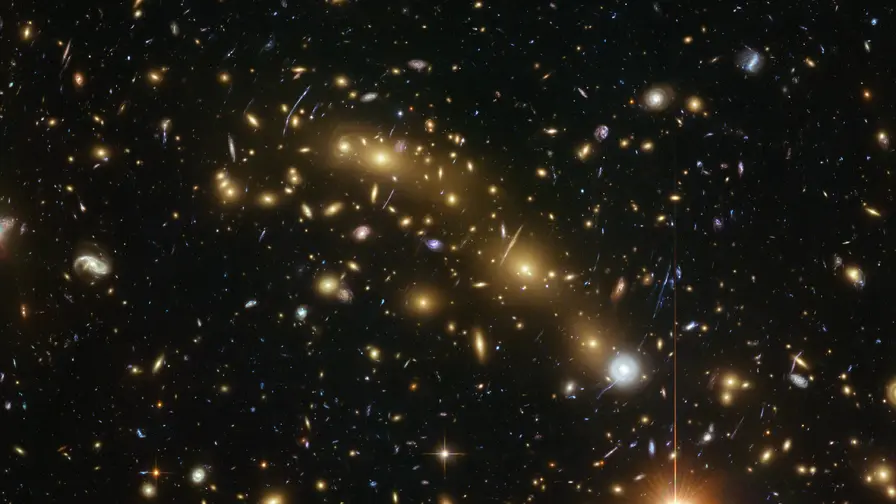
A deep field image obtained using the JWST
Expert Insight
Dr. Maya Cavendish, an observational cosmologist not involved in the study, comments: 'This detection is exciting because it links geometry and motion on truly vast scales. We often imagine galaxies spinning in isolation, but this filament shows how their spins can be a collective property driven by the larger dark matter network. Confirming more systems like this will tell us whether such coherent rotation is rare or a common feature of the cosmic web.'
Where next: tests and future observations
To build on this result, astronomers will want deeper, higher-resolution maps of gas and dark matter in and around the filament. Targeted observations with radio interferometers, integral-field spectrographs, and next-generation surveys could reveal the filament's mass distribution and whether rotation extends into the dark matter component. Simulations tuned to reproduce such a long vortical filament will also help test whether current models naturally produce these features.
Whether this cosmic tornado is unique or one example of a widespread phenomenon, its discovery highlights the growing power of coordinated surveys and the importance of looking for dynamical signatures at the largest scales. The cosmic web is not a static backdrop; it can carry motion, momentum, and memory of the early Universe to the galaxies we see today.








Leave a Comment
Comments (2)
wait, is redshift wiggle enough to claim the whole filament rotates? seems like a stretch, idk, need better stats
whoa this actually reads like sci fi, a slow cosmic tornado? so cool but kinda eerie, want the raw data pls!!!