

4 Minutes
Subtle changes in how older adults drive — fewer trips, simpler routes and less speeding — could be an early sign of cognitive decline. New research suggests that everyday driving patterns, captured by GPS trackers, combined with standard cognitive tests, may help detect mild cognitive impairment before crashes or major symptoms appear.
How researchers turned GPS data into an early-warning signal
Scientists at Washington University in St Louis followed volunteers for up to 40 months, automatically logging driving behavior from onboard GPS devices. The cohort included 56 people already diagnosed with mild cognitive impairment (MCI), a condition that often precedes Alzheimer’s disease, and 242 cognitively normal peers. Average age across participants was 75.
The team matched continuous driving metrics — trip frequency, distance, route complexity and speeding per trip — against established cognitive tests covering memory, attention and executive function, plus demographic factors such as age, education and a known genetic Alzheimer’s risk marker. When GPS-derived driving information was combined with clinical and demographic data, researchers could correctly detect cognitive decline in people with preexisting MCI about 87% of the time. Using driving data alone still identified MCI approximately 82% of the time.
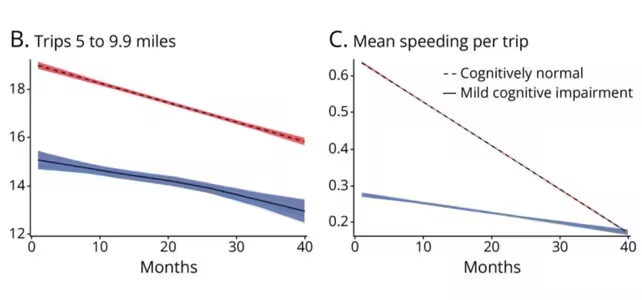
B) Longer trips and C) speeding per trip declined as measured over 40 months, comparing cognitively normal (red/dashed) with MCI (blue/solid) (Chen et al., Neurology, 2025)
What these driving patterns actually look like
Across the study window, participants with MCI made fewer trips, visited fewer unique destinations and tended to stick to simpler, familiar routes. Speeding per trip and the duration of longer journeys declined over time too. Some of this likely reflects self-regulation: older drivers often reduce risky behaviors by choice. But the consistent, measurable changes suggest that driving habits can function as a low-burden, unobtrusive behavioral biomarker for early cognitive change.
'Early identification of older drivers who are at risk for accidents is a public health priority, but identifying people who are unsafe is challenging and time-consuming,' said neurology researcher Ganesh Babulal. 'We found that using a GPS data tracking device, we could more accurately determine who had developed cognitive issues than looking at just factors such as age, cognitive test scores, and whether they had a genetic risk factor related to Alzheimer’s disease.'
Why this matters for safety, diagnosis and care planning
Driving requires complex multitasking: spatial navigation, decision-making, attention and sensorimotor coordination. Small declines in these domains can change driving choices before a person or clinician notices measurable cognitive losses on clinic tests. Detecting those shifts earlier could enable interventions that reduce crash risk, support better care planning and preserve autonomy for longer.
Researchers emphasize that GPS monitoring is not a standalone diagnosis. Instead, it could augment routine evaluations in clinical settings, flagging individuals who may benefit from deeper cognitive assessment or road-safety counseling. The study authors also call for careful attention to privacy, consent and ethical safeguards when using continuous behavioral data for medical screening.
Next steps: bigger studies and broader data
The Washington University team plans to validate the approach in larger and more diverse populations while incorporating additional variables such as vehicle type, geographic driving environment and comorbid medical conditions. Broader tests will help determine whether the signals they observed generalize across different driving cultures, urban versus rural settings and varying levels of digital access.
Expert Insight
Dr. Elena Morris, a fictional cognitive neuroscientist specializing in aging and mobility, offers a practical perspective: 'Behavioral signals like driving patterns are powerful because they capture function in the real world. Clinic tests are essential, but they only provide a snapshot. Continuous, passive monitoring can reveal trends before a crisis — as long as we protect privacy and use the data to support, not punish, older adults.'
Ultimately, integrating GPS-derived driving metrics with traditional cognitive screening could create a more sensitive, ethical and actionable pathway for early detection of cognitive decline. That would give clinicians, families and drivers more time to plan, adapt and stay safer on the road.













Leave a Comment
Comments (2)
Is this really reliable across cities, or rural areas? GPS noise, shared cars, consent - lots could go wrong, right? feels premature
Whoa, didnt see that coming. Seeing driving habits flag early decline is kinda scary but useful. Privacy worries tho, big time.