
6 Minutes
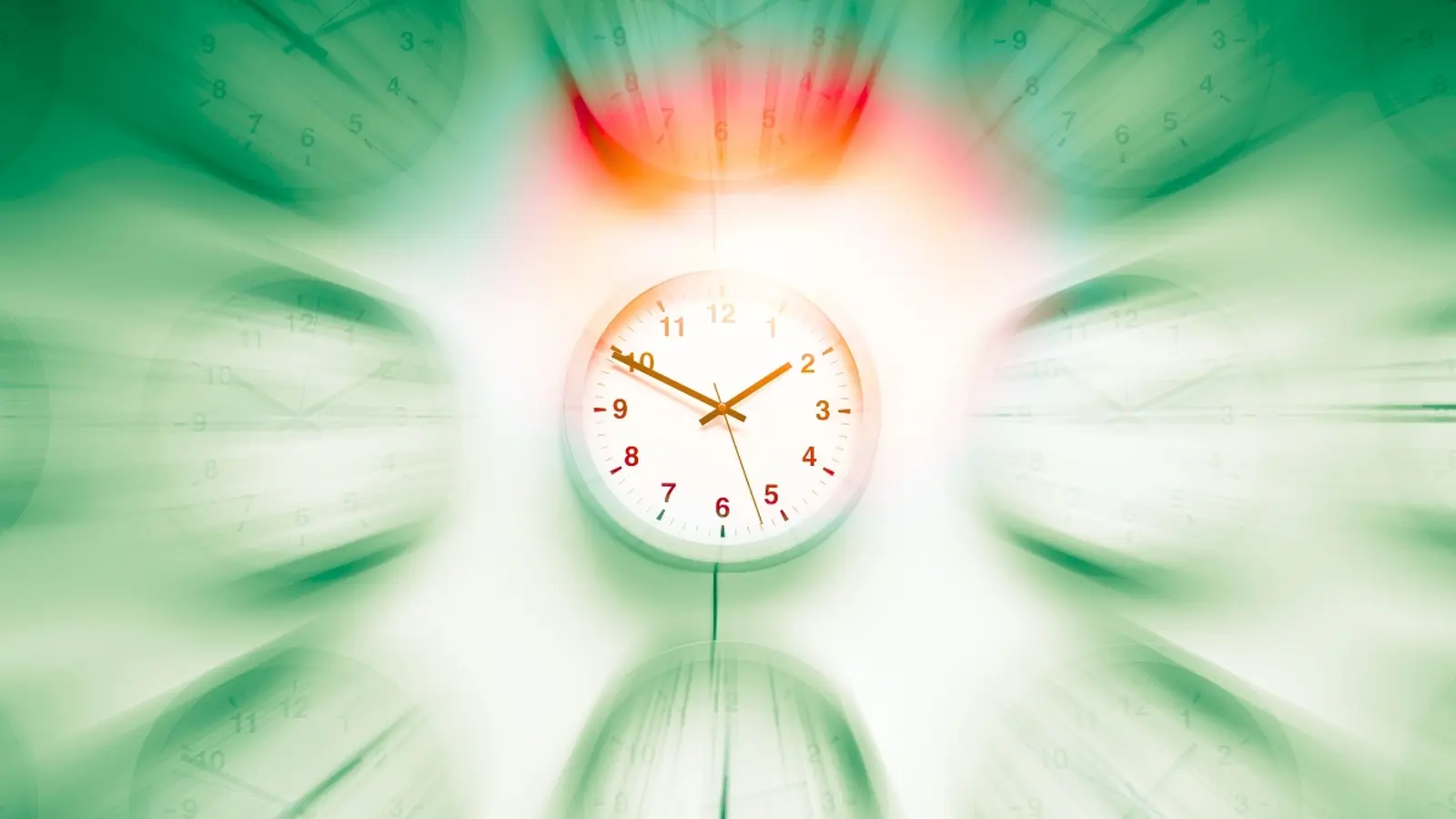
How did we suddenly jump from Easter chocolate to December decorations? The sensation that a year—or just the last few months—has slipped past faster than it should is more than a cultural gripe. It reflects how the brain constructs time from experience. Neuroscience and psychology show that our sense of time is not a passive readout of an external clock but an active inference driven by attention, memory and change.
How the brain measures time: no ticking clock inside your skull
When we talk about “time perception,” the phrase can mislead: there is no sense organ for time the way eyes detect light or ears detect sound. Instead, the brain infers the passage of time by tracking change. Put simply, your brain estimates how much happened during an interval and uses that to judge how long it lasted. This subtle inference process explains many everyday oddities — why a five-minute wait can feel eternal, while an hour of engrossing work can vanish.

Brains estimate time by keeping track of change
Lab experiments demonstrate this clearly. A brief flickering image often feels longer than a static image presented for the same objective duration. High arousal intensifies attention and memory encoding, causing the brain to store dense event traces. Later, those dense memories are read back as evidence of a longer episode. This effect helps explain why eyewitnesses in emergencies sometimes say time “slowed down.” In a striking study, participants who fell backward from a height into a safety net judged their own terrifying fall to last substantially longer than observers judged a similar fall. The first-hand fear amplified attention and memory density, biasing retrospective time estimates upward.
Two different ways of telling time: prospective vs retrospective

Understanding why whole weeks or months feel like they evaporated requires distinguishing prospective timing (how fast time seems to pass while it’s happening) from retrospective timing (how long an interval felt after it’s over). Prospectively, attention is the major factor: when you focus on the passage of time itself—say, watching a clock or waiting in line—time stretches. When your attention is captured by something engaging, time seems to contract. That’s why “time flies when you’re having fun,” but it also flies when you’re deeply focused at work.
Retrospectively, the brain relies on memory. If a period contained many unique, novel events, it leaves a rich trail of memories; the brain interprets that trail as evidence that a lot of time passed. Conversely, long stretches of routine generate sparse memory records. When you look back, there is less information to show that much happened, so the interval appears shorter. This mismatch—days that feel long in the moment but years that feel short in retrospect—tends to grow with age because novelty generally declines as routines solidify.
Why routine ages our subjective year
Children and young adults encounter frequent novel experiences: first days at school, new friendships, moving to a new place. Those events create dense, distinguishable memories that later make years feel rich and extended. Adults often settle into repeated cycles—commute, work, chores—that are efficient but memory-light. As a result, when December arrives, an older brain may conclude there was little new to mark the passage of months. That feeling — "Where did the year go?" — is a cognitive byproduct of low mnemonic density, not a defect in the calendar.
Apply science: how to make time feel fuller
If you want the year to feel longer in hindsight, the solution is straightforward but active: increase memorable, novel experiences and preserve them. Two practical strategies matter most.
- Create novelty. Seek new activities, destinations, or learning experiences. Even small deviations—taking a different route to work, trying a new hobby, or meeting new people—introduce distinct memory markers that make months feel fuller when you look back.
- Rehearse memories. Memory consolidation benefits from repetition. Keep a journal, take photos, or share stories about your days. Revisiting and narrating experiences strengthens their traces and makes the past feel more substantial.

If your immediate goal is to slow time in the present, the easiest (if least pleasant) trick is boredom: attention focused on the passage of time makes it drag. But to change how the year feels in December, cultivate variety and preserve what you do.
Scientific context and implications
Research on temporal perception connects cognitive neuroscience, attention research and memory consolidation. Studies of prospective and retrospective timing use behavioral experiments, physiological measures of arousal (like pupil dilation and heart rate), and neuroimaging to map how attention and memory systems bias temporal judgments. The findings have practical implications beyond personal well-being: they inform how eyewitness testimony is interpreted, how user experience designers structure attention in apps, and how educators pace novelty to improve learning and retention.
For instance, platforms that try to maximize engagement often create time-contraction experiences: highly absorbing feeds and seamless autoplay make minutes vanish, which is attractive for short-term metrics but can compress users’ perception of weeks and months. Conversely, experience designers who want users to recall life events or learning milestones should engineer distinct checkpoints and prompts to encourage reflection and memory replay.
Expert Insight
"Our brain constructs a narrative of time from the density of events it encodes," says Dr. Elena Morales, a cognitive neuroscientist at the University of Amsterdam. "If you want a richer sense of a life well-lived—not just in feeling but in memory—introduce variation and then revisit those moments. Photography, journaling and social storytelling are simple ways to reinforce the traces your brain uses to measure time."
Dr. Morales adds, "This is not merely philosophical. The neural mechanisms that bind experience to time are measurable. Attention, arousal and hippocampal encoding all interact to shape how we later reconstruct the length of an interval. So changing your routines can literally change how long your year feels."

Practical takeaways for an ordinary year
- Plan a few deliberate “firsts” throughout the year (a class, a short trip, a new hobby).
- Keep a lightweight log: weekly notes or photos help reinforce memories without huge effort.
- Mix routine with variety: small, regular changes (new routes, occasional surprises) are easier to sustain than big, infrequent upheavals.
- Be mindful of attention: when you want time to pass quickly, immerse yourself; when you want to savor the present, reduce stimulation and focus on sensory detail.
December will arrive every year on the same date, but whether it feels like it crept up or unfolded at a leisurely pace depends on how much you let life fill your attention and memory. Your internal clock is not broken—it’s telling you what you lived, not what the calendar counted.









Leave a Comment
Comments (2)
whoa that explains why christmas sneaks up!! im gonna start taking more pics and trying new cafes. small changes, big impact maybe? excited to try
Wait, so this means years feel short because I love routine? sounds plausible but is memory density really the whole story? feels a bit light on emotion effects.