
3 Minutes
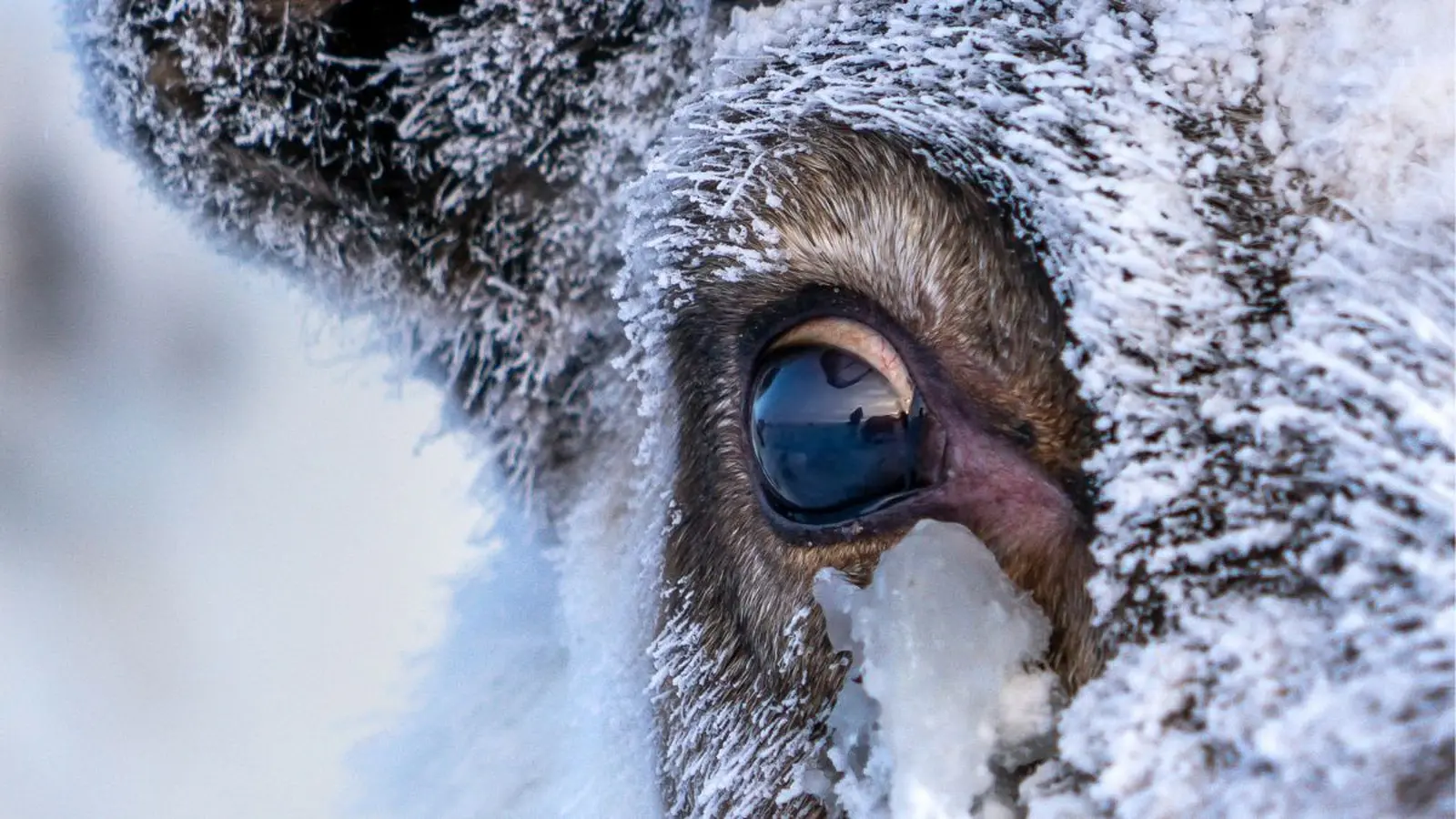
Reindeer are famous for their endurance in the Arctic, but their eyes hold a lesser-known seasonal surprise: they literally change color. As daylight dwindles and the polar landscape turns to twilight, the eyes of Rangifer tarandus shift from gold-green to a striking deep blue — an adaptation that helps these animals see in extreme low light.
A color change tuned to the Arctic sky
In summer, Arctic reindeer eyes reflect a gold and turquoise shimmer, similar to the nocturnal shine seen in cats. But during the long, dim polar winter — when the Sun stays low and twilight casts a pervasive blue glow over ice and snow — their eyes adopt a vivid blue hue. This seasonal shift was first noted by scientists in 2013 and has since been confirmed by anatomical and optical studies.
How the tapetum lucidum transforms vision
The switch is linked to the tapetum lucidum, a light-reflecting layer behind the retina found in many nocturnal mammals. In reindeer, that layer appears to change structure between seasons. The effect is functional: by reflecting more of the cold, blue-rich twilight back through the retina, the eye gives photoreceptors a second chance to capture photons. The practical payoff is dramatic — researchers estimate winter vision can be up to a thousand times brighter.
.avif)
The summer and winter tapetum color compared with environmental light, with the Arctic Sun above and below the horizon.
A trade-off: brightness versus resolution
Brighter input comes at a cost. The reflected light in winter produces an image with lower spatial resolution, described by scientists as a softened or blurred view, reminiscent of looking through frosted glass. That trade-off, however, makes evolutionary sense: detecting predators like wolves or locating patchy lichen in twilight is more important than resolving fine detail.
What the research shows
Work led by ophthalmologist Robert Fosbury and colleagues compared eyes from reindeer that died in summer with those collected in winter. Their 2022 analysis supports a season-dependent structural change in the tapetum. Fosbury used a helpful analogy: 'During very cold conditions, you let some air out of the tyres to increase traction on the ice,' he said. 'The reindeer lets fluid out of its tapetum to reveal a better view of its surroundings.' The evidence suggests pupil dilation in persistently low light may alter fluid balance in the eye, producing the observed optical shift.
Scientists emphasize the mechanism is not fully mapped. The exact biochemical triggers and the microscopic rearrangement of tapetal structures remain open questions. Crucially, whatever process causes the change must be reversible — reindeer return to their summer eye coloration when daylight returns.
.avif)
This reindeer eyeball has been sliced in half, revealing an iridescent blue layer
Why this discovery matters
Beyond its natural curiosity, the reindeer's seasonal eye offers insights into vision science and adaptation to extreme environments. It highlights how fluid dynamics at microscopic scales can alter optical function, and it suggests other low-light dwellers might employ similar tricks. Researchers recommend targeted studies across seasonal transitions — especially in autumn and spring — to observe the structural progression directly in the same individuals.
Whether for conservation biology, comparative physiology, or bio-inspired optics, the reindeer's blue eyes are a vivid reminder that evolution can tune not just form and behavior but the physics of sight itself.














Leave a Comment
Comments
No comments yet. Be the first.