
5 Minutes
NASA’s Europa Clipper spacecraft provided an unexpected and invaluable look at interstellar comet 3I/ATLAS in November, filling an observational gap when Earth and Mars were poorly positioned. Using the Southwest Research Institute–led Ultraviolet Spectrograph (Europa‑UVS), the mission captured the comet’s twin tails from a rare downstream vantage, detecting atomic signatures that shed light on the object’s composition and recent activity.
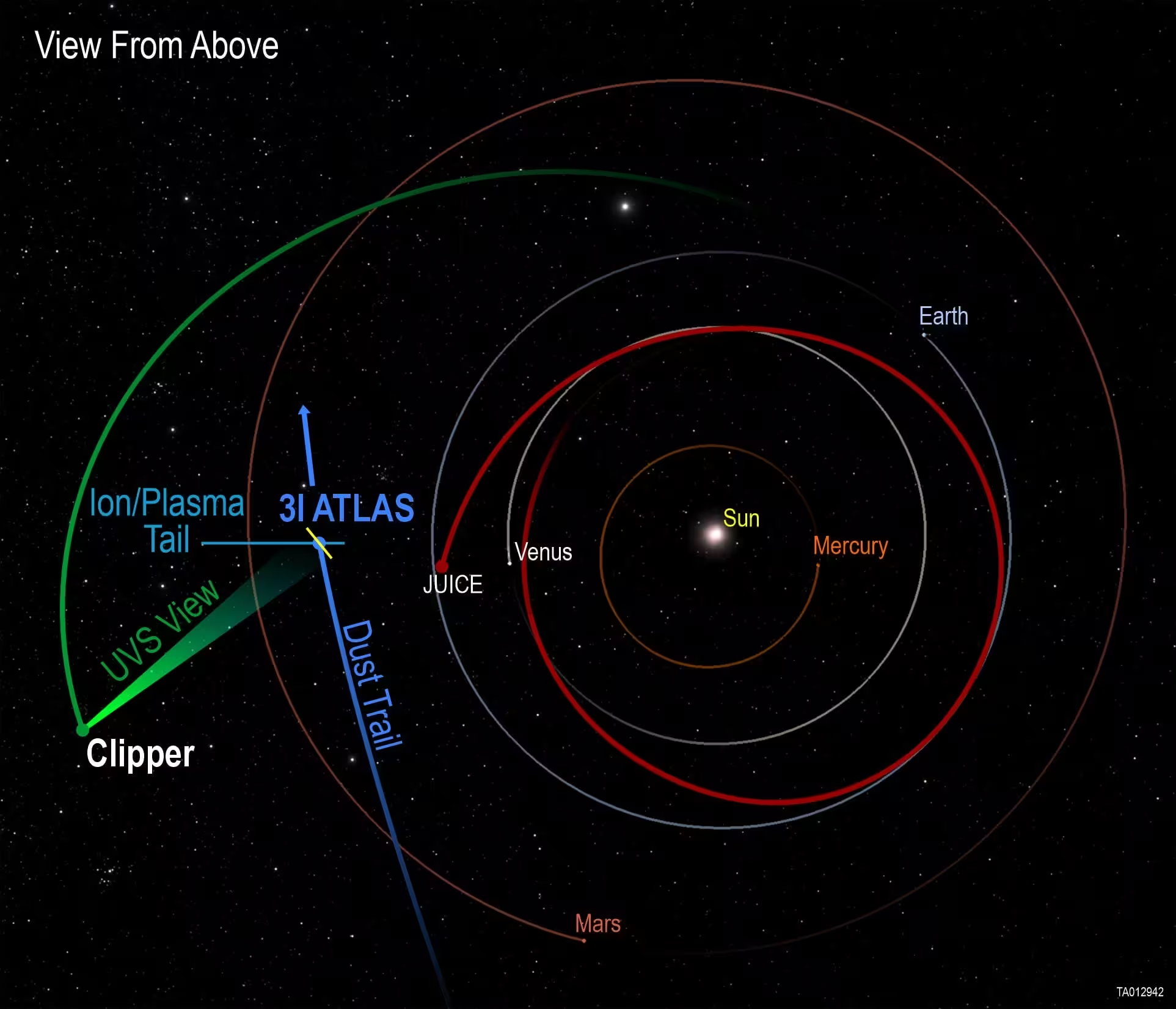
The Southwest Research Institute-led Ultraviolet Spectrograph (UVS) aboard NASA’s Europa Clipper spacecraft made valuable observations of the interstellar comet 3I/ATLAS during a period when it was difficult to observe from Mars- and Earth-based vantage points, viewing its two tails from between their downstream directions.
Why Europa Clipper suddenly became a comet hunter
Europa Clipper launched in 2024 with a primary mission to study Jupiter’s icy moon Europa, arriving in the Jovian system around 2030. But spacecraft en route often become opportunistic science platforms, and this time Europa‑UVS seized a narrow observing window to follow a visitor from beyond our star system: 3I/ATLAS, only the third confirmed interstellar object recorded crossing the solar system.
Within days of the comet’s discovery, trajectory solutions from NASA’s Jet Propulsion Laboratory showed that Europa Clipper would be favorably placed for observation in November. For ground-based observers on Earth the comet’s proximity to the Sun made detection difficult, while Mars-based viewing had already passed its best window. Europa Clipper sat between those vantage points and the Sun, allowing a look that neither Earth nor Mars could provide.
A rare downstream view of both comet tails
Comets typically develop two different tails as sunlight and the solar wind act on their material: a dust tail that tends to trail along the orbital path, and a plasma (ion) tail that points roughly away from the Sun. From Europa Clipper’s position closer to the Sun, Europa‑UVS observed 3I/ATLAS largely from downstream, effectively looking back toward the nucleus and its coma.
That geometry matters. Observing a comet from behind its tails changes how dust and gas distributions project on the sky, revealing structures and emission signatures that can be obscured or blended in anti‑sunward views. Europa‑UVS recorded ultraviolet emissions associated with oxygen and hydrogen atoms plus features tied to dust, evidence consistent with a recent period of intense outgassing following the comet’s perihelion (closest approach to the Sun).
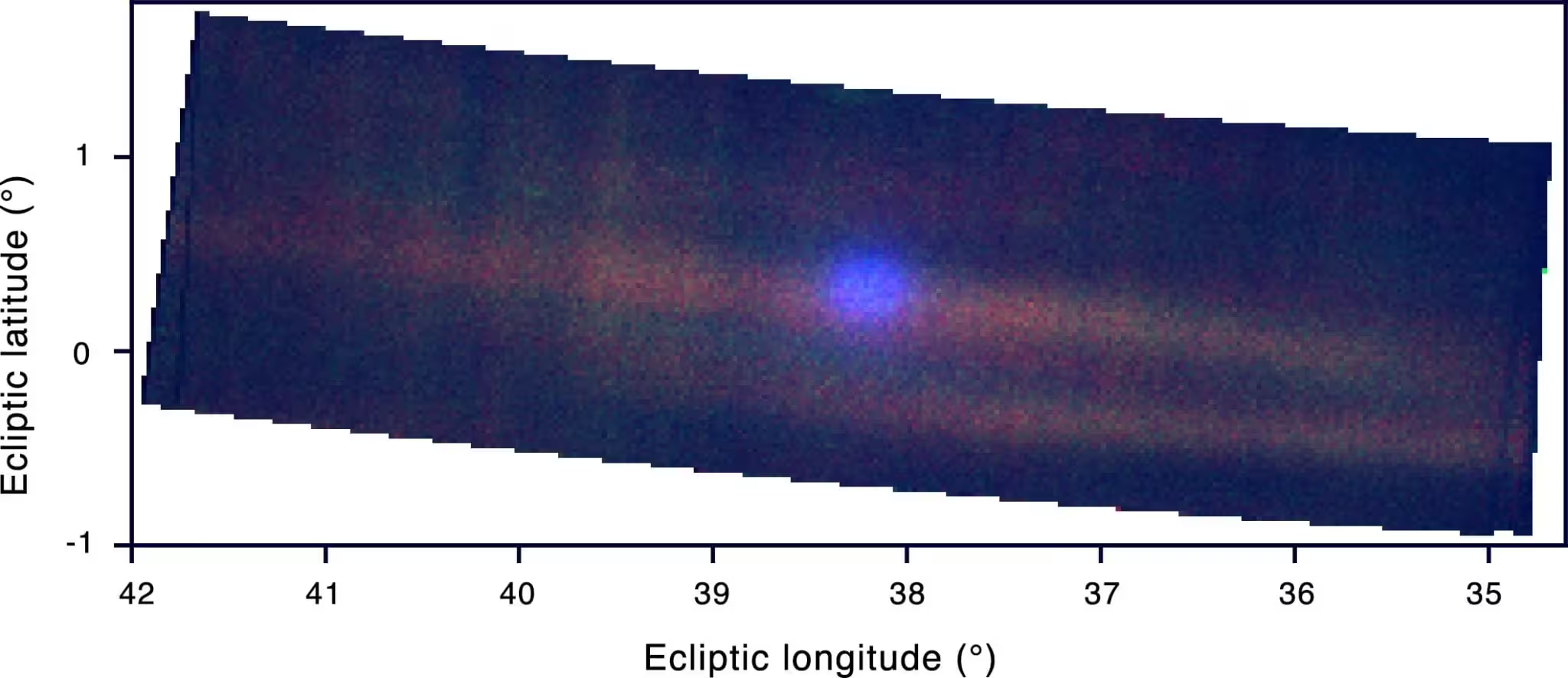
Interstellar comet 3I/ATLAS is seen in this composite image captured on Nov. 6, 2025, by the Europa Ultraviolet Spectrograph instrument on NASA’s Europa Clipper spacecraft, from a distance of around 103 million miles (164 million kilometers).
How ultraviolet spectroscopy reveals comet chemistry
Ultraviolet spectrographs, like Europa‑UVS, detect specific atomic and molecular transitions. Water and complex ices on a comet break apart when exposed to solar radiation: H2O photodissociates into hydrogen and oxygen atoms, which each emit ultraviolet light at characteristic wavelengths. By measuring those emissions, scientists infer production rates, composition, and the physical processes driving the coma and tail.
“Europa‑UVS is particularly adept at measuring fundamental transitions from atoms and molecules,” said Dr. Kurt Retherford, principal investigator for Europa‑UVS. “We can see gases come off the comet, and water molecules break apart into hydrogen and oxygen atoms.”
These atomic measurements help researchers estimate how much volatile material the comet shed during its passage through the inner solar system. Combined with dust detections, the data suggest that 3I/ATLAS experienced a significant outgassing episode, producing both neutral and ionized components that fed its dual tails.
Coordinated observations: linking views from space and Earth

Europa Clipper’s downstream perspective complements more conventional anti‑sunward observations. The European Space Agency’s JUICE mission, carrying its own UV spectrograph led by SwRI teams, gathered anti‑sunward data during a similar timeframe, while Earth‑ and Mars‑based telescopes provided additional spectral and imaging context before and after Europa Clipper’s window.
“We’re hopeful that this new view, along with observations from Earth‑based assets and other spacecraft, will help us to piece together a more complete understanding of the tails’ geometries,” said Dr. Thomas Greathouse, co‑deputy principal investigator of Europa‑UVS. Comparative geometry—seeing the same object from different angles—lets scientists disentangle projection effects and better map where dust and plasma lie relative to the nucleus.
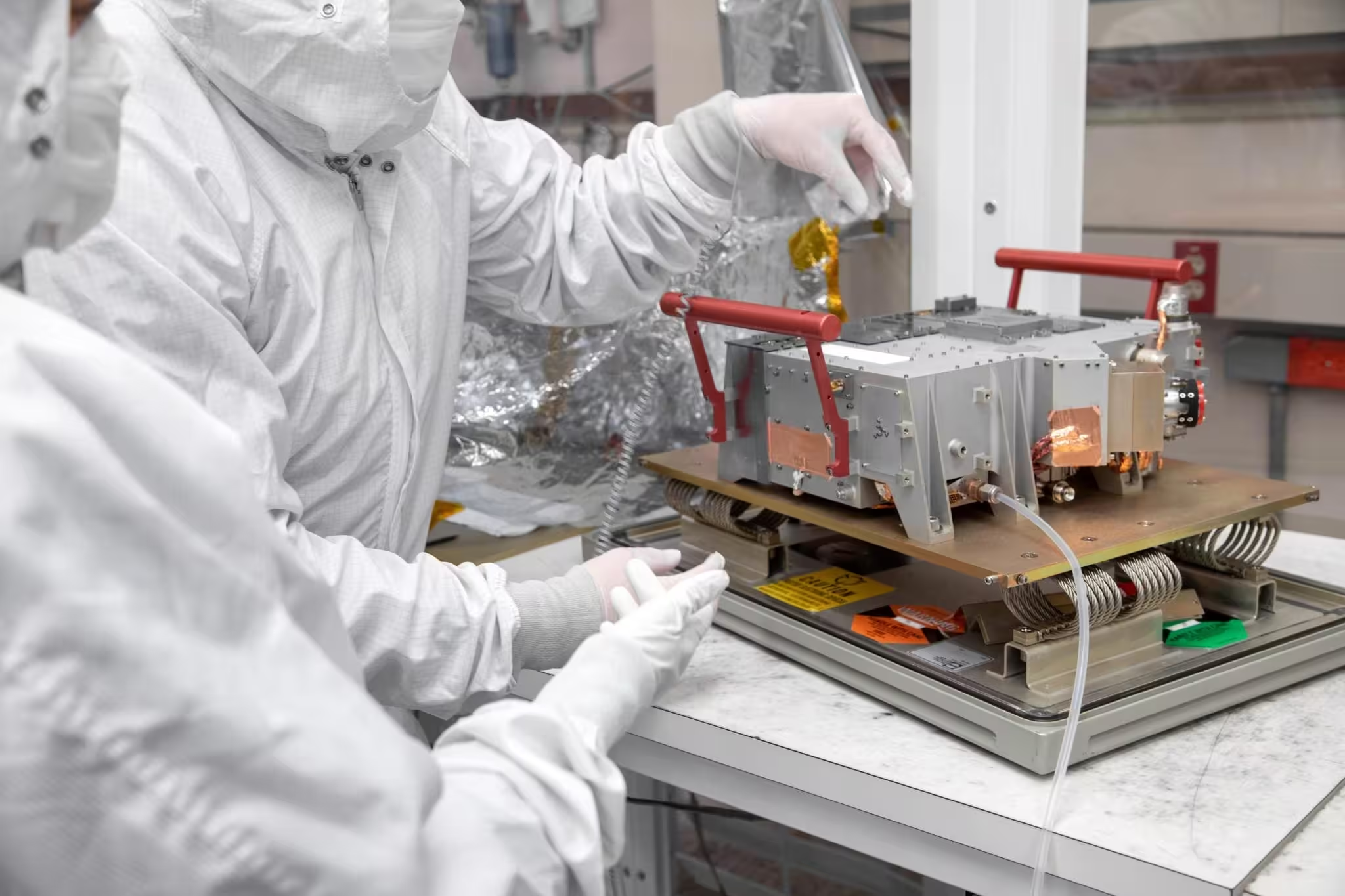
The SwRI-led UVS instrument collects ultraviolet light to assess the composition of Europa’s atmospheric gases and surface materials. It detected oxygen, hydrogen and dust features in the interstellar comet 3I/ATLAS and made unique downstream observations of its tails. Europa-UVS Co-deputy principal investigator Dr. Tracy Becker (left) and Europa-UVS principal investigator Dr. Kurt Retherford (right) are pictured with Europa-UVS during clean cabin testing.
What interstellar comets can teach us
Interstellar objects offer a rare chance to sample material formed around other stars. Measuring which atoms and molecules are released, and how vigorously they are emitted, hints at where and how the object formed and what processes it experienced during its travel through the galaxy. Are its ice compositions similar to comets from our Kuiper Belt or Oort Cloud? Did it undergo thermal processing or collisions that stripped or altered surface layers?
Dr. Tracy Becker, co‑deputy principal investigator of Europa‑UVS, framed the broader scientific questions: “Understanding the composition of the comet and how readily these gases are emitted can give us a clearer view of the comet’s origin and how it may have evolved during transit from elsewhere in the galaxy to our solar system. What are the chemical processes at play, and how can we unravel the comet’s origin in its own star system?”
Expert Insight
“Observations like these are a reminder of how multi‑purpose planetary missions can be,” said Dr. Amina Patel, an astrophysicist who studies small bodies and interstellar visitors. “Europa Clipper was built to probe Europa’s habitability, yet its UVS instrument is flexible enough to capture transient targets. By combining downstream and anti‑sunward perspectives, we get a stereoscopic view of the comet’s behavior—critical for interpreting volatile release and particle dynamics.”
This opportunistic dataset strengthens a growing archive of interstellar object observations and demonstrates the scientific value of instruments that can operate across mission profiles. As more interstellar visitors are discovered, coordinated observations from spacecraft and ground telescopes will be essential for decoding their origins and refining models of planetary system formation.






Leave a Comment
Comments (2)
Is the downstream vantage really that crucial? seems like projection effects could be modeled, but ok, neat opportunistic use of Clipper, still a bit skeptical
Wow this is wild, didnt expect Europa Clipper to snag an interstellar comet! Downstream view sounds like gold for composition studies, curious what juicier data they get...