
4 Minutes
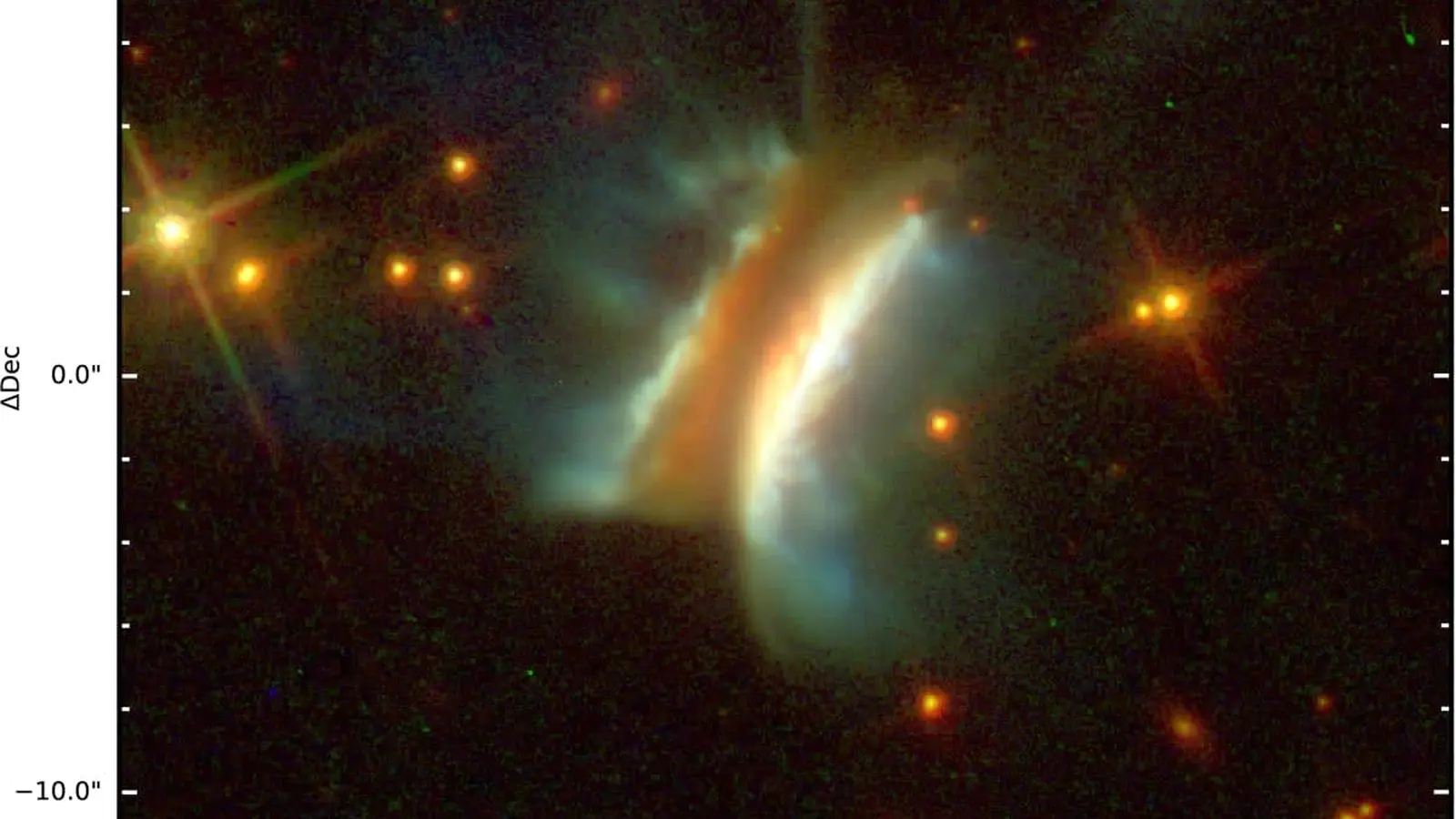
New Hubble observations have exposed unexpected turbulence and striking asymmetry in IRAS 23077+6707 — the largest protoplanetary disk yet imaged. Located about 1,000 light-years away, this enormous, oddly shaped disk offers a rare view into how planets might form in a wildly active environment.
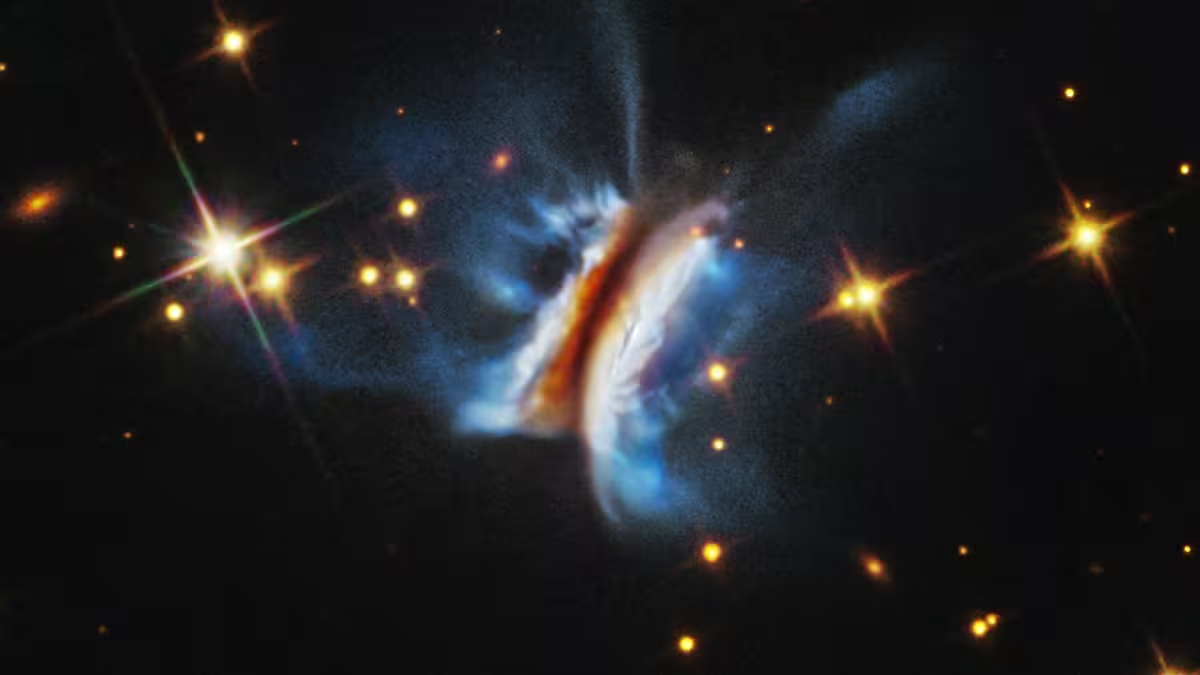
New imagery of the IRAS 23077+6707 system
A colossal, messy nursery for planets
IRAS 23077+6707 — nicknamed "Dracula's Chivito" — stretches nearly 644 billion kilometers (400 billion miles) across, over 100 times the average distance from the Sun to Pluto. That scale alone makes it exceptional, but Hubble's visible-light photos reveal additional surprises: long, filamentary wisps extending far beyond the main disk and a pronounced lopsidedness in the distribution of material surrounding the young star.
Instead of the tidy, symmetric structure often depicted in textbooks, this disk appears chaotic. One hemisphere is fed by extended gas filaments falling in from great distances, while the opposite side ends abruptly with much less planet-forming material. Astronomers say these features suggest dynamic interactions are shaping the system at a pace and scale rarely seen.
What the images tell us — and what they don't
Visible-light imaging from Hubble complements previous infrared views from telescopes such as JWST. Together, these datasets let researchers trace substructures in unprecedented detail, including thin, wispy layers that are easiest to see because the disk is oriented nearly edge-on from our vantage point.
Astrophysicist Kristina Monsch of the Center for Astrophysics (CfA) notes that the level of structural detail here is rare. "This makes the system a unique, new laboratory for studying planet formation and the environments where it happens," she says. The images highlight processes that may influence how and where planets can form inside massive disks.

Researchers are still working to interpret the full picture. Possible drivers for the disk's extreme size and shape include interactions with surrounding gas clouds, the action of powerful stellar winds from the central young star, or the motion of the whole system through its local interstellar environment. Any of these can stir material, create asymmetric inflows, or strip away outer regions of a disk.
Mass, potential and scientific payoff
Estimates suggest IRAS 23077+6707 contains enough gas and dust to form roughly 10 to 30 Jupiters' worth of mass. That doesn't mean dozens of Jupiters will necessarily become planets, but it does mark the system as an unusually rich testbed for studying how giant planets and multiple-planet systems might emerge under turbulent conditions.
Because planet formation plays out over millions of years, astronomers rely on snapshots of different systems at varying stages to build a timeline. This object's dramatic features let scientists observe rapid changes and dynamic interactions on shorter timescales, offering fresh constraints for models of disk evolution and planet assembly.
Names, discovery and ongoing study
The informal nickname honors two of the discoverers — one from Transylvania and one from Uruguay — blending local culture with a dash of humor. While the moniker is memorable, the scientific value is what really counts: the team has published its initial findings in The Astrophysical Journal and plans follow-up observations to map gas motions and composition more precisely.
Joshua Bennett Lovell of the CfA captures the excitement: "Hubble has given us a front row seat to the chaotic processes that are shaping disks as they build new planets — processes that we don't yet fully understand but can now study in a whole new way." Future monitoring with Hubble, JWST and ground-based observatories will seek to track changes, test hypotheses about the disk's asymmetry, and measure the dynamics of inflowing filaments.
Expert Insight
Dr. Elena Marquez, an astrophysicist not involved with the paper, puts the discovery in context: "Most protoplanetary disks are much smaller and more symmetric. Finding a system this huge and disturbed challenges our assumptions about the early stages of planetary systems. The combination of Hubble's visible-light clarity and JWST's infrared sensitivity lets us probe both the dusty surface layers and the denser midplane where planets form."

Ongoing spectroscopic observations will help distinguish between competing explanations — for example, whether external gas accretion or internal stellar activity is the dominant force sculpting the disk. Either way, IRAS 23077+6707 promises to refine our theories about how diverse planetary architectures can arise.








Leave a Comment
Comments (2)
Is this even external accretion or just a projection effect? Hubble's pics wow, but need kinematics data 1st. sounds intriguing though
wow this is wild!! a 400 billion mile disk?? makes me picture entire chaotic planet factories, messy but kinda beautiful... sysyems forming fast? crazy