
4 Minutes
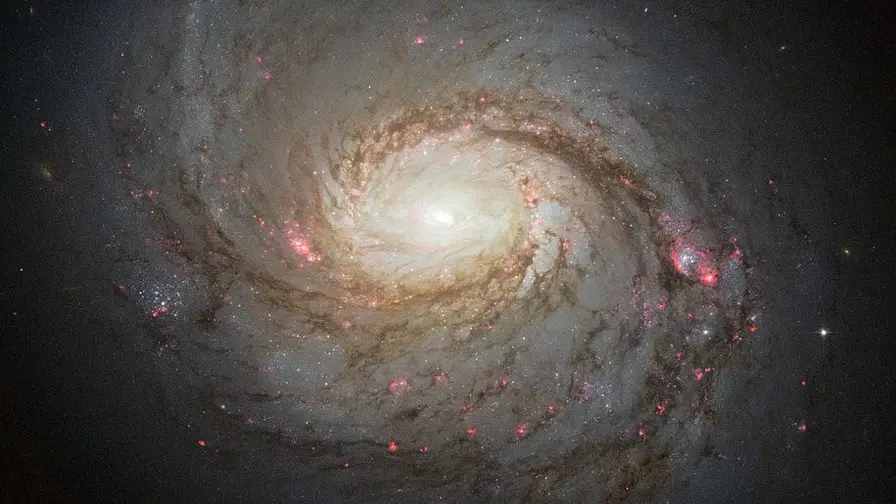
Once nearly invisible to backyard telescopes, the spiral galaxy NGC 4535 now bursts into view in a new Hubble image, its arms threaded with hot young stars and glowing nebulae. The picture offers a vivid snapshot of ongoing star formation in a galaxy some 50 million light-years away in Virgo.
.avif)
Once nearly invisible from Earth, NGC 4535 comes alive in Hubble’s view with swirling arms filled with young, blue stars and glowing pink nebulae.
Why this galaxy was 'lost' — and what Hubble reveals
NGC 4535 earned the nickname the Lost Galaxy because it appears faint in small telescopes, its diffuse light easy to miss against the night sky. From space, however, NASA's Hubble Space Telescope can collect far more light with its 2.4-meter mirror, resolving structures that ground-based amateur instruments simply cannot. The new image exposes sweeping spiral arms, a central bar of densely packed stars, and a network of star-forming regions that glow in distinctive colors.
Blue star clusters trace recent bursts of star formation: the blue hue signals hot, massive stars that burn intensely and live fast. Around many of these clusters lie pink nebulae known as H II regions — clouds of hydrogen gas ionized by the ultraviolet radiation of newborn massive stars. Those red-pink glows mark the places where stars are still forming today.
What the picture tells us about star formation
Hubble's view of NGC 4535 is more than a pretty picture. It is a piece of a larger effort to map star-forming regions across nearby galaxies. Astronomers involved in the PHANGS-HST program are cataloging tens of thousands of H II regions — roughly 50,000 across many galaxies — to compare how environment, gas density, and galactic structure influence how stars form.
Massive stars sculpt their surroundings in dramatic ways. Their intense radiation lights up hydrogen clouds, stellar winds sweep gas outward, and supernova explosions return heavy elements to the interstellar medium. Each of these feedback processes affects the timing and location of the next generation of stars. In NGC 4535, the interplay of spiral arms, the central bar, and localized bursts of star birth is visible across Hubble's high-resolution mosaic.
PHANGS-HST and the research behind the image
The image incorporates observations from the PHANGS (Physics at High Angular resolution in Nearby GalaxieS) program, which combines ALMA, Hubble, and other instruments to link cold molecular gas — the raw material for stars — with recently formed star clusters. PHANGS aims to create a multiwavelength atlas that reveals where gas collapses, how star clusters emerge, and how young stars then influence their natal clouds.
NGC 4535 was first highlighted in a 2021 Hubble release; this updated image adds sensitivity to the characteristic red glow of ionized hydrogen, bringing the youngest, most energetic star-forming regions into sharper relief. Those added details help researchers refine models of gas consumption, feedback, and the life cycle of star-forming regions in spiral galaxies.
Implications for galaxy evolution
Studying systems like NGC 4535 lets astronomers probe the physics that govern galaxy-wide star formation rates, structural evolution, and chemical enrichment. By comparing H II region catalogs across galaxy types — barred vs. unbarred, dense clusters vs. isolated spirals — scientists can test whether the same physical rules apply everywhere or whether local conditions produce different outcomes.
For example, bars can funnel gas toward galaxy centers, potentially boosting nuclear star formation or feeding central black holes. Spiral arms can compress gas into dense clumps that spawn clusters, while feedback from massive stars can both trigger and suppress further star birth. Hubble's resolution is crucial to untangle these competing effects on sub-kiloparsec scales.
Expert Insight
Dr. Elena Márquez, a lead researcher with the PHANGS-HST team, comments: "Images like this are scientific gold. They let us trace the lifecycle of star-forming clouds from cold gas to newborn clusters and then watch how those clusters change their surroundings. NGC 4535 is an excellent laboratory because its structure and active H II regions are easy to compare with molecular gas maps from ALMA."
Looking ahead, continued multiwavelength surveys and targeted follow-ups will refine our picture of how galaxies convert gas into stars over cosmic time. Hubble's legacy images, paired with next-generation observatories, promise deeper insight into the processes that light up the universe.





Leave a Comment
Comments (2)
Is it really 'lost' or just too faint for backyard scopes? Feels a bit like hype, but cataloging 50k H II regions sounds legit. curious how bars affect starbursts
Wow, that Hubble shot is wild, the spiral arms look like paint strokes. Pink nebulae popping, blue clusters everywhere. Makes me wanna buy a bigger scope, somday lol