
3 Minutes
China's Experimental Advanced Superconducting Tokamak (EAST), nicknamed the 'artificial sun', has crossed a key barrier in fusion research by operating beyond a long-standing plasma density limit. The result, reported by researchers at the Institute of Plasma Physics, Chinese Academy of Sciences and published in Science Advances, points to new strategies for building higher-performance fusion reactors.
Breaking the density ceiling: what changed
In tokamaks, plasma density matters: the denser the plasma, the more likely fusion reactions become. But pushing density upward usually triggers instabilities that make the plasma strike the vessel walls, ending confinement. That empirical boundary is commonly associated with the Greenwald limit, a rule-of-thumb that has constrained magnetic confinement experiments for decades.
The EAST team challenged the assumption that density alone governs the limit. Instead, they found a different culprit—impurities, especially metal atoms sputtered from the reactor’s inner lining. Tungsten, a hard metal widely used for plasma-facing components, was identified as a major source of contamination that degrades edge plasma behavior and precipitates disruptions.
How EAST tamed impurities to push performance
Researchers developed a new theoretical model called Boundary Plasma-Wall Interaction Self-Organization (PWSO) to describe how the plasma edge and wall materials interact and self-organize under different conditions. Guided by PWSO, the team modified the startup and heating sequence on EAST: they used electron cyclotron resonance heating combined with a pre-charged gas startup method to shape the edge plasma and reduce tungsten influx.
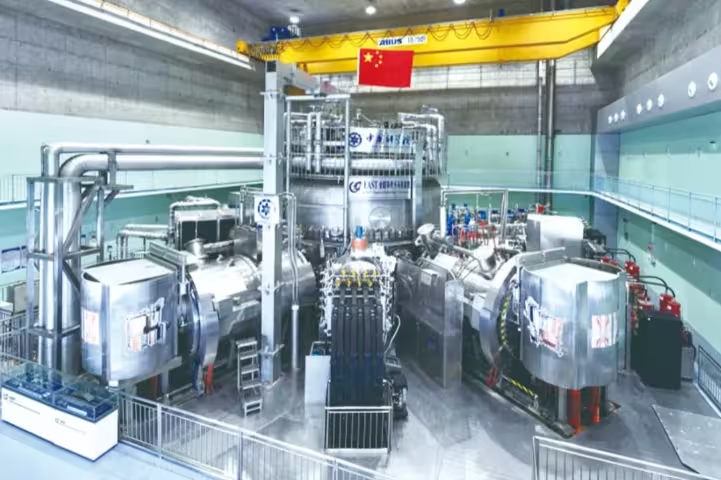
With impurity levels controlled, EAST entered what the researchers describe as a 'density free zone'—a regime where the plasma can reach higher densities without triggering the disruptive events tied to the traditional limit. Experimental data mapped closely to the PWSO model predictions, lending credibility to the idea that wall-sourced impurities, not just absolute density, set practical operational bounds.
Why this matters for fusion development
Controlling impurities is a practical lever for future tokamak design. If impurity management can reliably extend usable density, reactors can produce more fusion reactions per unit volume, improving overall efficiency and bringing compact and economically viable fusion closer to reality. While commercial fusion is still a long-term goal, findings like EAST's help solve incremental but crucial engineering problems.
As the EAST team noted, these results provide actionable guidance for next-generation devices that rely on superconducting magnets and long-pulse operation. In short: cleaner plasma edges could be as important as stronger magnetic fields in the race to net-positive fusion energy.
Researchers continue to refine PWSO and test impurity-control techniques on EAST and other platforms, aiming to translate laboratory breakthroughs into design principles for demonstration reactors and, eventually, power plants.













Leave a Comment
Comments
No comments yet. Be the first.